Executive Overview
In the upper echelons of contemporary fashion, few names carry the weight of radical experimentation quite like Issey Miyake. While the late Japanese designer’s signature heat-set pleating technique permanently altered the architecture of modern apparel, reducing it to a benchmark of textile innovation, his broader philosophy was never solely about clothing. It was about movement, engineering, lifestyle, and the intersection of apparel with art, science, and architecture.
Today, that legacy is stewarded by Satoshi Kondo, a 42-year-old Kyoto-born designer who has spent more than a decade quietly—yet radically—propelling the brand into a new era. As the artistic director, Kondo has avoided the lazy trap of nostalgic retrospection. Instead, he treats Miyake’s foundational ethos as an open-ended question rather than a static blueprint. Under Kondo’s creative direction, the house continues to stand apart from the predictable, commercialized center of the global fashion scene.
In a modern luxury landscape saturated by algorithmic design, fast-paced trend cycles, and hyper-digitized marketing, Issey Miyake remains an anomaly. It is a house anchored in the tactile reality of the physical garment, marrying ancient Japanese handicraft techniques with cutting-edge manufacturing. From viral revivals among Gen Z shoppers to striking flagship boutiques like the brand’s multilevel space opposite New York City’s Madison Square Park, the house proves that true innovation lies in a timeless pursuit: designing a holistic lifestyle where clothes, art, and humanity intersect.
Detailed Chronology: From Foundation to the Modern Runway
To understand where Issey Miyake stands today, one must trace a lineage that spans decades, materials, and disciplines. The brand was built not on seasonal trends, but on a relentless curiosity about how fabric interacts with the human form.
The Pioneer Years: Rewriting the Rules of Silhouette
Issey Miyake did not set out to be a revolutionary in the traditional Parisian sense; rather, his curiosity happened to upend the establishment. Rejecting the Western obsession with structured tailoring and restrictive undergarments, Miyake focused on the space between the body and the cloth. His revolutionary work spanned multiple decades and creative disciplines. He collaborated extensively with legendary photographer Irving Penn, making a visual poetry out of stiff and flowing textiles alike. He made singer and model Grace Jones his ultimate muse, designing avant-garde armor-like pieces that blurred the line between fashion and sculpture, and famously engineered the iconic black turtleneck that became synonymous with Apple co-founder Steve Jobs.
Miyake’s exploration was never confined to the runway. He designed innovative costumes for ballet companies, founded a pioneering design research center in Tokyo, and ultimately institutionalized a philosophy of democratic, unpretentious dressing. His most enduring product innovation—pleating—was introduced not as a decorative flourish, but as a practical solution. Lightweight, easy to pack, and virtually impervious to wrinkles, Miyake’s pleats offered the on-the-go global citizen unprecedented freedom of movement.
Passing the Torch: Satoshi Kondo’s Ascendance
Enter Satoshi Kondo. Having worked within the brand for over ten years before stepping into the role of artistic director, Kondo was uniquely positioned to inherit the mantle. Rather than looking backward, Kondo views his role as a continuation of a rigorous intellectual lineage.
"Miyake’s philosophy and approach to clothing design are deeply integrated into the brand identity, carried on by every designer who followed him, myself included," Kondo reflects. "My role as the current designer is to continue that lineage, practicing Miyake’s teachings to explore new possibilities, rather than looking back."
This forward-facing philosophy has translated into runway shows that defy categorization, seamlessly balancing conceptual rigor with unpredictable whimsy:
- Spring/Summer 2025: A masterclass in organic draping and lightweight textures, pushing the boundaries of how fabrics breathe and move around the human skeleton.
- Fall/Winter 2024–2025: A stark exploration of stark monochrome and structural outerwear, emphasizing the marriage of raw materiality and urban utility.
- Spring/Summer 2026: A riot of subverted conventions. Kondo presented twisted polo shirts featuring exaggerated, hunchback-like shoulder pads emblazoned with provocative statements such as "I am autonomous" and "I am animated." Everyday household objects appeared seemingly trapped between the body and the dress, creating lumpy, surrealist silhouettes. Garments looked molded directly to the front of the wearer and stapled on the sides, evoking a stretched-canvas effect, while organic elements like feathers molded against the body to mimic the geometry of ferns.
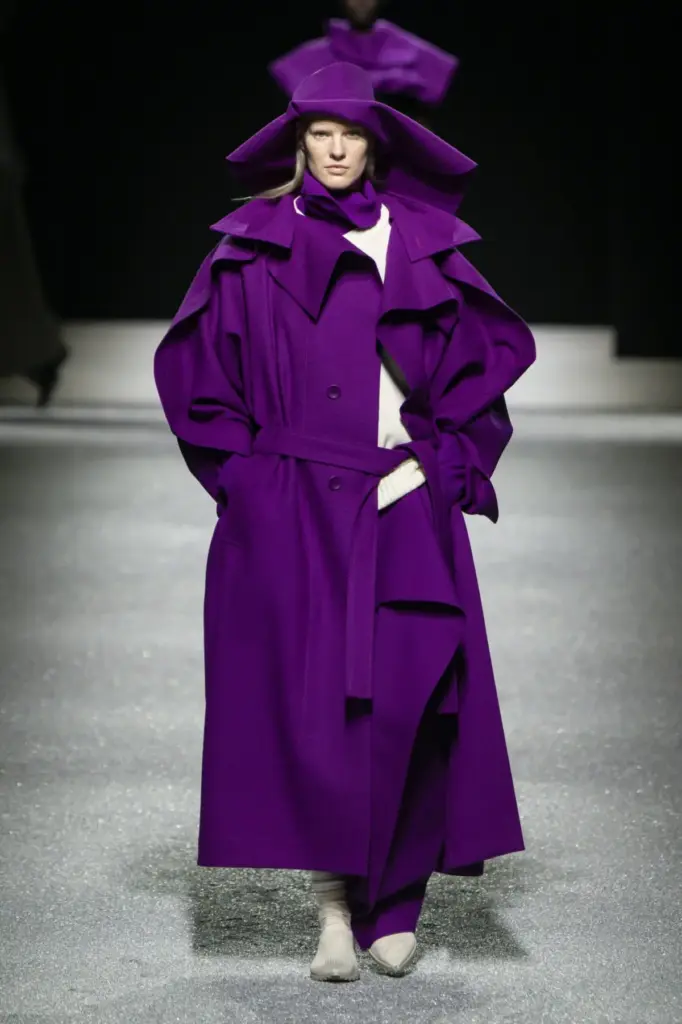
- Fall/Winter 2026: A deliberate narrative and visual slowdown. Transitioning from the frenetic energy of the previous season, Kondo focused on a more muted, meditative color palette—showcasing paper-light trench coats in deep eggplant hues, molded handkerchief tops in light-reflective fabrics that shifted color under changing illumination, and zigzag-pleated separates in electric blues and vibrant chartreuses.
Supporting Context & Metrics: The Intersection of Craft and Commerce
In an industry currently obsessed with data-driven micro-trends and AI-generated design iterations, Issey Miyake’s market resilience tells a fascinating story. The brand’s enduring appeal relies on a delicate ecosystem balancing traditional handicraft, high-level material science, and a surprisingly robust multi-generational consumer base.
The Gen Z Pleats Resurgence
Paradoxically, while luxury houses spend millions trying to capture the elusive Gen Z demographic through digital-first strategies, Issey Miyake’s pleats have experienced a massive, organic resurgence among younger shoppers. For Gen Z—a generation that values both sustainability (durability, timelessness) and fluid, gender-neutral self-expression—the brand’s pleated garments offer a functional paradise.
Kondo notes that pleats should never be viewed merely as a static material or rigid manufacturing process. Instead, they represent "playfulness and freedom of movement." For the modern consumer constantly navigating a fast-paced urban lifestyle, the practicality of the garments remains unmatched: they are featherlight, crush-resistant, and require minimal maintenance.
The Urushi Body Series and Material Innovation
A cornerstone of Kondo’s recent collections is the interplay between nature and technology. In the Fall/Winter 2026 collections, this philosophy manifested physically in the Urushi Body series—sinuous, molded bustiers that opened and closed the runway shows.
Drawing inspiration from washi (traditional Japanese paper) and how it organically clings to the contours of the human form, these pieces fuse ancient craft references with modern technological execution. According to Kondo, technology within the atelier is never employed to replace human touch, but rather to "preserve, if not highlight, the trace of the maker’s hand, create something beyond our imagination, and aid production efficiency."
This devotion to tactility is mirrored in the brand’s retail architecture. The newly opened multilevel flagship boutique near Madison Square Park in New York City serves as a physical manifestation of this lifestyle-driven ethos. Customers entering the space are not merely shopping for seasonal clothes; they are stepping into an environment where architecture, retail design, and art converge. Here, clients can purchase everything from the architectural Urushi Body bustiers to paper-light outerwear, experiencing firsthand the meticulous care that goes into every thread.
Official Statements: In the Words of Satoshi Kondo
To truly grasp the operational philosophy of Issey Miyake today, one must examine the direct insights of its artistic director. In conversations detailing his design methodology, Kondo emphasizes a democratic, open-minded approach to creativity:
"In my practice of design and making, I try to keep an open mind, an eye that does not discriminate, and not favor one idea over another based on perception or convention."
Addressing how the atelier balances human intervention with modern industrial tools, Kondo explains:
"As a designer, I make things and develop ideas with my own hands, seeing both success and failure in the creative process as clues leading to the next exploration. Nature is a source for discovering unscripted beauty through serendipity. Technology is a medium of translating an idea into form."
Perhaps most importantly, Kondo underscores the irreplaceable value of physical garments in an increasingly virtualized world:
"My approach to design and making can be something that grows beyond boundaries between disciplines and revolves around the idea of ‘designing a lifestyle’ — how we dress, eat, and live. Clothing is real. I believe that there is a sense of joy that comes from putting on a garment, an experience that is physical and tactile."
Reflecting on the foundational teachings passed down from the brand’s founder, Kondo shares a guiding maxim that continues to shape the atelier’s direction:
"What I learned from Miyake is that a stone found in a park can be just as beautiful as a sculpture in a museum. How you look at and treat a material, a craft, or a technology is what gives it value beyond its intended use."
Future Outlook: A Revolutionary Act of Looking
As the fashion industry careens toward hyper-automation, digital runway experiences, and ephemeral social media trends, Issey Miyake remains steadfast in its counter-cultural positioning. Under the leadership of Satoshi Kondo, the house proves that true luxury today is not found in conspicuous consumption or algorithmic conformity, but in intellectual curiosity and meticulous craftsmanship.
Kondo’s refusal to establish a predictable, repeating "look" for each seasonal presentation injects a vital sense of spontaneity and creative urgency into the Parisian and global fashion circuits. You never quite know what will turn the corner on an Issey Miyake runway—whether it is a surrealist, canvas-stapled dress, a feather-molded fern silhouette, or an impossibly light eggplant-colored trench coat.
By treating design as a holistic lifestyle intervention—bridging the gap between architecture, performance art, culinary culture, and apparel—Kondo ensures that the house will continue to stand apart. In a world of noise, the simple act of looking closely at a material, questioning its boundaries, and transforming it into something both human and fantastical remains Issey Miyake’s most revolutionary act. It is a philosophy that ensures we will look forward to what the house dreams up next with bated breath.