Executive Overview
Four months after designer Matthieu Blazy first sent shockwaves through the global fashion establishment with his Resort 2027 collection for Chanel in Biarritz, France, the most talked-about piece from that line has officially crossed from the runway into high-stakes reality. The subject of this intense industry scrutiny is not a revolutionary textile, a groundbreaking silhouette, or an archival reinvention of the legendary maison’s iconic tweed. Instead, it is a piece of footwear that defies the very definition of its category: the "barefoot sandal," widely dubbed by fashion critics as the ultimate "non-shoe."
Featuring little more than a structural leather heel cap and an intricate system of lacing that binds directly to the wearer’s foot, the design leaves the sole and toes completely exposed to the elements. When Blazy debuted the footwear concept in Biarritz, it immediately divided opinion. Traditionalists recoiled at the radical departure from institutional codes of luxury, while avant-garde enthusiasts praised the provocative commentary on modern dressing.
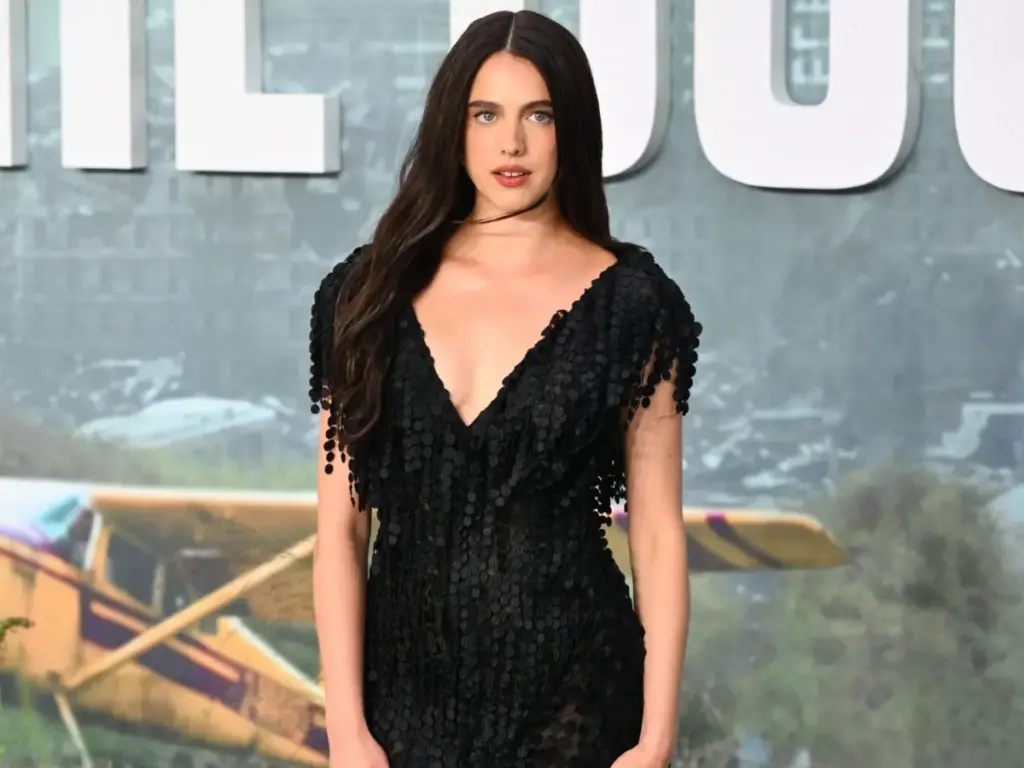
The debate escalated from theoretical runway critique to concrete cultural reality when actor Margaret Qualley stepped onto the step-and-repeat in London, England, for the premiere of her upcoming Ridley Scott-directed film, The Dog Stars. Co-starring Jacob Elordi, the high-profile cinematic event provided the ultimate backdrop for Qualley to debut the polarizing footwear in the wild. Paired with a classic, fringe-adorned little black dress designed by Blazy specifically for Chanel, the half-barefoot look instantly hijacked the media cycle.
This moment signifies more than a mere styling choice; it represents a calculated shift in red-carpet philosophy. By trading practicality and conventional glamour for conceptual risk, Qualley and Blazy have underscored a broader industry movement toward subversion, exclusivity, and performance art disguised as evening wear. As these ultra-exclusive items remain shielded from commercial retail—accessible only to top-tier VIP clients—the "non-shoe" phenomenon stands as a masterclass in modern luxury marketing, proving once again that controversy remains fashion’s most potent currency.
Detailed Chronology: From the Biarritz Catwalk to the London Red Carpet
The Genesis: Biarritz and the Birth of the "Non-Shoe"
The narrative of the Chanel barefoot sandal began earlier this year on the sun-drenched coast of Biarritz, France, where Matthieu Blazy staged his highly anticipated Resort 2027 presentation. While the collection featured a robust assortment of resort wear—including masterful updates to Chanel’s signature tweeds, relaxed tailoring, and a front row packed with global A-listers—the collective attention of the fashion press zeroed in on the models’ feet.
As the procession of looks unfolded, spectators quickly realized that standard footwear had been entirely discarded. Models sauntered down the runway in a garment that challenged the ontological boundaries of footwear. Stripped of a traditional sole, arch support, or toe box, the shoes consisted solely of a minimalist leather heel counter anchored by delicate straps wrapped up the foot and ankle. The design forced an immediate cultural reckoning among fashion editors, buyers, and consumers alike. Social media feeds erupted with incredulous memes contrasting the ethereal sandals against the harsh realities of urban environments, with critics asking the inevitable question: How could anyone survive the grimy, unforgiving pavements of New York City or London in a shoe that offers zero physical protection?

Yet, within this impracticability lay the genius of Blazy’s vision. By stripping the shoe down to its barest structural components, the designer forced a reevaluation of footwear as a purely decorative, sculptural artifact rather than a utilitarian accessory.
The Escalation: Margaret Qualley’s London Premiere
The theoretical debate surrounding the footwear transitioned into physical reality in London. Margaret Qualley arrived at the premiere of The Dog Stars—her eagerly awaited collaboration with legendary director Ridley Scott—commanding immediate attention from international paparazzi.
The evening’s ensemble was a study in contrasts. Up top, Qualley wore a timeless, understated little black dress featuring delicate cap sleeves and subtle fringing, custom-crafted by Blazy for Chanel. The silhouette paid homage to the house’s rich heritage of effortless evening elegance. However, the styling pivot occurred at ground level.
Walking across the hard, unforgiving gray concrete of the London venue—notably devoid of the traditional plush carpeting typically rolled out for high-profile cinematic premieres—Qualley’s feet were entirely exposed. Secured only by the intricate leather lacing of the Chanel barefoot sandals, her toes and soles made direct contact with the exterior environment. The stark visual of high fashion meeting unforgiving urban architecture created an instant viral moment, cementing the "non-shoe" as the defining accessory of the season.
Supporting Context & Metrics: The Economics of Polarization and Red-Carpet Risk
The Anti-Commercial Strategy of Luxury Houses
To fully understand the significance of the Chanel barefoot sandal, one must examine the shifting economic models governing top-tier luxury fashion houses. In an era dominated by mass-market accessibility, digital shopping algorithms, and widespread trend replication, items like the non-shoe serve a distinct purpose: brand elevation through calculated exclusivity.
Industry analysts note that pieces of this caliber are rarely, if ever, designed with mass commercial viability in mind. A comprehensive review of current retail inventories reveals that the barefoot sandals are absent from commercial e-commerce platforms and boutique shelves alike. Acquiring a pair requires direct access to high-level VIP client services, positioning the footwear not as a consumer commodity, but as a museum-grade collectible or an emblem of ultimate insider status.

| Dimension | Traditional Red-Carpet Footwear | Chanel Resort 2027 "Non-Shoe" |
|---|---|---|
| Primary Function | Support, elevation, aesthetic completion | Conceptual provocation, sculptural adornment |
| Practicality | High to moderate (heels, flats, boots) | Extremely low (zero sole/toe protection) |
| Commercial Availability | Widely retailed across global flagships & web | Reserved exclusively for VIPs and private clients |
| Cultural Impact | Expected elegance, low controversy | High polarization, viral media engagement |
The Evolution of Red-Carpet Dressing
Red-carpet fashion has historically been governed by unwritten rules of conventional glamour: towering stilettos, coordinated evening bags, and pristine silhouettes designed to project an aura of untouchable perfection. However, over recent seasons, a distinct counter-movement has emerged among younger Hollywood stars and visionary stylists.
Actresses like Margaret Qualley—whose personal aesthetic consistently leans toward the romantic, ethereal, and bohemian—are uniquely positioned to challenge these outdated orthodoxies. Qualley’s style profile has long embraced elements of whimsy and unexpected texture. By wearing a garment that defies logic on the red carpet, she participated in a long-standing tradition of fashion as performance art. The choice signaled a broader industry fatigue with safe styling choices, proving that today’s most influential style icons are willing to endure minor physical discomfort—or court public skepticism—in pursuit of a striking aesthetic statement.
Official Statements and Industry Perspectives
While Chanel’s corporate communications team has maintained a measured silence regarding the viral nature of the footwear, industry insiders, critics, and fashion historians have offered vociferous commentary on the trend.
Matthieu Blazy, speaking broadly about his design philosophy during the Biarritz presentation cycle, emphasized the importance of breaking conventional boundaries in contemporary luxury design. "Fashion loses its vitality when it becomes too comfortable, too predictable, and too accommodating to the mainstream," Blazy noted in post-show interviews. "We must continually interrogate the objects we take for granted—even something as fundamental as how we touch the ground."
Prominent fashion critics have been sharply divided, mirroring the public reaction:
- The Avant-Garde Perspective: "The barefoot sandal is a brilliant exercise in negative space," wrote one leading European fashion editor. "By removing the sole, Blazy forces us to look at the foot itself as part of the garment. It is daring, sculptural, and entirely fearless."
- The Pragmatic Critique: Conversely, mainstream lifestyle commentators questioned the sanity of wearing such a design outside controlled runway environments. "It is the ultimate triumph of concept over common sense," remarked a prominent style columnist. "A shoe that requires you to walk unprotected on city streets is less of an accessory and more of an endurance test."
Despite the polarization, celebrity stylists have universally praised Qualley’s commitment to the look. Several prominent Hollywood stylists pointed out that red carpets have grown increasingly sanitized, making moments of genuine stylistic risk increasingly rare and valuable.

Future Outlook: Where Does the "Non-Shoe" Go From Here?
As the dust settles on Margaret Qualley’s London premiere, the broader implications of the Chanel barefoot sandal begin to come into focus. Far from being a fleeting runway gimmick, the shoe has established a benchmark for how luxury houses can generate cultural capital without relying on traditional commercial volume.
1. The Trickle-Down Effect in Fast Fashion
While the authentic Chanel iteration will remain locked behind the iron curtain of VIP exclusivity, historical precedent suggests that the conceptual DNA of the "non-shoe" will soon ripple outward. Fast-fashion retailers and contemporary brands are expected to interpret the barefoot sandal trend, albeit with functional modifications like invisible rubber soles or cushioned footbeds. This democratization of the avant-garde ensures that the silhouette will enter the broader cultural consciousness, even if its extreme iterations remain confined to the elite.
2. Redefining Red-Carpet Boundaries
Qualley’s willingness to walk the step-and-repeat in footwear that bares her soles to the elements is likely to embolden other risk-taking celebrities. As audiences grow weary of repetitive designer partnerships and predictable archival revivals, the demand for authentic fashion moments—those that spark genuine debate, confusion, and awe—will only intensify.
3. The Enduring Legacy of Matthieu Blazy’s Chanel
Ultimately, the longevity of this moment rests on the shoulders of Matthieu Blazy. By challenging the baseline definition of what constitutes a shoe, Blazy has proven his ability to steer the conversation around the Chanel brand into uncharted territory. Whether the barefoot sandal is remembered as a fleeting satirical masterpiece or the dawn of a permanent shift in footwear philosophy, one thing remains certain: the fashion world will be watching every step the maison takes next—even if those steps are taken entirely barefoot.