Executive Overview
For generations, the missionary position has occupied a foundational, if sometimes misunderstood, place in human intimacy. Universally recognized and practically instinctive, it is often dismissed by cultural mythos as routine, uninspired, or the baseline from which all "real" sexual adventure departs. However, modern sexology, ergonomic research, and contemporary relationship dynamics are challenging this reductive narrative. Far from a static template, the classic face-to-face embrace is proving to be a remarkably versatile architectural framework capable of infinite adaptation.
Experts in human sexuality and pleasure-mapping note that minor shifts in angular geometry, weight distribution, and leverage can radically transform a standard encounter into an experience characterized by profound emotional connection, intense physiological stimulation, and targeted tactile pleasure. By examining ten distinct, elevated variations of this traditional posture—ranging from the high-intensity Mating Press to the ergonomic liberation of the Floating Missionary—this report explores how modern couples are reinventing foundational intimacy. The following analysis breaks down the mechanics, pros, cons, and optimization strategies for each variation, offering an authoritative roadmap for revitalizing bedroom repertoire through anatomical precision and mindful communication.

Detailed Chronology: The Evolution of the Face-to-Face Encounter
To understand where modern intimate practices are heading, it is helpful to trace how couples have adapted the face-to-face embrace across decades of changing sexual landscapes.
Phase I: The Standard Paradigm
Historically, the default missionary position served as the primary blueprint for reproductive biology and baseline intimacy. Characterized by the receiving partner lying supine with open legs while the giving partner assumes a superimposed weight-bearing stance, its evolution was long constrained by traditionalism. For decades, sex education treated this position as a static end-goal rather than a dynamic starting point, leading to widespread complaints of underwhelming clitoral stimulation or physical fatigue.

Phase II: The Ergonomic Awakening
As sex-positive education gained mainstream authority in the late 20th and early 21st centuries, intimacy experts began dissecting physical positions through the lens of biomechanics. Pioneers in the field introduced variations designed to solve physiological shortcomings—such as incorporating wedge pillows, altering leg heights, and utilizing external aids. This era marked the birth of specialized techniques like the Coital Alignment Technique (CAT), proving that face-to-face positioning could be intentionally modified to optimize female orgasmic potential through targeted pubic bone friction.
Phase III: The Contemporary Multidisciplinary Approach
Today, the evolution of the face-to-face embrace has entered a sophisticated, multidisciplinary phase. Influenced by modern sex educators—such as Evie Plumb, founder of Cliterally the Best—and a destigmatized approach to accessory integration (including advanced vibrators, restraint systems, and suspension hardware like sex swings), contemporary practitioners view the position as a customizable module. Modern variations now deliberately accommodate diverse body types, mobility limitations, power-play dynamics, and distinct sensory fetishes, cementing the position’s status as a cornerstone of modern sexual exploration.

Supporting Context & Metrics: Anatomy, Ergonomics, and Pleasure
Navigating the mechanics of these ten sophisticated variations requires an understanding of the physiological and psychological vectors at play. Intimacy is rarely purely physical; it is an interplay of pressure, angle, neurological feedback, and emotional vulnerability.
+-------------------------------------------------------------------------+
|                  THE ANATOMY OF FACE-TO-FACE INTIMACY                   |
+--------------------------+----------------------------------------------+
| Factor                   | Physiological & Psychological Impact         |
+--------------------------+----------------------------------------------+
| Angular Geometry         | Alters the depth of insertion and stimulates |
|                          | specific internal zones (e.g., G-spot,       |
|                          | deep fornix).                                |
+--------------------------+----------------------------------------------+
| Skin-to-Skin Contact     | Maximizes oxytocin release, heightening      |
|                          | emotional bonding and psychological safety.  |
+--------------------------+----------------------------------------------+
| Weight Distribution      | Determines muscular fatigue for the giving   |
|                          | partner and dictates the degree of physical  |
|                          | constraint or freedom for the receiver.      |
+--------------------------+----------------------------------------------+
| External Integration     | Offsets the primary limitation of standard   |
|                          | penetration (clitoral bypass) via toys,      |
|                          | hands, or manual friction.                   |
+--------------------------+----------------------------------------------+
1. The Standard Missionary
- How to Do It: The receiving partner reclines supine with legs spread. The giving partner positions themselves centrally between the receiver’s legs, supporting their upper body weight on hands or forearms to execute entry.
- Pros: Offers maximized skin-to-skin contact, sustained eye contact, and deep penetration. Its intuitive nature ensures virtually universal familiarity.
- Cons: Inherently low clitoral stimulation via thrusting alone.
- Optimization Strategies: Incorporate a vibrating cock ring or introduce a handheld vibrator during or between strokes. The giving partner can occasionally pause deep thrusting to glide externally along the vulva or intergluteal cleft (in anal applications).
2. The Mating Press
- How to Do It: An aggressive evolution of the traditional setup where the receiving partner elevates their legs upward toward the giver’s shoulders, allowing the giving partner to drive their torso flush against the receiver with every stroke.
- Pros: Highly intense and intimate. Described by sex educators as a conduit for profoundly deep penetration paired with powerful eye contact or physical grounding.
- Cons: Potential for over-penetration, which can cause discomfort if unmanaged.
- Optimization Strategies: Initiate movement at a measured pace. This posture heavily complements psychological power-play dynamics, such as consensual wrist pinning or exploring breeding fantasies, and easily accommodates ejaculating or textured prosthetics.
3. Spreadeagle
- How to Do It: The receiving partner extends both arms and legs outward in a wide, expansive configuration, creating an atmosphere of deliberate vulnerability. The giving partner hovers slightly above, utilizing self-supported weight.
- Pros: Encourages profound emotional connection and deep entry while leaving the receiving partner’s hands completely free for independent clitoral manipulation or toy use.
- Cons: Places the onus of clitoral stimulation entirely on the receiver or external accessories.
- Optimization Strategies: Build physiological anticipation by utilizing extended foreplay—tracing the inner thighs and torso slowly before transitioning to penetration. Alternatively, have the receiver rest their legs over the giver’s thighs for customized leverage.
4. The Floating Missionary
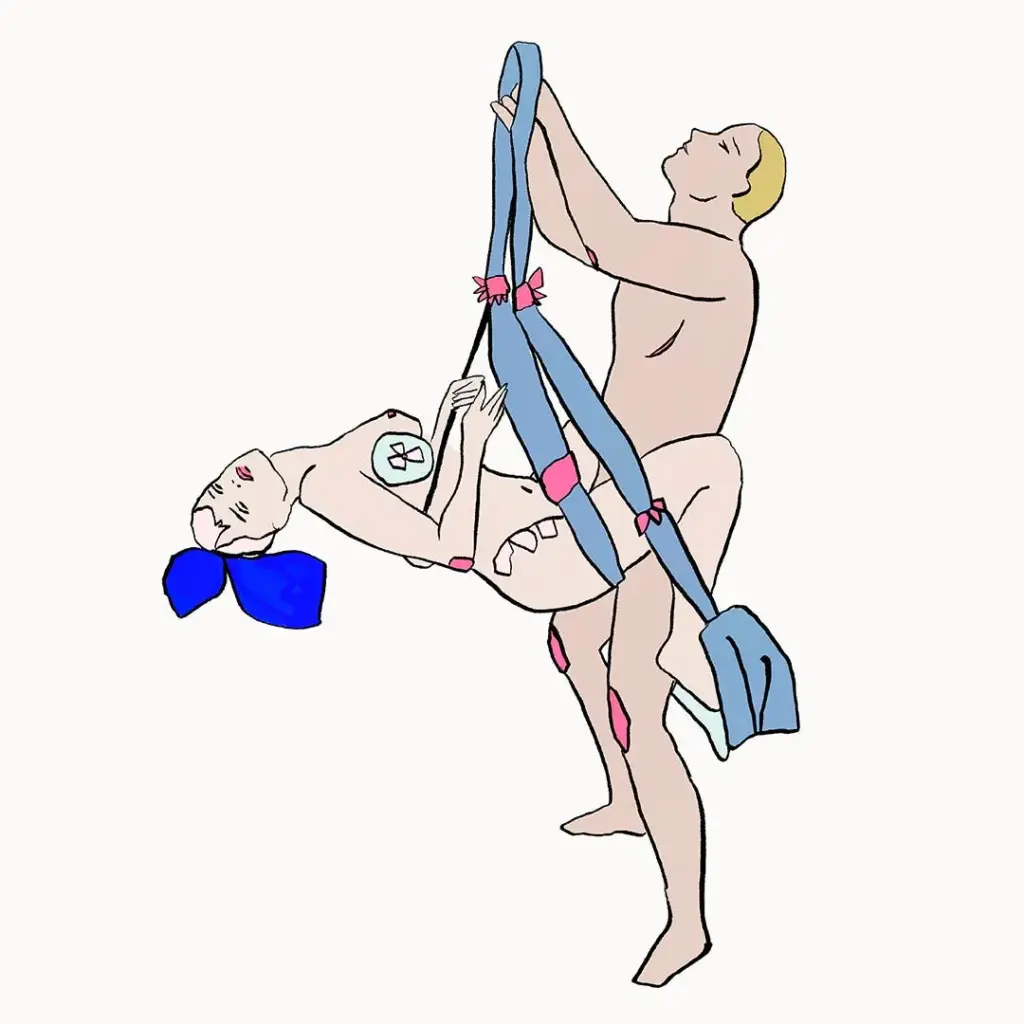
- How to Do It: Weightlessness is achieved by utilizing an ergonomic sex swing. The receiving partner settles into the seat with feet secured in stirrups and hands gripping the support straps, while the standing partner approaches to guide the entry.
- Pros: Radically alters physics, making thrusting effortless and accommodating individuals with physical mobility constraints or joint sensitivities.
- Cons: Requires specialized hardware, though many modern units install without permanent structural modifications.
- Optimization Strategies: The receiver can actively dictate pace and depth by wrapping their arms around their partner’s torso to draw them closer. This posture also serves as a prime vehicle for safe, consensual restraint integration using the swing’s anchor points.
5. The Jackknife
- How to Do It: The receiver lies supine with one leg fully extended parallel to the partner’s body, while the opposite leg is sharply flexed toward the chest. The giver enters from above, often clasping the elevated leg for structural support.
- Pros: Shifts the internal entry angle completely, offering novel friction patterns against the pubic bone.
- Cons: Holding a single leg elevated can introduce muscular fatigue over extended sessions.
- Optimization Strategies: Regularly alternate legs or lower both limbs to rest. Partners can heighten sensory engagement by incorporating kissing, caressing, or alternative stimulation along the elevated limb.
6. The X Spot
- How to Do It: The receiver adopts an X-shaped posture with arms and limbs widely abducted. The giving partner assumes a rigid plank-like posture on knees and forearms, hovering just above to minimize broad body contact.
- Pros: Isolates the sensation of penetration by removing distracting torso friction, focusing neural feedback directly on internal nerve endings.
- Cons: High physical exertion requirement for the giving partner, necessitating frequent breaks or positional shifts.
- Optimization Strategies: Alternate between spoken communication and silent, gaze-locked synchronicity. Stripping away verbal cues allows both participants to tune entirely into breathwork and tactile feedback.
7. The Dirty Dangle
- How to Do It: The receiver lies back on an elevated, sturdy surface (such as a reinforced table or counter edge) while the standing partner enters as the receiver wraps their legs around their waist.
- Pros: Delivers exceptional depth and leaves the receiver’s upper body entirely unencumbered for manual exploration or toy integration.
- Cons: The steep angle of entry can occasionally prove too intense; depth must be carefully regulated.
- Optimization Strategies: Ensure absolute structural integrity of the elevated surface beforehand. If depth becomes uncomfortable, the receiver should actively bend their knees tightly toward their chest to shorten the vaginal/anal canal.
8. The Purring Kitty (Coital Alignment Technique)
- How to Do It: The giving partner shifts several inches higher up the receiver’s body than in a standard posture. Upon entry, the giver arches and grinds their pelvic symphysis directly against the receiver’s clitoris using micro-movements.
- Pros: Directly addresses the classic missionary shortfall by providing consistent, rhythmic clitoral stimulation through pelvic bone friction during penetration.
- Cons: May not generate sufficient stimulation for all anatomies, requiring supplemental tools if anorgasmia persists.
- Optimization Strategies: Generous lubrication is mandatory to facilitate smooth gliding motions. Experiment with circular or side-to-side pelvic grinding rather than linear thrusting to discover unique neural triggers.
9. Shoot the Moon
- How to Do It: The receiver positions their hips precisely at the mattress edge with knees pulled toward their chest. The standing giver grasps the receiver’s ankles to manage entry and leverage.
- Pros: Grants the giving partner precise control over the entry angle, making it easy to cycle through different anatomical depths rapidly.
- Cons: Places control almost entirely in the hands of the giver, potentially reducing autonomous agency for the receiver.
- Optimization Strategies: Empower the receiver to issue real-time verbal guidance ("slower," "wider," "deeper") to ensure mutual satisfaction. Finish by allowing the receiver to stimulate themselves while the partner maintains visual or physical contact.
10. The Lock and Load
- How to Do It: The receiver lies completely flat with legs pressed tightly together. The giving partner drapes their legs on the outside of the receiver’s limbs during entry.
- Pros: Compressing the receiver’s legs creates a significantly tighter encasement, dramatically heightening internal friction. It is exceptionally beneficial for smaller anatomical dimensions or when utilizing strap-on harnesses.
- Cons: Initial entry alignment can prove mechanically awkward.
- Optimization Strategies: Begin in a standard, open-legged posture to achieve comfortable entry, then instruct the receiver to bring their legs together once depth is established. The receiver can gently roll their pelvis to maximize external friction against the pubic region.
Official Statements and Expert Perspectives
As the discourse surrounding sexual wellness matures, clinical sexologists and educators continue to advocate for structural experimentation as a tool for relational health and sexual literacy.

"We are moving away from the idea that sex should be effortless or intuitive in every single instance," explains sex educator Evie Plumb. "When couples introduce deliberate variations like the Mating Press or the Spreadeagle, they aren’t just changing physical angles—they are actively communicating boundaries, exploring power dynamics, and prioritizing mutual physical satisfaction over cultural scripts. Intimacy is an active design process."
Furthermore, relationship counselors emphasize that stepping outside of rote routines helps break physiological habituation. When the brain encounters novel physical stimuli and unfamiliar ergonomic alignments, neurochemical pathways associated with novelty and desire—such as dopamine release—are re-engaged, revitalizing long-term partnerships.

Future Outlook: The Trajectory of Intimate Ergonomics
Looking ahead, the intersection of ergonomic design, sexual wellness, and body-positive education promises to further revolutionize how intimate spaces are utilized. As manufacturers continue to engineer accessible, aesthetically pleasing furniture—such as modular lounge wedges, adjustable restraint systems, and sleek suspension apparatuses—the barrier to entry for advanced physical exploration is lowering significantly.
Moreover, the destigmatization of open dialogue regarding sexual mechanics ensures that future generations will approach intimacy with a toolkit prioritizing comfort, consent, and customized pleasure over rigid traditionalism. By treating foundational positions not as immutable rules, but as dynamic canvases for creative expression, modern couples are unlocking new dimensions of connection that prove traditional intimacy has never been more vibrant.