From surrealist silhouettes to chaotic textures, the sartorial landscape of Yorgos Lanthimos’s cinematic triumph reimagines 19th-century history to mirror a protagonist’s radical awakening.
Executive Overview
When audiences hear the word "Frankenstein," cultural memory immediately conjures images of gothic decay, monochromatic shadows, and industrial grotesquery. Yet, in Yorgos Lanthimos’s visually arresting adaptation of Alasdair Grey’s 1992 postmodern novel, Poor Things, the traditional aesthetic of the reanimated monster is entirely upended. Instead of rags and stitched-together misery, the film presents an explosion of vibrant, forward-thinking fashion that feels simultaneously rooted in the late 19th century and plucked straight from a contemporary London Fashion Week street-style blog.
At the center of this visual feast is Bella Baxter, played with fearless vulnerability by Emma Stone. Reanimated following a dramatic suicide attempt through an experimental brain transplantation—wherein the brain of an unborn child is placed into the body of its mother—Bella embarks on a kaleidoscopic journey of self-discovery, sexual liberation, and intellectual maturation. Guiding her physical and internal transformation is costume designer Holly Waddington. Tasked by Lanthimos to bypass strict historical accuracy in favor of emotional resonance, Waddington crafted a wardrobe that acts as a second skin for Bella. It is a sartorial archive of her psychological evolution, shifting from infantile, unstructured garments to hyper-stylized bourgeois ensembles, and ultimately resolving in effortless, self-actualized casualwear.
This deep dive explores the mechanics behind Poor Things’ costume design, examining how silhouettes, textures, and historical subversion coalesce to form one of the most compelling visual narratives in modern cinema.
Detailed Chronology: The Sartorial Evolution of Bella Baxter
The trajectory of Bella Baxter’s wardrobe is intrinsically linked to her cognitive development and her geographical trajectory as she flees the confines of her creator’s home to experience the wider world. Waddington’s design philosophy traces this journey across several distinct phases, each marked by specific sartorial choices that reflect Bella’s internal shifts.
Phase I: The Genesis of Innocence and Chaos
When viewers are first introduced to Bella Baxter, she is trapped in a gilded cage—the eccentric, sterile London estate of her creator, Dr. Godwin Baxter (Willem Dafoe), whom she endearingly refers to as "God." Mentally operating at the level of a toddler due to her unique transplantation, Bella’s early wardrobe reflects her lack of socialization and her impulsive, chaotic nature.
Waddington dresses Stone in dramatic, voluminous tops paired with billowing bloomers and casual trousers. These pieces immediately establish a sense of whimsy and unpolished energy.
“[Lanthimos] did not want me to be historically accurate with the costumes,” Waddington explains, detailing her initial research into the 1890s—an era famed for exaggerated sleeves and structured frames. Instead of copying museum pieces, Waddington sought to reinterpret late-Victorian textures. “I wanted them to feel wild, chaotic, and organic.”
These early garments are deliberately effortless, symbolizing a mind unburdened by societal expectations, etiquette, or patriarchal shame. They are clothes made for uninhibited movement, crawling on floors, and dropping food—actions that horrify the polite society Bella will soon encounter.
Phase II: The Explosion of Bourgeois Extravagance
As Bella’s insatiable curiosity prompts her to flee her home alongside the slick, hedonistic lawyer Duncan Wedderburn (Mark Ruffalo), her wardrobe undergoes a dramatic metamorphosis. Stepping out into the sprawling, phantasmagoric metropolises of Lisbon, Alexandria, and Paris, Bella’s clothes become an outward manifestation of her expanding consciousness.
The costumes in this middle act are a riot of saturated hues, exaggerated proportions, and mixed textures. In one standout sequence, Bella pairs a pristine white ruffled top with canary-yellow shorts, tiny black sunglasses, a cropped cobalt-blue jacket, and ankle boots. In another, a billowing white ruffle top is offset by a fluid, translucent bubblegum-pink skirt.
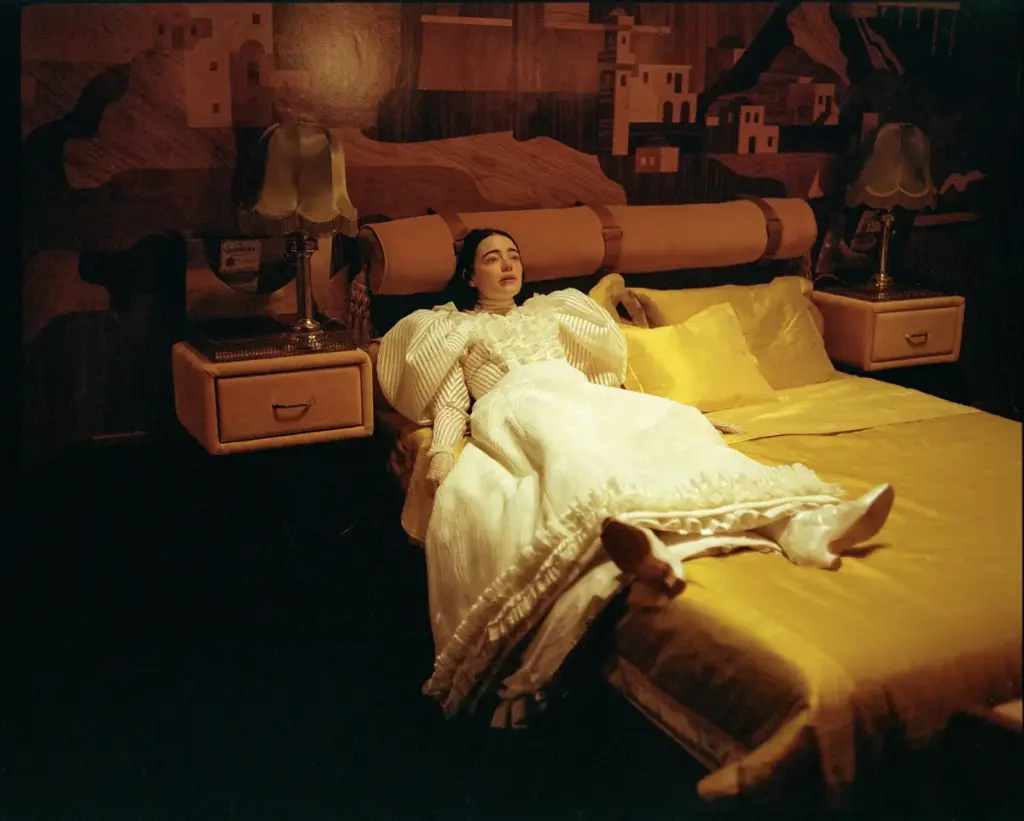
As her travels continue and she encounters global disparities—such as the shocking reality of systemic poverty in Alexandria—her fashion begins to absorb the complexities of class consciousness. Confronted with human suffering for the first time, Bella recognizes her own unearned upper-class privilege, a realization underscored by the rigid architecture of a traditional Victorian dress featuring oversized white puffed sleeves. These clothes no longer just cover her body; they act as armor, absorbing the shocks of an industrializing, unequal world.
Phase III: The Architecture of Patriarchal Oppression
Later in the narrative, the film confronts the dark remnants of Bella’s past life before the experiment—a period governed by the suffocating patriarchal conventions of the European aristocracy. To visually translate the psychological imprisonment Bella feels during these encounters, Waddington turned directly to 19th-century fashion photography.
Stone is encased in a striking, deep-blue gown paired with a rigid, traditional overcoat, alongside an arresting, armor-like copper dress accented with intricate golden filigree.
“I wanted a stark contrast [to the looks she wears after the experiment],” notes Waddington. “These outfits are striking, beautiful, very serious—and deeply telling.”
These garments serve as visual metaphors for the corset of societal expectations. They restrict movement, command absolute reverence, and project an image of unyielding feminine decorum that Bella’s free-spirited soul violently rejects.
Phase IV: Self-Actualization and Radical Freedom
The narrative crescendo of Poor Things resolves in a manner as liberating as it is unpretentious. Shedding the expectations of Victorian propriety, the aristocratic pretensions of her past lives, and the eccentricities of her early reanimation, Bella finally steps into her ultimate identity as an autonomous medical professional and free-thinking individual.
In the film’s closing moments, Bella wears a deceptively simple outfit: a cream-colored knit sweater paired with a textured copper maxi skirt.
“At that point, they are just clothes,” Waddington reflects. “I wanted her outfit to look as though she had finally found herself—as though she knew exactly who she was.”
Supporting Context & Metrics: Breaking Down the Wardrobe
To fully appreciate the scope of Poor Things’ aesthetic achievements, it is necessary to examine the broader production context, the collaborative synergy between director and designer, and the technical metrics of the wardrobe department.
The Collaborative Vision of Lanthimos and Waddington
Yorgos Lanthimos is celebrated for his uncompromising visual style—characterized by wide-angle fish-eye lenses, jarring tonal shifts, and dystopian world-building (evident in earlier works like The Lobster and The Favourite). In Poor Things, Lanthimos envisioned a fantastical, hand-crafted alternate universe that combined late-19th-century industrialism with surrealist fantasy.
Waddington was given unusual creative freedom. Rather than relying on historical costume houses that stock pre-made period pieces, the costume department constructed almost every major look from scratch. This allowed them to manipulate fabrics—combining modern synthetic sheens with traditional wools, silks, and cottons—to create the uncanny valley effect that defines the film’s visual language.
Key Sartorial Metrics & Design Signatures
- The Sleeve as a Psychological Motif: Throughout the film, sleeve volume scales directly with Bella’s emotional state. In infancy/reanimation, sleeves are loose and floppy; during her bourgeois phase, they expand into architectural marvels that consume space; in her oppressed past, they lock her arms into rigid postures.
- Color Psychology: The palette transitions from muted laboratory grays and earthy tones (associated with Godwin Baxter) to electric pinks, vibrant yellows, and deep oceanic blues during her sexual awakening, finally settling into grounding earth tones (creams and coppers) by the film’s conclusion.
- The Subversion of Bridal Wear: One of the most discussed costumes in the film is Bella’s wedding dress. While traditional cinematic bridal gowns emphasize exposure, purity, and facial reveal, Waddington made the radical choice to bind a traditional white lace veil across the lower half of Stone’s face. This single adjustment transformed a symbol of patriarchal submission into a mask of enigmatic autonomy. According to production notes, this was Emma Stone’s favorite look in the entire film.
Official Statements and Design Philosophy
The creative minds behind Poor Things have spoken extensively about the philosophical underpinnings of the film’s visual design, emphasizing that the clothes were never merely decorative, but active participants in the storytelling.
"We didn’t want the audience to look at the screen and simply say, ‘Ah, yes, 1890.’ We wanted them to feel disoriented, excited, and alive," Holly Waddington stated in a recent interview discussing the film’s premiere. "Bella’s brain is that of a child growing at an accelerated rate into a woman’s body. Her clothes had to capture that accelerated psychological trajectory—moving from chaotic experimentation to absolute self-possession."
Director Yorgos Lanthimos consistently championed designs that defied historical purism. By merging Victorian silhouettes with futuristic color palettes and avant-garde street-style sensibilities, the production ensured that Poor Things remained untethered to a specific timeline, transforming Victorian London, Paris, and Lisbon into dreamscapes of the female subconscious.
Future Outlook: The Cultural Legacy of Poor Things Fashion
As Poor Things continues to captivate global audiences and dominate awards season conversations, its impact on contemporary fashion and costume design is already becoming palpable.
- The Revival of Neo-Victorianism with a Twist: Designers are noting a renewed interest in exaggerated silhouettes—particularly oversized puff sleeves, corsetry worn as outerwear, and voluminous bloomers—recontextualized through modern, sustainable fabrics. The "anti-historical" approach pioneered by Waddington demonstrates that period pieces do not need to be museum pieces; they can serve as canvases for modern feminist commentary.
- The Shift Toward Character-Driven Wardrobes: In an era where franchise filmmaking often relies on standardized CGI costumes or generic superhero suits, Poor Things stands as a masterclass in artisanal, character-driven costume design. It proves that tactile, hand-crafted textiles hold an unmatched power to convey internal psychological shifts.
- Enduring Cultural Resonance: Bella Baxter’s final outfit—the unpretentious cream sweater and copper skirt—has already entered the lexicon of iconic cinematic wardrobes. It signals a departure from the external gaze, suggesting that true style is not about performing for society, but about finding a uniform that honors one’s authentic self.
In summary, while Poor Things borrows the skeletal framework of the Frankenstein myth, its heart—and its wardrobe—beats with an entirely different, fiercely independent pulse. Through Holly Waddington’s visionary costume design, Bella Baxter’s journey from a reanimated experiment to a self-actualized woman is rendered in brilliant technicolor, securing the film’s place as a landmark achievement in cinematic style.
Poor Things is available to stream and view in select cinemas worldwide.