Executive Overview
Biographical filmmaking has long labored under the dead weight of hagiography—the tendency to transform historical icons into marble monoliths, sanitized of their contradictions, vices, and messy humanity. The Idiot(s), a wildly off-kilter and invigorating new dramedy directed by the Polish filmmaking duo Małgorzata Szumowska and Michała Englert, takes a sledgehammer to this venerable cinematic tradition. Rather than presenting Fyodor Dostoevsky as the serene, bearded patriarch of Russian letters who gazed unflinchingly into the abyss of the human condition, the film drags the author squarely into the mud.
By focusing on a sharply defined, conflict-laden passage of his life—his turbulent honeymoon in Germany with his much younger second wife, Anna Snitkina—The Idiot(s) manages a rare cinematic feat. It offers a biting, darkly comedic exercise in separating the art from the artist, not by excusing the creator’s moral and personal failures, but by weaponizing them to find a truer, more visceral value in his perspective.
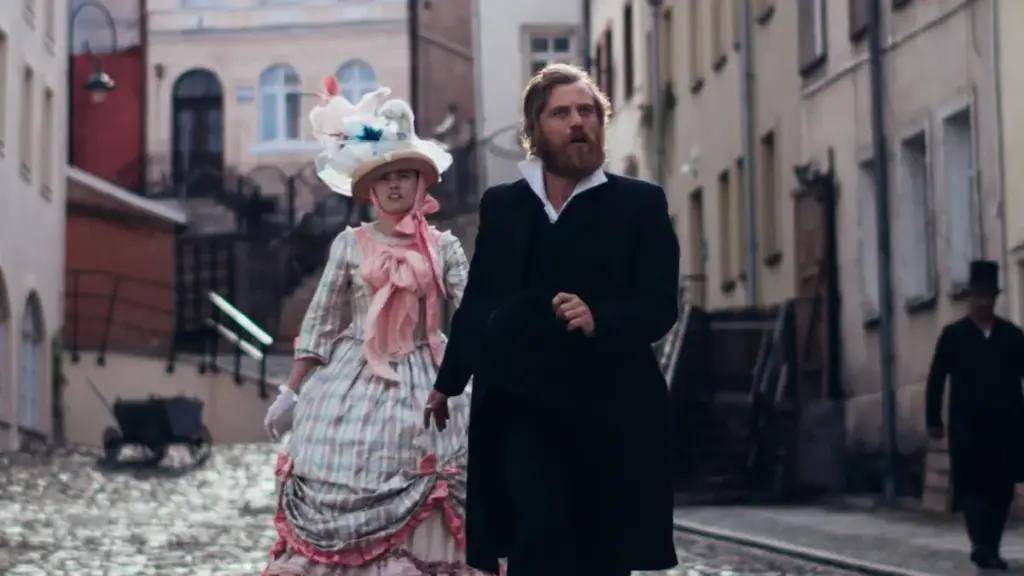
Anchored by a physical, sweat-and-vomit-soaked performance from Johnny Flynn as the wretched, gambling-addicted novelist, and an anchoring, luminous turn by Aimee Lou Wood as Anna, the film dismantles the polished mirage of the 19th-century intellectual. Instead, Szumowska and Englert deliver a cinematic experience that is part cringe comedy, part psychological survival drama, and entirely subversive. By trading stately historical distance for bodily fluids, scatological humor, and anachronistic winks—such as a stripped-down, acoustic rendition of A-ha’s "Take on Me"—The Idiot(s) makes the provocative case that true artistic genius is rarely born from divine inspiration, but rather from the chaotic, humiliating friction of everyday madness.
Detailed Chronology: Madness, Roulette, and the German Honeymoon
The narrative engine of The Idiot(s) draws its primary inspiration from Andrew D. Kaufman’s meticulously researched non-fiction book, The Gambler Wife: A True Story of Love, Risk and the Woman Who Saved Dostoyevsky. Rather than attempting to encapsulate an entire life across decades, Szumowska and Englert narrow their lens to the hazardous months following the sudden nuptials of the newly minted literary celebrity and his stenographer-turned-wife.
Fresh off the international success of Crime and Punishment, Fyodor arrives in Germany enveloped in the protective fog of his own literary prestige. Yet, his outward fame conceals an internal pressure cooker of crippling debt, mounting desperation, and an insufferably proud, nationalistic disdain for Western Europe. To Fyodor, the opulence and perceived superficiality of the West are physical offenses. This defensive patriotism reaches its narrative peak early in the film during an impromptu, wildly uncomfortable dance-off with his compatriot and rival scribe, Ivan Turgeniev (played with sniveling, cowardly precision by Christian Friedel of The Zone of Interest). While Turgeniev has comfortably assimilated into the bourgeois comforts of Western Europe, Fyodor views this adaptation as a betrayal of the Russian soul, fueling an obsessive contempt that drives much of the film’s early friction.
As the weeks bleed into months, the honeymoon devolves into a grueling war of attrition against financial ruin. Fyodor’s addiction to the roulette wheel swallows their meager funds whole, transforming the grand project that would become the novel The Idiot into a race against starvation. Szumowska and Englert refuse to romanticize this downward spiral. They juxtapose the palatial, gilded accommodations of European elites with the damp, grimy, bug-infested apartments where Fyodor and Anna are forced to take shelter.
The depravity of the aristocratic figures populating the periphery—portrayed with a delicious, bloodthirsty snark by a cast featuring Vicky Krieps—is rendered through a nearly cartoonish lens, reflecting Fyodor’s own paranoid and resentful worldview. In one striking sequence, when local elites demand that the famous author entertain them with a salacious personal anecdote, Fyodor subverts their voyeurism. He spins a harrowing, profoundly melancholic tale of class sorrow that transfixes the room, simultaneously displaying his peerless storytelling wizardry and unmasking the hollow, out-of-touch moral decay of the ruling class.
Yet, this intellectual dominance is repeatedly undercut by Johnny Flynn’s physically vulnerable performance. Flynn portrays Dostoevsky not as a man of quiet contemplation, but as a creature driven by raw, unbridled impulses. When the author loses his last ruble at the casino, he does not merely accept defeat; he collapses into a puddle of humiliation, crawling across casino floors, weeping and begging for another stake. These moments vibrate on a razor-thin wire between high tragedy and excruciating cringe comedy, permanently severing the connection between the grandness of Dostoevsky’s oeuvre and the miserable, unglamorous reality of his daily existence.
Supporting Context & Metrics: The Mechanics of Subversion
To fully appreciate the disruption The Idiot(s) brings to the biographical genre, one must examine the creative partnership behind the camera and the economic realities of the production itself.
Directors Małgorzata Szumowska and Michała Englert have spent decades refining a collaborative cinematic language, previously co-directing critically acclaimed features such as Never Gonna Snow Again and Infinite Storm. Historically a married couple whose personal and professional lives are inextricably linked, Szumowska and Englert bring a deeply lived-in understanding of domestic partnership to the screen. This dynamic explains why The Idiot(s) functions so effectively as a two-hander. While Dostoevsky’s name dominates the historical record, the film elevates Anna Snitkina to co-protagonist status, granting her equal—if not superior—dramatic weight.
Production and Narrative Metrics
- Source Material Foundation: Primarily adapted from Andrew D. Kaufman’s 2021 biographical study, The Gambler Wife.
- Thematic Focus: The intersection of artistic genius, clinical addiction, domestic labor, and the 19th-century European class divide.
- Tone Profile: A hybrid genre piece combining historical costume drama, psychological dramedy, scatological realism, and modern anachronistic satire.
- Key Creative Collaboration: Co-directed and co-shot to emphasize an intimate, claustrophobic visual style that mirrors the financial and emotional walls closing in on the protagonists.
The financial precariousness central to the film’s plot was a tangible reality for the historical Dostoevskys. Living in exile to escape Russian creditors, Fyodor was trapped in predatory contracts with publishers who demanded rapid delivery of serial chapters under threat of financial forfeiture. In the film, this pressure is mirrored through visceral cinematic choices. Scatological humor and bodily fluids—vomit, sweat, ink, and tears—permeate the frames, actively stripping away the pristine, starch-collared dignity historically assigned to 19th-century intellectuals.
Furthermore, the stylistic inclusion of anachronisms, most notably the stripped-down, acoustic reinvention of A-ha’s 1980s synth-pop anthem "Take on Me," serves a vital structural purpose. It shatters any lingering illusion that the audience is watching a dusty, solemn museum piece. It acts as an explicit stylistic reminder that the human passions, insecurities, and neuroses plaguing these historical figures are identical to our own.
Official Statements and Critical Reception
While The Idiot(s) continues to generate heated debate on the international festival circuit, early critical notices have praised its audacity. Industry analysts and reviewers have particularly highlighted how the film sidesteps the traditional pitfalls of the "biopic formula."
In statements regarding the conceptualization of the project, co-director Małgorzata Szumowska emphasized the necessity of stripping away the reverence traditionally afforded to literary icons:
"We live in an era where we constantly demand perfection from the creators we admire, and when we find out they were deeply flawed, broken, or downright impossible human beings, we panic. With this film, we wanted to do the opposite. We wanted to say: Yes, Dostoevsky was a monster, a degenerate gambler, an arrogant chauvinist—and yet, the art he produced came precisely from that boiling swamp of madness. You don’t have to love the man to understand the miracle of his survival."
Co-director and cinematographer Michała Englert added context regarding the visual approach to the couple’s dynamic:
"The historical record often treats Anna as a footnote, a silent angel who cleaned up after the great genius. We refused that dynamic. Anna’s heroism wasn’t passive; it was tactical, gritty, and often exasperated. Aimee Lou Wood brought an intelligence to the role that shows she wasn’t just surviving Fyodor—she was actively managing a volatile enterprise."
Critics have widely echoed these sentiments. Variety noted that the film "starts off with an advantage over most [biopics] since it covers only a finite, conflict-laden passage of its subject’s storied life," praising its ability to function as a "biting exercise in separating the art from the artist." Reviewers have similarly singled out the chemistry between Flynn and Wood, noting that Wood’s portrayal of Anna injects an indispensable "open-hearted charisma and cleverness" that prevents the film from collapsing into pure cynicism.
Future Outlook: Redefining the Biographical Paradigm
As The Idiot(s) prepares for wider theatrical distribution and potential awards-season contention, its broader impact on the landscape of historical cinema remains to be seen. For decades, the biographical drama has remained tethered to safe, linear trajectories—childhood struggle, breakthrough success, personal tragedy, and a final, validating curtain call. Films like The Idiot(s), alongside recent postmodern cinematic biographies, signal a vital evolution in how contemporary audiences consume history.
By refusing to sanitize Dostoevsky, Szumowska and Englert have created a template for a new kind of biographical storytelling—one that respects the audience enough to abandon hagiography in favor of uncomfortable psychological truth. The film posits that our collective obsession with placing historical figures on pedestals does a disservice not only to historical accuracy, but to the very nature of artistic creation.
When we accept that timeless masterworks can emerge from a year of utter madness, financial ruin, and domestic desperation, we bridge the chasm between the past and the present. The Idiot(s) reminds us that culture was not forged by marble gods in formal attire, but by flawed, sweating, desperate mortals wrestling with their demons—and that their work remains all the more revelatory for it.