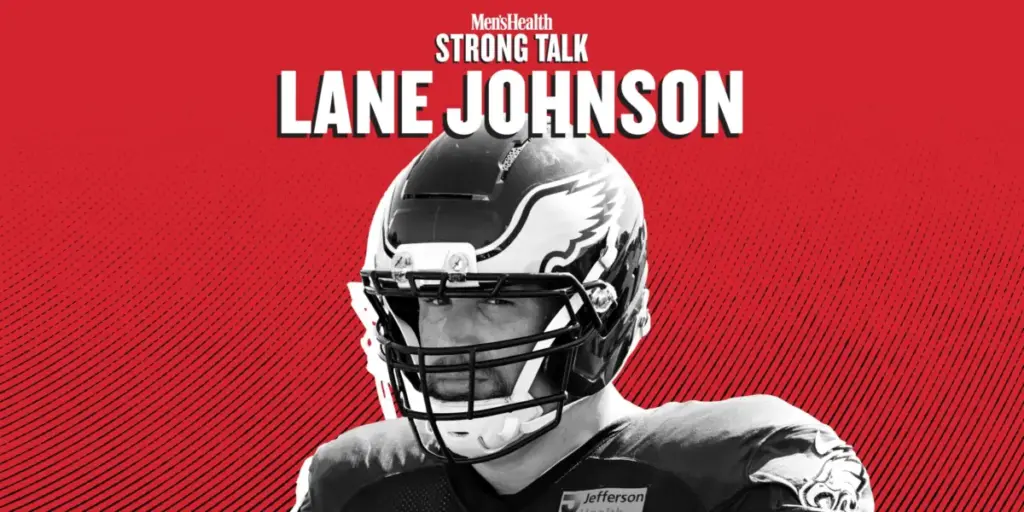
For over a decade, Philadelphia Eagles offensive tackle Lane Johnson has stood as an immovable pillar on one of the NFL’s most dominant offensive lines. A two-time Super Bowl champion (2017 and 2024) and widely regarded as one of the most physically imposing and naturally gifted athletes in professional football, Johnson’s resume speaks for itself. Yet, behind the multi-million-dollar contracts, the championship rings, and the daunting physical stature lies a reality few fans ever witness: debilitating performance anxiety, chronic perfectionism, and a psychological toll that frequently manifests in physical illness before kickoff.
In a candid, deep-dive interview on the Men’s Health series Strong Talk with Ebenezer Samuel, C.S.C.S., Johnson pulled back the curtain on the unseen pressures of elite athletics. Discussing everything from his grueling 6,000-calorie daily training diet and his cross-disciplinary training sessions with World’s Strongest Man Mitchell Hooper to his looming retirement decision ahead of the 2026 NFL season, Johnson delivered a masterclass in vulnerability. By normalizing conversations around pre-game panic attacks and the psychological burdens carried by hyper-competitive athletes, Johnson is redefining what it means to be strong—proving that true resilience requires confronting mental battles just as fiercely as physical ones.
Detailed Chronology: From Collegiate Anxiety to NFL Breakthroughs
To understand the weight Lane Johnson carries on the football field, one must trace the trajectory of his mental health struggles back to their roots. While his physical ascension through the ranks of high school, collegiate, and professional football appeared seamless from the outside, the internal landscape told a vastly different story.
The Roots of Perfectionism in College
Long before he was locking down elite edge rushers in the NFC East, Johnson began experiencing performance anxiety during his collegiate playing days. Like many elite athletes, his internal drive was fueled by a relentless pursuit of perfection. In the hyper-critical environment of high-level sports, any mistake—whether a missed block, a blown assignment, or a lost rep—is magnified under the glaring lights of television cameras and coaching staffs.
For Johnson, this perfectionism transformed into a toxic psychological feedback loop. The pressure to maintain flawlessness did not elevate his game; instead, it eroded his peace of mind, pulling him entirely out of the present moment. Instead of enjoying the privilege of competing at the highest level, Johnson found himself paralyzed by the fear of failure.
The Escalation to the Professional Level
As Johnson transitioned to the NFL, the stakes multiplied exponentially. The financial pressures, the physical demands, and the microscopic scrutiny of professional football exacerbated his anxiety. What began as mild collegiate nerves metastasized into full-blown physical manifestations of panic.
In his interview with Samuel, Johnson offered a visceral description of game-day mornings that shattered the stoic gladiator stereotype often projected onto NFL players:
"A lot of us would dry heave before games. We would wake up early, and it was like a mini panic attack for us. It could be an 8 o’clock game at night and we’d wake up at 5:30 and puke."
For years, Johnson suffered in silence, initially failing to comprehend what his body was experiencing. The disconnect between his outward appearance as an elite, dominant behemoth and his internal state of acute distress created a profound sense of isolation.
Finding Common Ground and Normalizing the Struggle
The turning point for Johnson arrived when he began looking outside the traditional boundaries of football to understand his psychological state. By connecting with Mixed Martial Artists (MMA) and combat sports athletes, Johnson discovered a shared fraternity of suffering. Fighters competing in high-stakes combat sports—where the margin for error is razor-thin and the physical consequences are immediate—reported experiencing the exact same pre-match physical sickness and anxiety.
Realizing that elite fighters, despite their terrifying reputations and combat readiness, battled the same nervous system overrides brought on by performance pressure was revelatory for Johnson. It dismantled the illusion that he was uniquely broken or weak.
"A lot of people are scared to have the conversation. At the same time, I know a lot of my teammates may be struggling with this," Johnson noted.
By reframing his anxiety not as a personal failure but as a universal human response to high-stress environments, Johnson began the long journey toward emotional management and acceptance.
Supporting Context & Metrics: Fueling and Conditioning a Titan
While Johnson’s mental health advocacy forms the emotional core of his recent disclosures, his physical preparation remains nothing short of legendary. Maintaining a body capable of neutralizing the planet’s most lethal pass rushers requires an uncompromising, science-backed approach to nutrition, recovery, and cross-training.
The 6,000-Calorie Daily Fueling Strategy
Playing offensive tackle at an elite All-Pro level requires an immense mass-to-power ratio. During heavy training blocks, Johnson consumes approximately 6,000 calories per day to sustain his massive frame, repair muscle tissue, and maintain explosive force output.
Macronutrient Distribution: To fuel high-intensity gridiron sessions, Johnson’s diet is heavily front-loaded with complex carbohydrates, high-biological-value proteins, and healthy fats.
Digestive Management: Consuming 6,000 calories is not merely about indulgence; it is a full-time logistical challenge. Athletes of Johnson’s caliber must time their nutritional intake meticulously to avoid sluggishness during practice while ensuring glycogen stores remain fully saturated.
Cross-Disciplinary Training: Learning from the World’s Strongest Man
Johnson’s hunger for self-improvement extends far beyond the Philadelphia Eagles’ NovaCare Complex. Earlier this summer, Johnson made headlines by inviting reigning World’s Strongest Man Mitchell Hooper to train with him.
The collaboration offered a fascinating cross-pollination of strength disciplines:
Biomechanics & Leverage: Hooper, an exercise science expert and elite strongman, brought unique insights regarding leverage, core stabilization, and maximal force production.
Functional Adaptability: While strongman competitions test static and dynamic absolute strength across odd objects (Atlas stones, yokes, logs), NFL trench warfare requires multi-directional explosiveness, lateral agility, and endurance under fatigue. The training exchange allowed Johnson to incorporate unconventional loading patterns into his routine, further bulletproofing his joints and enhancing his functional power output.
Injury Mitigation and Longevity
Sustaining a career as an offensive lineman for over a decade requires surviving an absolute war of attrition. Ligament tears, joint degradation, and chronic concussive impacts are occupational hazards. Johnson’s ability to continually bounce back from severe injuries is a testament to his stringent physical therapy protocols, sleep hygiene, and dedication to proactive soft-tissue work. Yet, as he enters the twilight of his career, the physical toll has become an inescapable factor in his future planning.
Official Statements & Insights from the Strong Talk Discourse
The dialogue between Lane Johnson and fitness expert Ebenezer Samuel on Strong Talk cuts through the superficial soundbites typical of sports media, offering a raw, unvarnished look at the modern athlete’s psyche.
Breaking the Stigma of Mental Health in Major Sports
Historically, the culture of the NFL has prized stoicism above all else. Players were historically expected to "play through" psychological pain just as readily as physical injuries. Johnson’s willingness to openly discuss dry heaving, panic attacks, and the existential dread preceding high-stakes games marks a monumental shift in sports culture.
By vocalizing these experiences, Johnson provides a blueprint for younger athletes entering the league. He actively dismantles the toxic narrative that mental vulnerability equates to athletic fragility. His message is clear: elite performance and severe performance anxiety can—and frequently do—coexist. Managing that coexistence is the true mark of professional maturity.
The Burden of Perfectionism
Samuel and Johnson dissected how the very trait that makes athletes great—perfectionism—can simultaneously become their psychological undoing. When an athlete views any outcome short of perfection as a catastrophic failure, their sympathetic nervous system remains locked in a state of chronic hyperarousal.
Johnson’s insights emphasize the necessity of mindfulness:
Staying Present: The antidote to anxiety, Johnson suggests, is forcing oneself back into the immediate moment. Obsessing over a blown assignment from the previous quarter or panicking about an All-Pro opponent lined up across the line of scrimmage drains the mental bandwidth required to win the current rep.
Redefining Success: Shifting the internal metric from "never making a mistake" to "executing the next task with maximum conviction" allows elite competitors to quiet the physiological panic response.
Future Outlook: The 2026 Season and Life After Football
All athletic stories must eventually reach their final chapter. For Lane Johnson, that horizon is rapidly approaching, and he is meeting it with the same brutal honesty that characterizes his approach to mental health.
The Looming Retirement Decision
During the lead-up to the 2026 NFL season, Johnson dropped a bombshell announcement indicating that the upcoming campaign could potentially be his final year in the National Football League. At a position as punishing as offensive tackle, playing into one’s mid-30s at an elite level is an extreme anomaly reserved for generational talents.
The decision to walk away is multifaceted:
Physical Preservation: After countless snaps, surgeries, and grueling rehabilitation cycles, Johnson is acutely aware of the long-term implications of football on post-career quality of life. Walking away while still operating at a high level allows him to preserve his physical health for his family and future endeavors.
Mental Exhaustion: The relentless, year-round cycle of preparation, performance anxiety, and media scrutiny takes a profound cumulative toll. Retiring allows Johnson to step off the competitive treadmill and reclaim his mental peace.
Post-Football Legacy
While Johnson has not fully detailed his post-retirement blueprint, his experiences position him uniquely for future advocacy work, particularly in the realms of men’s mental health, athletic performance optimization, and mentorship. Whether through podcasting, coaching, or corporate leadership, Johnson’s voice will undoubtedly continue to resonate far beyond the white lines of the football field.
As the 2026 season approaches, fans and analysts alike would do well to appreciate not just what Lane Johnson accomplishes between the whistles, but the immense internal weight he has successfully carried, managed, and ultimately conquered throughout a legendary career.