Executive Overview
As the transitional haze of late summer gives way to the definitive crispness of the final four months of the year, the global fashion apparatus pivots from speculative critique to pragmatic execution. The Fall/Winter 2026 collections—initially unveiled during the whirlwind of international Fashion Months earlier this year—are officially making their long-awaited descent from the ethereal heights of Parisian, Milanese, and New York runways into brick-and-mortar boutiques, digital storefronts, and consumer wardrobes.
What began as conceptual theatrics on the catwalk has now been filtered through the rigorous demands of real-world wearability. The overarching aesthetic of Fall/Winter 2026 is a study in calculated juxtaposition: it marries the hyper-practical, slimmed-down silhouettes that dominated early-year trend forecasts with a persistent appetite for theatricality, defiance, and high-contrast styling. Consumers are no longer merely looking at clothes as functional protection against the elements; they are approaching wardrobe construction as a tactical exercise in personal branding, strategic layering, and long-term investment.
For the discerning shopper, the transition from seasonal appreciation to actual cart-building requires a calculated approach. Whether one is eyeing the slouchy irreverence of low-rise trousers, the second-skin precision of modern tailoring, or the tactile warmth of oversized shearling, the key to mastering the upcoming season lies in intentional curation. By analyzing the structural motifs, material innovations, and styling equations put forth by leading design houses, this report provides an authoritative roadmap to the seven definitive trends shaping the Fall/Winter 2026 landscape—and offers strategic advice on how to secure them wisely.
Detailed Chronology: From Runway Concept to Retail Reality
To fully understand how the Fall/Winter 2026 wardrobes are taking shape, one must trace the evolutionary timeline of the season—a trajectory defined by deliberate pacing, structural recalibration, and a meticulous retail rollout.
Phase 1: The Catwalk Genesis (February – March 2026)
The groundwork for the current retail landscape was laid during the Fall/Winter 2026 Fashion Weeks. Designers globally sought to reconcile the chaotic, fast-paced rhythms of modern life with garments that offer both psychological comfort and visual authority. In Paris, Milan, and New York, houses like Gucci, Prada, Saint Laurent, and Balenciaga presented collections that traded in extreme proportions. We witnessed the radical dropping of waistlines, the re-emergence of liquid-like pencil skirts, and a renewed commitment to tactile, heavy-duty outerwear. These shows were meticulously dissected, giving rise to early-year trend reports that championed a slimmed-down, highly practical yet dreamy silhouette.
Phase 2: The Intermediary Translation (April – July 2026)
As the fashion cycle entered its mid-year hibernation, celebrity street style and red-carpet appearances acted as the ultimate testing ground for runway concepts. Trendsetters like Charli xcx, Gabbriette, and Bella Hadid began road-testing extreme low-rise silhouettes, heavy layering, and unexpected color pairings in real-world environments. This phase served as a cultural bridge, moving the garments out of the rarefied air of the runway and into the public consciousness, proving that avant-garde pieces could successfully translate to high-profile nightlife and day-to-day public appearances.
Phase 3: The Retail Influx and Strategic Curation (August – December 2026)
Now, as the merchandise floods retail floors and e-commerce platforms, consumers face the ultimate pragmatic test: identifying the definitive investment piece for the cold-weather months. Rather than engaging in impulsive retail therapy, the modern shopper is adopting a patient, highly methodical acquisition strategy. Savvy fashion enthusiasts are utilizing late-summer sales, setting up automated notifications on luxury resale platforms like TheRealReal, and cross-referencing runway styling notes to build cohesive capsule wardrobes. The transition from physical catwalks to digital shopping carts marks the definitive realization of the Fall/Winter 2026 vision.
Supporting Context & Metrics: The Seven Pillars of Fall/Winter 2026 Style
A comprehensive analysis of the season reveals seven distinct stylistic movements. Each trend captures a specific facet of the contemporary zeitgeist, balancing nostalgic throwbacks with forward-thinking design.
1. Low-Rise Pants: The Defiant Return of Slouch
If there is one silhouette that continues to polarize and fascinate the fashion industry, it is the unapologetically low-rise trouser. While high-rise denim and classically tailored mid-rise cuts maintained a quiet presence on the perimeter, the undeniable anchor of the season’s bottom-weight styling is the ultra-low waistline.
Ranging from structural trousers at Gucci to utilitarian cuts at McQueen and Tom Ford, these pants sit dangerously low on the hips. Far from being a mere nostalgic nod to the early 2000s, this iteration of the low-rise is executed with sharper tailoring and heavier luxury fabrics. On the streets, style icons such as Gabbriette and Charli xcx have embraced the look, proving that when paired with oversized outerwear or structured cropped jackets, low-rise trousers project an effortless, high-stakes nonchalance.
2. Skinny Pants and Second-Skin Silhouettes
Counterbalancing the slouch of low-rise trousers is the aggressive tightening of silhouettes through the resurgence of slim-fit and skinny pants. While previous seasons were entirely dominated by wide-leg fatigue, Fall/Winter 2026 has officially welcomed back the second-skin aesthetic.
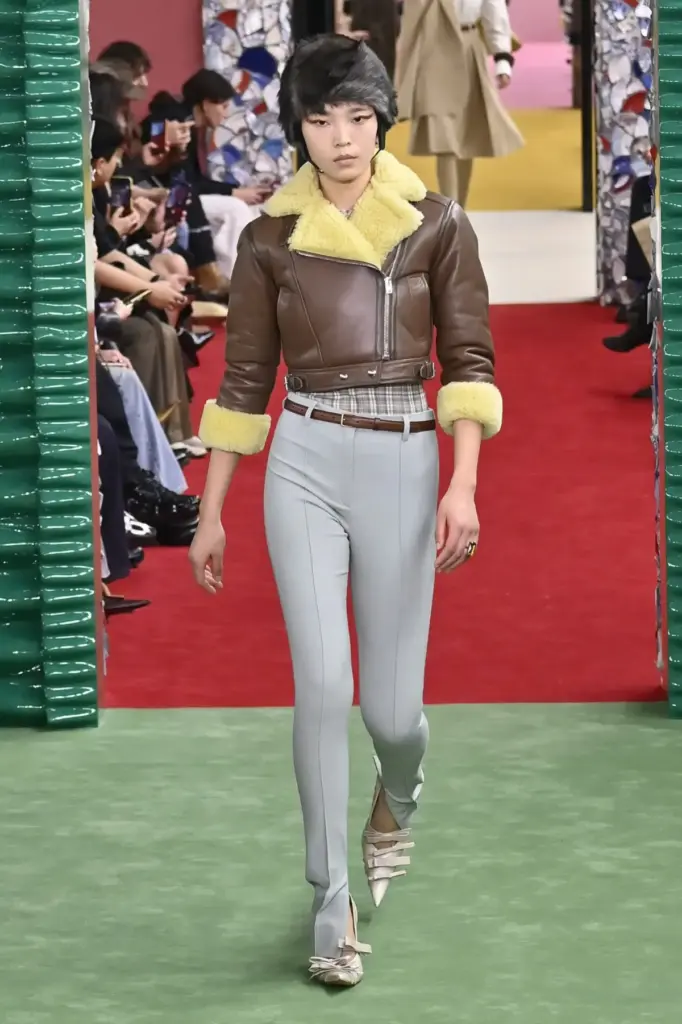
From the Y2K-coded denim revivals at 7 For All Mankind to the avant-garde stirrup leggings presented by Jil Sander, the message is clear: volume on the bottom is no longer mandatory. Acne Studios pushed this concept to its tactical limit with mini shearling-lined leather trousers, while houses like Balenciaga balanced the tight-fitting aesthetic on top and bottom with capacious, oversized outerwear. Whether leaning fully into the shrinkage or playing with proportion through contrasting volumes, the skinny pant has reclaimed its place in the modern wardrobe.
3. Color Blocking: The Art of Brash Juxtaposition
Fall color palettes have historically relied on muted earth tones, charcoal grays, and somber ivories. Fall/Winter 2026 shatters this monochromatic tradition through audacious, high-contrast color blocking. Designers have leaned into shades that, on paper, should violently clash, deriving their appeal precisely from their dissonance.
Marc Jacobs championed this movement with streamlined collections featuring solid-print skirts paired with sequined tops in completely contrasting hues. Similarly, Mugler utilized sickly, hyper-saturated color combinations to elevate its signature ’80s power-dressing silhouettes. The thrill of this trend lies in stretching the boundaries of traditional color theory, encouraging wearers to experiment with pairings that defy conventional styling rules.
4. Smart Layers: The Architecture of the 12-Hour Day
Modern lifestyles demand clothing that can effortlessly transition from morning meetings to late-night engagements. Enter the concept of "smart layers"—a masterclass in functional complexity. Prada’s runway—famously anchored by multiple appearances from Bella Hadid—set the gold standard for how to construct an outfit capable of surviving a 12-hour day.
Layering was executed with clinical precision across the board. Marni layered technical jackets over classic cardigans and crisp button-downs, while Michael Kors Collection reinterpreted the classic American prep uniform by stacking a blue oxford shirt beneath a crimson sweater and a tailored blazer. This trend encourages wearers to dismantle traditional layering hierarchies, mixing technical outerwear with tailoring and knitwear to create functional, multidimensional outfits.
5. The Evolution of the Pencil Skirt
The traditional, corporate-stiff pencil skirt has undergone a dramatic structural liberation. Initiated by Matthieu Blazy’s waist-dropping debut for Chanel in late 2025, the industry has fundamentally re-evaluated how a fitted skirt should hang on the body.
The Fall/Winter 2026 iterations are remarkably slinky, fluid, and daring. Saint Laurent introduced latex-and-lace hybrid pencil skirts complete with high front slits, while Chanel countered with swishy, lightweight chainmail versions. Marni opted for feather-light fabrications anchored by heavy-duty utilitarian belts. Whether styled as an ultra-seductive piece paired with a sheer bodysuit (à la Bella Hadid) or interpreted through a refined, ladylike lens, the modern pencil skirt is a far cry from its librarian ancestors.
6. Doubling Down on Plaids and Tartans
Plaid established itself as a formidable pattern during previous cold-weather cycles, but Fall/Winter 2026 demands a complete structural double-down on checks and tartans. Design houses have moved past traditional heritage interpretations, opting instead for exaggerated scales and off-kilter placements.
Celine showcased extra-large, commanding plaid prints, while Auralee subverted expectations with asymmetrical, Western-influenced plaid shirting. The secret to adopting this trend without looking costumey lies in scale manipulation and selective integration—pairing a bold plaid coat with minimalist black basics to let the pattern command the room.
7. Shearling and Shaggy Outerwear
Outerwear remains the ultimate canvas for winter investment, and for Fall/Winter 2026, texture reigns supreme. Shearling, faux fur, and shaggy statement coats are dominating the sartorial conversation.
While full-length, sumptuous fur coats from houses like Chanel represent the pinnacle of luxury splurging, designers have also introduced moderated takes on the trend. Saint Laurent and Gucci showcased coats featuring exaggerated furry collars—delivering high theatricality without the overwhelming bulk of a full fur silhouette. For those looking to field-test their outerwear in rustic, picturesque settings—such as a restorative getaway to Hyatt’s Bar N Ranch in Yellowstone—these pieces offer the ultimate blend of high fashion and tactile warmth.
Official Statements and Industry Perspectives
The commercial viability and cultural impact of the Fall/Winter 2026 collections have drawn widespread commentary from leading creative directors, retail analysts, and fashion editors.
Industry analysts note that consumer behavior has shifted definitively toward intentional, high-utility acquisitions. “We are witnessing a post-novelty marketplace,” notes one leading luxury retail strategist. “Consumers are no longer buying pieces purely for a fleeting social media moment. They are looking at the Fall/Winter 2026 runways and asking: How does this garment function within a multi-year rotation? The return of precision tailoring, smart layering, and durable outerwear reflects an economy of style built on longevity and deliberate contrast.”
Design houses have similarly emphasized the duality of protection and self-expression in their official collection notes. Speaking on the architectural construction of modern silhouettes, prominent design ateliers highlighted that the garments are engineered to empower the wearer. “Clothing should not merely decorate the body; it should alter your posture, dictate your pace through a room, and provide an armored sense of self,” shared a leading Parisian design house representative following the conclusion of Fashion Month. This philosophy underscores why trends like the second-skin skinny pant, the liberated pencil skirt, and the dramatic shearling collar have resonated so deeply—they are physical manifestations of confidence and control.
Future Outlook: The Long-Term Trajectory of Fall/Winter Fashion
As the retail landscape stabilizes heading into the final months of 2026 and anticipation builds for the upcoming spring cycles, the impact of these runway trends will undoubtedly extend far beyond the immediate cold-weather season.
The dichotomy established this season—balancing hyper-slim, second-skin tailoring with slouchy, unrestrained proportions—suggests that future collections will continue to explore the tension between structure and fluidity. Furthermore, the increasing reliance on digital resale ecosystems and secondary luxury markets indicates a permanent shift in how consumers acquire and circulate high-end fashion. The patient shopper who utilizes resale platforms to secure a coveted Auralee plaid shirt or a archival shearling coat is redefining the lifecycle of luxury garments.
Ultimately, Fall/Winter 2026 will be remembered as a season that demanded discernment. It proved that style is not born from blindly following a singular aesthetic, but from the intelligent collision of opposites: the slouch of a low-rise trouser paired with the precision of a smart layer; the dissonance of brash color blocking tempered by classic outerwear; and the fusion of heritage patterns with futuristic silhouettes. For the modern dresser, the blueprint is set—now it is time to make the trends your own.