Executive Overview
In the bustling metropolitan landscape of Berlin, a dynamic and mouth-watering fitness phenomenon is quietly taking over the weekend routine: the Pastry Run. Merging the cardiovascular demands of endurance sports with the indulgent, communal comfort of artisanal baking, this trend has swiftly transformed from a casual social media novelty into a thriving urban subculture. At its core, the concept is disarmingly simple: lace up your running shoes, complete a scenic urban route, and cross a bakery threshold as your ultimate finish line. Here, the sweat of exertion is immediately rewarded with the sugary glory of a freshly baked pastry and a velvety flat white.
Far from being a mere passing fad, the Pastry Run represents a profound shift in how urbanites approach wellness. It deconstructs the often solitary, punishing nature of distance running and infuses it with joy, community, and gastronomy. Fitness enthusiasts, casual joggers, and food lovers are no longer forced to choose between maintaining a healthy lifestyle and indulging their culinary passions; instead, the two worlds have harmoniously collided.
Nowhere is this cultural convergence more visible than in the German capital, where specialty coffee shops and artisan bakeries are bustling weekend hubs for sweaty athletes refueling after their morning miles. Dedicated running clubs now chart their routes specifically to terminate at legendary local bakeshops, turning the traditional post-run stretch into an inclusive coffee break.
To explore the depths of this movement, we examine a unique intersection of high-performance footwear and zero-waste vegan baking. Through an exclusive collaboration between the iconic athletic brand Nike and Berlin’s pioneering zero-waste vegan establishment, FREA Bakery, the Pastry Run has achieved a new milestone. By translating the technical specifications of a high-end running shoe—the Nike Invincible 3—into a bespoke, edible work of art, this partnership encapsulates the innovative spirit driving modern urban culture.
Detailed Chronology: From Grassroots Movement to High-Fashion Pastry
The rise of the Pastry Run did not happen overnight, nor was it masterminded by a corporate marketing board. Instead, it grew organically from the asphalt up, fueled by the collective exhaustion and appetite of urban runners seeking a better reason to wake up early on weekend mornings.
The Genesis of the Movement
In cities like Berlin, where running culture thrives alongside an uncompromising appreciation for specialty coffee and artisanal cuisine, the crossover was inevitable. Joggers returning from routes along the Landwehr Canal or through the expansive paths of the Tiergarten naturally gravitated toward neighborhood cafés to socialize. Over time, informal groups began organizing structured runs explicitly designed around culinary destinations.
These were not the hyper-competitive time-trial sessions of traditional track clubs. Rather, they were conversational, social runs where pace took a back seat to participation. The finish line became a democratic space: fast marathoners and slow joggers alike gathered around communal tables, bonded by shared physical effort and an appreciation for expertly laminated croissants, sourdough breads, and artisanal espresso drinks.
Entering the Zero-Waste Haven: FREA Bakery
As the trend gained mainstream traction, established culinary institutions began taking notice. Among them was FREA Bakery, nestled in the vibrant corridor between Torstraße and Invalidenstraße in Berlin-Mitte. Known widely as the world’s first fully vegan, zero-waste bakery, FREA operates on a closed-loop system where all organic waste is composted within 24 hours and returned to regional farms.
Jasmin, co-founder of FREA Bakery, admits that while the formal concept of a "Pastry Run" was initially new to her, the reality of catering to endurance athletes was already a familiar weekend rhythm. "Actually, after a marathon, we get a lot of runners coming straight to us," she notes.
With its bright, sprawling interior, high ceilings, and minimalist aesthetic, FREA proved to be the quintessential architectural finish line. Runners could map out a scenic route starting from the historic Mauerpark, cruise southward through the leafy avenues of Prenzlauer Berg, and coast to a gentle stop right at the bakery’s doorstep.
The Nike Invincible 3 Collaboration: Translating Tech to Taste
The convergence of fitness and gastronomy reached an artistic peak when FREA was approached with an unprecedented creative challenge: materialize the architectural and sensory qualities of a high-performance running shoe into an edible pastry.
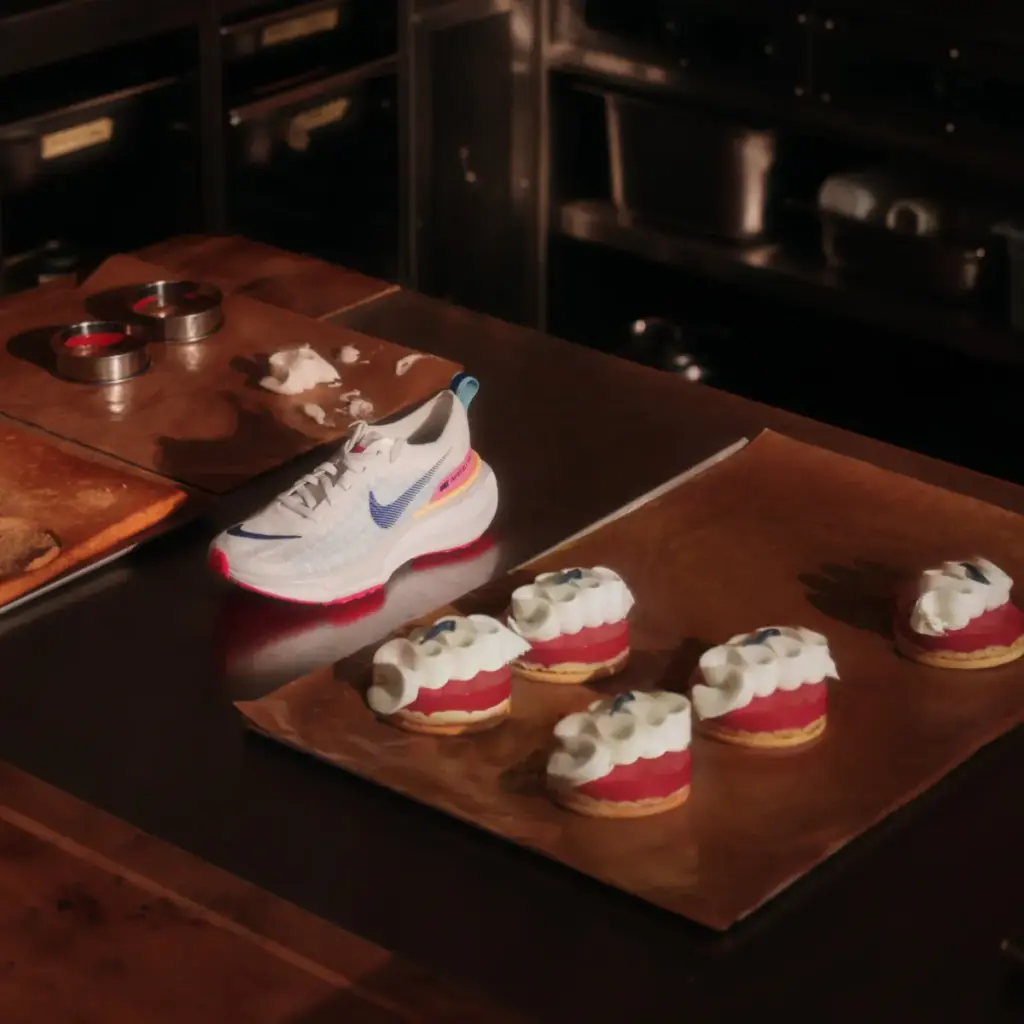
The muse for this culinary experiment was the Nike Invincible 3, a premier distance-running shoe celebrated for its maximalist cushioning, stability, and butter-soft footbed designed to deliver absolute comfort across varied terrains. When Jasmin first encountered the shoe, her imagination was immediately sparked, particularly by its distinctive white colorway accented with vibrant splashes of color.
"It’s a new type of challenge," Jasmin reflects. "That white colorway with vibrant color elements immediately activated my imagination. You look at it and you already think of pastry."
What followed was an intensive period of conceptualization, design, and culinary engineering. Head Pastry Chef Thomas took the structural blueprint of the shoe and translated it into the language of baking. Supported by Jasmin and the entire FREA team, Thomas embarked on a rigorous series of test kitchens designed to capture the exact tactile and gustatory profile of the footwear.
"The tasting was the most beautiful part!" Jasmin laughs, recalling the development phase. The core mission was clear: engineer a textural experience that mirrored the plush, responsive, and cloud-like ride of the Invincible 3. The result of this meticulous R&D process was an avant-garde creation: a delicate raspberry tart crafted from an airy sponge cake base, elevated with a featherlight white chocolate cream designed to melt effortlessly on the tongue.
Supporting Context & Metrics: The Intersection of Wellness and Gastronomy
To understand why the Pastry Run has captured the cultural zeitgeist so successfully, one must analyze the broader behavioral shifts occurring within urban demographics. Modern fitness culture is undergoing a radical decentralization. The rigid, gym-bound discipline of the 1990s and 2000s has given way to lifestyle-integrated movement, where physical activity is seamlessly woven into social and cultural rituals.
The Rise of Social Running Clubs
Over the past five years, the global running community has experienced a massive demographic shift. Traditional, highly structured athletic clubs are sharing space—and often losing members—to independent, lifestyle-oriented running collectives. These communities prioritize inclusivity, mental health, and post-run socialization over pace splits and personal records.
- Community-First Approach: Modern running groups often cap their paces at conversational speeds, ensuring that participants of all athletic abilities feel welcome.
- The Post-Run Ritual: Studies in consumer behavior indicate that micro-rewards significantly increase habit formation. By pairing exercise with an immediate, high-reward culinary treat, runners create a powerful positive reinforcement loop.
- Economic Impact on Local Businesses: Independent bakeries and specialty cafés that open their doors early to runners are seeing a significant surge in weekend morning revenue. In cities like Berlin, London, and New York, the intersection of run-clubs and coffee shops has spawned a lucrative micro-economy.
Sustainability and Mindful Indulgence
The collaboration between Nike and FREA Bakery also highlights a growing consumer demand for ecological consciousness within high-end lifestyle spaces. For decades, athletic brands faced criticism regarding their environmental footprints, while the baking industry grappled with food waste and supply chain transparency.
By partnering with a zero-waste pioneer like FREA, the initiative bridged the gap between high-performance athletic gear and sustainable gastronomy. The ingredients used in the limited-edition Nike pastry were locally sourced, plant-based, and aligned with a circular economic model—proving that treating oneself after a hard run does not have to come at the planet’s expense.
Official Statements & Insights
The fusion of athletic footwear design and artisanal pastry creation required a unique dialogue between diverse creative industries. Below, we examine the philosophical motivations driving this trend through key insights gathered from the minds behind the FREA Bakery initiative.
On the Creative Challenge of Shoe-to-Pastry Translation
When asked about the conceptual leap required to turn footwear into food, Jasmin emphasized the natural synergy between design, structure, and sensory pleasure:
"We wanted the taste to deliver the exact same soft feeling as a run with the Invincible 3. It’s about creating a new kind of challenge—taking something structural and engineering it into something delicious."
This sentiment underscores a broader trend in contemporary marketing and product design: experiential cross-pollination. Brands are no longer confined to their traditional silos. Footwear companies are entering the culinary space, and bakeries are embracing athletic subcultures, resulting in immersive consumer experiences that engage all five senses.
The Logistics of a Limited-Edition Drop
To celebrate the launch of the collaboration, FREA Bakery hosted an exclusive, limited-time activation over two consecutive weekends in late March (March 23–24 and March 30–31, 2024). Operating between 8:00 AM and 5:00 PM at their Gartenstraße location in Berlin-Mitte, the bakery offered the bespoke Nike-inspired raspberry and white chocolate tarts entirely free of charge.
The execution followed a strict streetwear-style drop model:
- Exclusivity: Quantities were strictly limited per day.
- Accessibility: The pastries were distributed on a first-come, first-served basis ("Wer zuerst mahlt, malt zuerst").
- Atmosphere: The bakery floor transformed into an unofficial clubhouse where runners, sneakerheads, and local foodies intermingled.
The massive turnout reaffirmed that consumers are hungry—both literally and figuratively—for creative, tactile experiences that bridge the digital and physical worlds.
Future Outlook: Where is the Pastry Run Headed?
As the dust settles on successful pop-up activations and urban runners continue to map out their weekend bakery routes, industry insiders are left asking: What is next for the Pastry Run phenomenon?
The Expansion of Culinary-Athletic Collaborations
Given the overwhelmingly positive reception of the FREA Bakery activation, it is clear that this is only the beginning. Jasmin herself has hinted at future possibilities, noting that the experience has permanently altered how her team views seasonal menu planning.
- Future Flavor Profiles: Future iterations of performance-inspired pastries could draw inspiration from different shoe models, terrain types, or weather conditions (e.g., stabilizing trail-running pastries versus lightweight marathon-speed tarts).
- Permanent Run-Club Menus: Several European cafés are already exploring the implementation of permanent "Runner’s Menus," offering specialized macro-balanced yet indulgent treats designed specifically for post-endurance recovery.
- Global Replication: While Berlin remains a vibrant epicentre for this subculture, metropolitan hubs in North America and Asia are rapidly adopting the Pastry Run model, tailoring it to their respective local bakery traditions.
Redefining the Finish Line
Ultimately, the longevity of the Pastry Run lies in its emotional resonance. In an increasingly digitalized and isolated world, people are craving tangible, real-world connections. They want to move their bodies, breathe fresh air, taste exceptional food, and share those moments face-to-face with friends old and new.
Whether you are a seasoned marathoner chasing a personal best or a casual jogger looking for an extra push to get off the couch, the promise of a golden, flaky pastry and a hot cup of coffee waiting at the end of the route changes the psychological calculus of exercise. Running is no longer a chore of self-punishment; it is an invitation to celebrate movement, community, and the simple, profound joy of good food.
As the movement continues to evolve, one thing remains certain: the finish line has never tasted so sweet.