Executive Overview
In an ideal marketplace, the intrinsic quality of a product should dictate its commercial viability. If developers invest years of grueling labor, creative vision, and technical engineering into crafting a top-tier video game, basic market logic suggests it should be rewarded with commensurate success. Yet, the history of the interactive entertainment industry is littered with tragic anomalies: critically acclaimed masterpieces that quietly tanked, innovative concepts that vanished into obscurity, and beloved franchises pushed to the brink of extinction—not because the games were bad, but because the people tasked with selling them fundamentally misunderstood how to do so.
Marketing can make or break an entertainment property. A mediocre game wrapped in immaculate, high-energy hype can shatter sales records, while a generational masterpiece hobbled by absent, misguided, or bizarrely offensive promotional campaigns can struggle to break even. Publishers like Electronic Arts, Activision, Square Enix, and Sony have repeatedly fallen into the trap of over-indexing on shock value, misrepresenting core gameplay loops to chase wider demographics, or burying high-potential projects under catastrophic release schedules.
This retrospective explores the video games that suffered from some of the worst, most bizarre, or entirely absent marketing schemes in industry history, evaluating how these blunders impacted sales, shaped public perception, and, in some rare cases, how these titles managed to achieve cult status in spite of their corporate handlers.
Detailed Chronology: A History of Promotional Missteps
1. The Legend of Zelda: Ocarina of Time (1998)
Regarded universally as one of the greatest and most structurally influential video games ever created, Nintendo’s The Legend of Zelda: Ocarina of Time for the Nintendo 64 has a nearly spotless legacy. Nearly spotless, that is, except for a profoundly ill-conceived marketing campaign deployed in the United Kingdom.
In an effort to shake off Nintendo’s strictly family-friendly image and appeal to older demographics, a UK print and television advertisement asked prospective buyers an aggressively exclusionary question: "Willst thou get the girl? Or play like one?"

The campaign relied on casual, institutionalized sexism, leaning into the archaic stereotype that video games were an exclusive boys’ club. Even for the late 1990s, the tagline felt regressive and antagonistic. While localized protests and complaints failed to pull the ad, it thankfully remained isolated to the UK market and did nothing to stunt Ocarina of Time’s legendary commercial run. Today, it stands as an embarrassing curio from an era when marketing teams thought casual misogyny was the key to selling high fantasy.
2. Burnout 2 and Shadow Man 2 (2002–2003): Acclaim’s Descent into Madness
If there is a hall of fame for disastrous video game marketing, bankrupt publisher Acclaim occupies an entire wing. During the early 2000s, Acclaim’s UK division launched a series of stunts so legally questionable and tone-deaf that they pushed the company straight toward insolvency.
To promote the arcade racing sequel Burnout 2, Acclaim offered to directly pay for the speeding tickets of any motorist who could prove they received one while driving under the influence of the game’s adrenaline-fueled energy. Unsurprisingly, the UK government and safety advocacy groups were furious, accusing the publisher of actively incentivizing reckless driving. Burnout 2 was a brilliant arcade racer, but the stunt overshadowed the game’s stellar design, and Acclaim collapsed into bankruptcy two years later.
Things were even worse for Shadow Man 2 (officially titled Shadow Man: 2econd Coming). In what Acclaim aggressively branded as "deadvertising," the publisher approached cash-strapped families offering financial subsidies for funeral costs in exchange for placing promotional stickers and billboards for Shadow Man 2 directly onto the tombstones of their recently deceased loved ones. Billed as a way to "help poorer families give their loved one a good send-off," the stunt crossed ethical boundaries so severely that public backlash was immediate and absolute. Unsurprisingly, nobody took Acclaim up on the offer, and the game’s sales cratered, proving definitively that there is such a thing as bad publicity.
3. God of War 2 (2007): The Headless Goat Debacle
Before Sony’s God of War franchise pivoted to exploring the quiet, melancholic complexities of fatherhood and Kratos’s struggles with generational trauma, the series was entirely built on hyper-violence, Greek mythology, and an unhinged, amoral protagonist who screamed his way through the pantheon.

As part of the 2000s zeitgeist where publishers competed to see who could be the most "edgy," Sony Computer Entertainment Europe crossed a major line during a media event for God of War 2. To give journalists a taste of ancient Greek brutality, Sony invited the press to a launch party where attendees were encouraged to reach inside the headless, warm carcass of a real, slaughtered goat and rip out its internal organs to eat.
While Sony later clarified that the goat’s insides were filled with standard, edible Greek food, the use of a real animal corpse sparked widespread outrage among animal rights organizations and mainstream media outlets. Sony was forced to issue a formal, groveling apology. The stunt was symptomatic of a wider disconnect between Sony’s regional divisions at the time, as Sony Europe—possessing far more autonomy then—frequently deprioritized marketing for titles born in America, contributing to the original God of War’s slow start overseas.
4. Dead Space 2 and Dante’s Inferno (2009–2011): EA’s Era of Shock Value
Electronic Arts during the Xbox 360 and PlayStation 3 generation had a compulsive habit of leaning into manufactured controversy. Two titles in particular bore the brunt of this misguided strategy: Dante’s Inferno and Dead Space 2.
For Dante’s Inferno—an action-platformer heavily inspired by God of War and The Divine Comedy—EA orchestrated a fake public protest outside the Electronic Entertainment Expo (E3). Actors hired by EA marched outside the convention center holding signs condemning the game for its sacrilegious depiction of hell, attempting to trick the media into believing real religious zealots were offended. When the stunt was exposed as a fabricated PR stunt, the internet rolled its eyes, and the game went on to underperform commercially, killing plans for a sequel.
Shortly after, EA targeted mothers with the infamous "Your Mum Hates Dead Space 2" campaign. Focus groups of middle-aged mothers were recorded being genuinely horrified and traumatized by footage of Necromorph dismemberment, which EA then packaged into promotional spots to make the sci-fi horror sequel look cool and rebellious to teenagers. Instead of generating smart grassroots hype, the campaign felt desperate, juvenile, and exploitative. Despite being an atmospheric masterpiece, Dead Space 2 missed EA’s lofty internal sales expectations, leading the publisher to label the project a commercial failure.

5. Titanfall 2 (2016): A Masterclass in Corporate Sabotage
Few games in first-person shooter history have suffered a more tragic commercial fate than Respawn Entertainment’s Titanfall 2. Featuring a campaign narrative that ranks among the finest in the genre’s history—paired with deeply satisfying, fluid movement mechanics and tightly balanced multiplayer—the game was an unmitigated critical triumph.
Yet, EA systematically sabotaged its release. First, the marketing campaign failed to adequately communicate that the sequel included a robust, narrative-driven single-player campaign, leaving many consumers to assume it was a pure multiplayer continuation of the first game.
Worse still was the release window. EA bafflingly chose to launch Titanfall 2 mere weeks after its own massive powerhouse, Battlefield 1, and right alongside Activision’s juggernaut Call of Duty: Infinite Warfare. Squeezed between two of the biggest sci-fi and military shooter franchises on earth, Titanfall 2 was starved of oxygen at launch, leading to dismal initial sales that robbed Respawn of the immediate commercial rewards their brilliant work deserved.
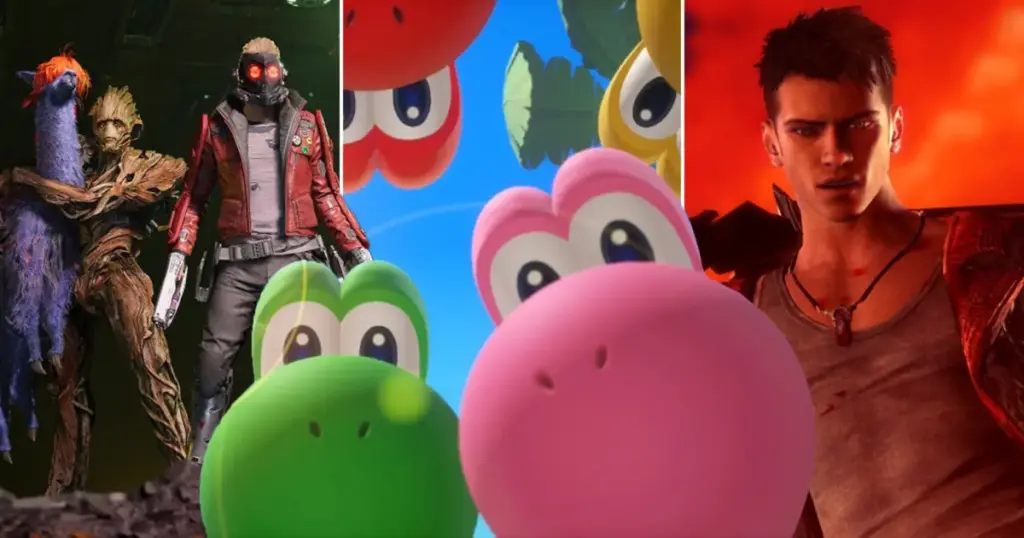
6. Marvel’s Guardians of the Galaxy (2021): Misrepresenting a Hidden Gem
When Square Enix announced a single-player Guardians of the Galaxy video game, consumer enthusiasm was hovering near absolute zero. Fresh off the back of Crystal Dynamics’ bloated, critically lukewarm live-service misfire Marvel’s Avengers, the gaming public had zero appetite for another corporate superhero cash-grab.
Square Enix’s marketing department did the game zero favors. Trailers leaned heavily into 1980s pop-music needle drops and Star-Lord wisecracks, presenting the project as a desperate, cheap imitation of the Marvel Cinematic Universe films. Worse still, the lack of cooperative multiplayer—in a game featuring a team of cosmic outcasts—baffled fans.

When the game finally launched courtesy of Eidos-Montréal, it was an absolute revelation. Beneath the marketing veneer lay a deeply heartfelt, emotionally resonant story about grief, coupled with brilliantly frantic tactical combat. Unfortunately, the damage was already done. Branded a commercial flop by Square Enix, the game became a convenient scapegoat for the publisher’s broader financial anxieties, ultimately playing a role in Square Enix selling off its entire Western development arm.
7. Yoshi and the Mysterious Book (2026): Nintendo’s Silent Treatment
Even Nintendo—a company legendary for its airtight, infallible product positioning—is not immune to marketing blunders. When Yoshi and the Mysterious Book was revealed for the Nintendo Switch 2, early trailers presented it as a standard, overly simplistic platformer aimed squarely at small children, offering little justification for early adopters to invest in new hardware.
Nintendo severely undersold the title. In practice, Yoshi and the Mysterious Book featured intricate, toy-box levels filled with ingenious puzzle-solving mechanics and tactile physics that easily rivaled the studio’s best work. Yet, Nintendo’s marketing completely ignored these sophisticated design pillars. Stranger still, Nintendo broke with corporate tradition by refusing to publish any official sales figures for the game. Despite launching shortly after Yoshi enjoyed a major cinematic spotlight in the Super Mario Galaxy movie adaptation, the game is widely believed to have missed the million-sales mark—a tragedy for one of the finest titles of its release year.
Supporting Context & Metrics
To understand why publishers continue to mismanage product marketing, one must look at the shifting economics of AAA video game development. As budgets have ballooned from tens of millions to upwards of $300 million per title, the margin for error has vanished.
| Game Title | Publisher / Developer | Marketing Misstep | Commercial Outcome |
|---|---|---|---|
| Burnout 2 | Acclaim | Offered to pay real-world speeding tickets | Acute controversy; publisher bankrupted within two years |
| Shadow Man 2 | Acclaim | Placed ads on real human tombstones ("deadvertising") | Widespread public disgust; failed to save studio from closure |
| God of War 2 | Sony / SCEE | Staged press event featuring a dead goat’s carcass | Severe animal rights backlash; corporate apologies |
| Dead Space 2 | EA | Used horrified mothers in shock-value ad campaigns | Labeled a commercial failure despite critical acclaim |
| Titanfall 2 | EA / Respawn | Launched directly between Battlefield 1 and Call of Duty | Undersold heavily at launch; required years of word-of-mouth |
| Guardians of the Galaxy | Square Enix / Eidos | Misrepresented as a generic MCU movie clone | Deemed a financial flop; triggered Western studio sell-off |
| Yoshi and the Mysterious Book | Nintendo | Framed as a simplistic kids’ game; zero sales disclosures | Missed major commercial milestones despite rave reviews |
When financial stakes are this high, marketing departments often panic. Rather than trusting the core creative vision of a game—such as Titanfall 2’s peerless gunplay or Guardians of the Galaxy’s emotional depth—executives frequently default to lowest-common-denominator strategies: shock value, demographic over-correction, or safe, anonymous corporate homogenization.

Official Statements & Industry Fallout
The repercussions of these marketing disasters have radically reshaped the gaming landscape over the past two decades. Acclaim’s reckless stunts stand as a permanent cautionary tale regarding the limits of edgy PR. In a 2002 interview regarding the Shadow Man 2 tombstone controversy, an Acclaim spokesperson defended the strategy as a natural extension of the game’s gothic themes, telling The Guardian that the subsidy program would "particularly interest poorer families, acting as a burial cost subsidy to give their loved one a good send-off." The public reaction was so overwhelmingly toxic that it effectively codified the boundary line for ethical video game advertising.
Similarly, EA’s aggressive pivot toward shock marketing during the Xbox 360 era ultimately forced internal structural evaluations. Reflecting on the commercial underperformance of Dead Space 2, former developers noted that spending upwards of $60 million on development while relying on juvenile, confrontational PR campaigns alienated core demographics without capturing the broader casual market EA so desperately craved.
On the developer side, the fallout has often been fatal. Eidos-Montréal poured their collective hearts into Marvel’s Guardians of the Galaxy, only to watch Square Enix publicly pin the company’s fiscal shortcomings on the title’s perceived failure. This miscalculation directly fueled Square Enix’s disastrous pivot toward blockchain investments and the subsequent sell-off of iconic Western studios like Crystal Dynamics and Eidos-Montréal to Embracer Group.
Future Outlook
As the video game industry marches deeper into the current hardware generation, the lessons of past marketing disasters remain painfully relevant. With development cycles stretching to 5 or 6 years per title, publishers can no longer afford to treat marketing as an afterthought or a vehicle for cheap, offensive shock value.
Consumers are increasingly savvy, utilizing digital spaces, independent reviews, and word-of-mouth networks to bypass traditional advertising noise entirely. When a publisher misrepresents a game—whether by dressing it up as a generic live-service clone like Guardians of the Galaxy, burying it beneath competing monoliths like Titanfall 2, or failing to showcase its actual mechanical depth like Nintendo did with Yoshi and the Mysterious Book—audiences notice.

The era of selling video games through dead goats, graveyard billboards, and casual sexism is thankfully behind us. Yet, the challenge remains for modern publishers: learning to trust the creative integrity of the developers they employ, and crafting marketing campaigns that celebrate a game’s true strengths rather than hiding them behind a smokescreen of manufactured hype. Until that lesson is permanently learned, brilliant games will continue to fight an uphill battle against the very people paid to champion them.