Executive Overview
The intersection of political satire, international diplomacy, and broadcast television has long been a volatile testing ground for cultural norms. In its recent Season 2 premiere, Saturday Night Live U.K.—hosted by veteran American actor Jeff Goldblum—dove headfirst into this geopolitical and social fray, delivering a biting opening episode that quickly reverberated across transatlantic media channels.
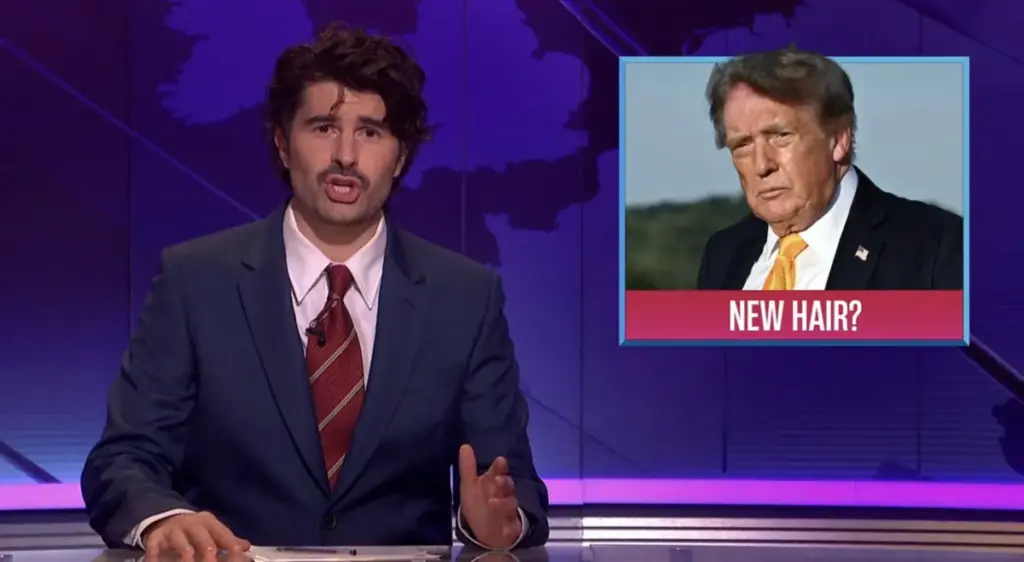
At the forefront of the program’s signature "Weekend Update" segment was a relentless barrage of comedic targets. Most notably, U.S. President Donald Trump became the focal point of mockery following a noticeable shift in his personal appearance upon disembarking from Air Force One. Co-anchors Ania Magliano and Paddy Young steered the segment with a distinctively British comedic sensibility, blending absurdist visual observations with sharp political commentary.
However, the program’s ambitions extended far beyond the traditional realms of American presidential ribbing. The episode strategically pivoted toward sensitive domestic British issues, tackling the elite traditions of the British monarchy, the pressures and controversies surrounding elite educational institutions such as Eton College, and the volatile landscape of far-right anti-migrant demonstrations. By taking aim at figures like far-right activist Danny Tommo and the Patriot Platform group, Saturday Night Live U.K. demonstrated an appetite for punching upward and outward, testing the legal boundaries of what late-night television can—and should—address in an era of heightened political sensitivities.
This comprehensive report examines the cultural, political, and media ramifications of the season premiere. Through a detailed chronology of the broadcast, contextual analyses of the socio-political touchstones referenced on air, and an evaluation of the delicate dance between broadcast compliance and provocative humor, this article explores how Saturday Night Live U.K. is carving out a unique space in the contemporary comedy landscape.
Detailed Chronology of the Broadcast
The Season 2 premiere of Saturday Night Live U.K. opened with traditional fanfare, anchored by guest host Jeff Goldblum, whose idiosyncratic charm set an unpredictable tone for the evening. Yet, it was during the program’s second half—specifically the "Weekend Update" desk—that the broadcast transformed from standard sketch comedy into a lightning rod for cultural discourse.
The segment commenced with co-anchor Ania Magliano addressing international headlines, swiftly directing her attention toward Washington and, more specifically, the aesthetic choices of the U.S. President. Describing Trump’s arrival after stepping off Air Force One, Magliano remarked on a perceived deviation from his characteristic golden-blonde coiffure.
"This week, President Trump stepped off Air Force One sporting a different hair color," Magliano quipped to the studio audience, before delivering a punchline that immediately circulated across social media platforms: "He appears to be trialling a new shade of brown. Or, he’s shat his head."
The comedic baton was then passed to co-anchor Paddy Young, who leaned into classic late-night double entendres while simultaneously breaking the fourth wall regarding network censorship. "People are questioning, does the carpet still match the drapes?" Young queried. He then paused, pivoting to acknowledge the unseen guardians of broadcast compliance: "I wouldn’t know, that’s between the president and the punchline that just a second ago was taken from me by our legal team. Thank you, legal team, it was almost funny." Whether this exchange was a scripted meta-joke or an unscripted acknowledgment of last-minute legal redactions remains a point of discussion among television analysts, highlighting the tightrope walk producers must perform when broadcasting content targeting high-profile international figures.
Moving from global superpowers to domestic British institutions, the segment sharply shifted tone. Prince George’s entry into Eton College—one of the United Kingdom’s most storied and exclusive boarding schools—prompted a dark historical observation from Magliano. Referencing the institution’s complex legacy, Magliano remarked, "How will he survive being stuck in a place famous for producing sexual abusers? By leaving it and going to Eton College," eliciting audible gasps and murmurs from the live studio audience.
The broadcast then turned its lens toward the contentious issue of civil unrest and far-right mobilization within the U.K. The anchors targeted recent anti-migrant demonstrations, specifically focusing on activist Danny Tommo and his associated group, Patriot Platform.
"On Saturday, members of Tommo’s group Patriot Platform yelled obscenities, threw stones, spat and then said goodbye to their families and headed to the protest," Magliano joked, juxtaposing domestic family life with the aggressive nature of street-level extremism.
Expanding on the critique, Young dissected Tommo’s personal and professional background. "Who is this Danny Tommo?" Young responded rhetorically. "Before launching Patriot Platform he is reported to have tried his luck as both a bricklayer and a web designer. However, neither worked out as he had the physique of a web designer and a mind of a brick."
With these rapid-fire segments, the premiere established an aggressive comedic baseline for Season 2, signaling to viewers that no topic—regardless of its political gravity or potential for controversy—was off-limits.
Supporting Context & Metrics
To fully understand the cultural weight of the Saturday Night Live U.K. premiere, one must examine the socio-political climate in which the program operates. Late-night satire in the United Kingdom occupies a historically distinct space compared to its American counterpart. While U.S. late-night shows like Saturday Night Live or The Daily Show operate under federal protections such as the First Amendment, British broadcasting is governed by stringent regulatory frameworks enforced by Ofcom (the Office of Communications). These regulations mandate standards regarding fairness, privacy, and the prevention of hate speech, making the execution of provocative political comedy an exercise in calculated legal navigation.
The Transatlantic Comedy Divide
The mocking of American political figures on British television is a long-standing tradition, yet applying the raw, unfiltered satirical style of U.S. late-night television to British domestic politics requires structural adaptation. Donald Trump has been a frequent muse for comedians globally; however, visualizing his physical presentation—particularly his hair—remains an evergreen trope. The psychological impact of such public mockery on international relations is negligible, but it underscores the globalized nature of modern political identity, where a leader’s aesthetic is as much a subject of international diplomacy as trade policies.
Domestic Flashpoints: Eton and Far-Right Extremism
By invoking Eton College, the writers tapped into deep-seated British class resentments. Eton has historically educated a disproportionate number of British prime ministers, nobility, and cultural elites. However, in recent years, elite educational institutions have faced intense public scrutiny regarding institutional safety, historical oversight, and systemic power imbalances. Magliano’s joke, while relying on dark humor, struck a chord regarding public skepticism toward elite privilege and accountability.
Simultaneously, the targeting of far-right figures like Danny Tommo reflects an increasing appetite among younger British comedians to confront nationalist and anti-migrant rhetoric directly. Recent years have seen a surge in street protests across the U.K. organized by various factions under the banner of anti-immigration advocacy. By reducing these ideological movements to personal satire—critiquing both their public behavior and the personal histories of their organizers—the program sought to deflate the perceived gravity of extremist movements through ridicule.
Media Metrics and Digital Spillovers
In the digital age, late-night television is rarely consumed solely via traditional linear broadcasting. The success of a segment is increasingly measured by its velocity across digital ecosystems such as TikTok, X (formerly Twitter), and YouTube. Within hours of the broadcast, clips featuring the critique of Trump’s hair, the joke regarding Eton College, and the dismantling of Danny Tommo’s background had amassed millions of impressions. This digital-first consumption model encourages producers to craft bite-sized, highly shareable moments that can transcend the domestic British audience and capture global attention.
Official Statements and Industry Reactions
As of the publication of this report, representatives for Donald Trump have not issued a formal statement regarding the remarks made on the program. Historically, the former U.S. President and his communications team have frequently dismissed late-night satirical commentary as "failing" or "biased," choosing to address media slights via personal social media channels rather than through formal diplomatic or legal channels.
Similarly, representatives for Eton College have declined to comment on the program’s satirical characterization of the institution. Educational bodies typically maintain a policy of non-engagement with entertainment media to avoid amplifying controversial jokes or inadvertently drawing further attention to satirical critiques.
Within the British broadcasting sector, media analysts and television critics have offered mixed reviews regarding the tone and execution of the season premiere. Writing in major cultural publications, some critics lauded the show for its willingness to address complex socio-political fractures without softening its edges. Others, however, questioned whether deploying dark humor in the context of institutional abuse and civil unrest risks trivializing matters of genuine societal harm.
A spokesperson for the production company behind Saturday Night Live U.K. declined to comment on specific interactions with the legal department referenced during the broadcast, maintaining that the creative process operates with the full editorial and legal oversight necessary to comply with U.K. broadcasting codes while preserving creative autonomy.
Future Outlook
The trajectory of Saturday Night Live U.K. Season 2 will be closely monitored by television executives, political commentators, and legal experts alike. As the political landscapes in both the United Kingdom and the United States continue to experience profound polarization, satirical programs face an increasingly narrow path: they must remain relevant and daring enough to capture the public imagination while avoiding regulatory sanctions or costly legal disputes.
Looking ahead, several key themes are expected to dominate the remainder of the season:
- Escalating Political Cycles: With upcoming electoral milestones and shifting geopolitical alliances, international political figures will likely remain prime targets for satirical commentary. How the show balances its critique of foreign leaders versus domestic politicians will shape its political identity.
- Regulatory Scrutiny: As the program pushes boundaries—particularly concerning sensitive domestic topics such as institutional conduct and social unrest—Ofcom guidelines will serve as an invisible boundary marker. Producers must continuously weigh the comedic payoff against the risk of formal viewer complaints and regulatory investigations.
- The Digital Adaptation: The economic viability of late-night television increasingly depends on viral metrics. Future episodes are expected to be engineered with digital fragmentation in mind, ensuring that individual segments can easily be packaged for social media distribution.
Ultimately, the Season 2 premiere of Saturday Night Live U.K. has proven that political satire in the United Kingdom is willing to embrace a sharper, more confrontational ethos. Whether this bold approach will solidify the show’s status as a vital cultural touchstone or invite continuous controversy remains one of the most compelling narratives in contemporary television.