Executive Overview
In the hyper-connected, perpetually online ecosystem of modern social media, few phenomena are as thoroughly documented or as ruthlessly executed as the public roasting of high-profile figures. On a platform once known purely as Twitter—and now operating under the monolithic branding of X—billionaire owner Elon Musk found himself on the receiving end of one of the most viral corporate "ratios" in recent internet history.
The instigator was none other than the official social media team behind Ubisoft’s marquee franchise, Assassin’s Creed. What began as a routine online culture-war skirmish involving partisan video game criticism rapidly escalated into a wider public reckoning concerning authenticity, algorithmic visibility, corporate branding, and the fragile nature of online clout.
The incident underscores a broader sociological phenomenon within digital subcultures: the intersection of billionaire vanity, gaming authenticity, and platform ownership. Musk, an avid gamer who frequently leverages his massive digital footprint to comment on industry trends, found his gaming bona fides publicly dismantled. The Assassin’s Creed account brilliantly weaponized Musk’s own recent controversies—specifically his widely scrutinized Path of Exile 2 "boosted account" scandal—to completely neutralize his critique of progressive Twitch streamer Hasan Piker.
Generating over 400,000 likes overnight, the blistering response not only ignited a firestorm of memes and public amusement but also served as a stark reminder of the unpredictable dynamics at play when corporate entities engage directly in the trenches of internet discourse. This report provides a comprehensive, investigative breakdown of the events leading up to the ratio, the contextual history of Musk’s gaming controversies, the public reaction, and the long-term implications for corporate brand management on user-generated platforms.
Detailed Chronology: From Twitch Sponsorships to a Billion-Dollar Ratio
To understand how a major video game franchise came to publicly mock the owner of X on his own platform, one must trace the timeline of escalating tensions that preceded the viral post.
The Catalyst: Grummz, Assassin’s Creed Shadows, and Hasan Piker
The entire sequence of events was set into motion by the contentious discourse surrounding Ubisoft’s upcoming release, Assassin’s Creed Shadows. The game has been a frequent lightning rod for internet culture-war debates. The flashpoint arrived when notorious video game commentator and critic "Grummz" publicly lambasted the Ubisoft marketing team. His grievance? The decision to sponsor prominent, left-leaning Twitch streamer Hasan Piker to play and showcase the title.
Grummz framed the corporate sponsorship as an out-of-touch attempt to artificially manufacture hype using politically polarizing figures. Predictably, this sentiment resonated deeply within certain conservative and anti-establishment gaming circles, quickly drawing the attention of platform heavyweights.
Elon Musk Enters the Fray
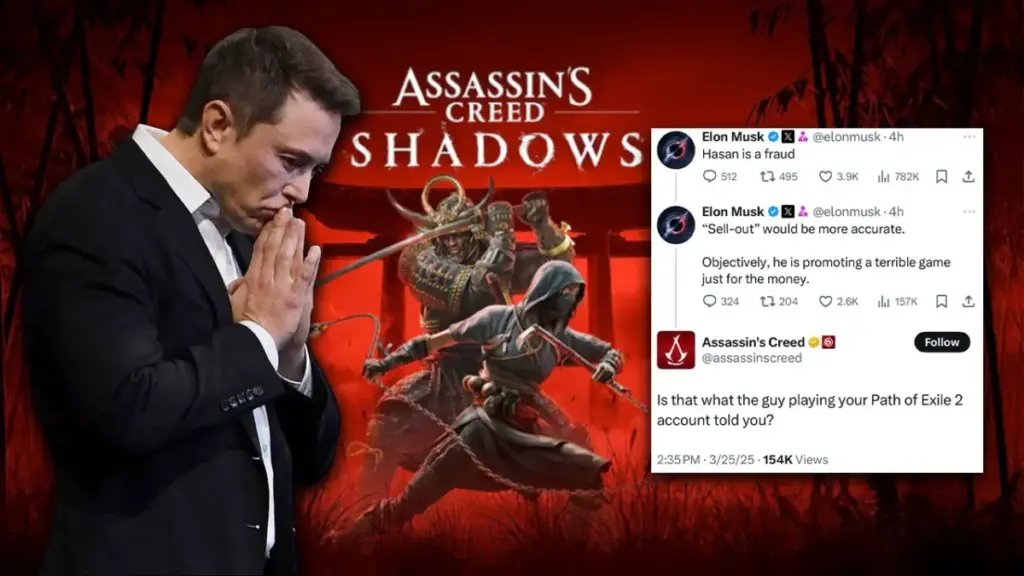
Always eager to weigh in on trending internet culture wars, Elon Musk waded into the commentary thread. Directing his ire at Piker, Musk didn’t mince words. He publicly labeled the left-wing streamer a "fraud" and a "sell-out," accusing him of promoting a "terrible game just for the money."
Coming from the world’s wealthiest individual and the proprietor of the very platform hosting the debate, the critique was designed to carry heavy cultural weight, painting Piker’s promotional efforts as disingenuous and purely mercenary.
The Strike: @AssassinsCreed Drops the Mic
However, Musk severely underestimated the preparedness of corporate social media handlers. The official, verified X account for Assassin’s Creed (@AssassinsCreed) immediately recognized an open goal and capitalized on it with surgical precision.
Instead of addressing the policy or politics of influencer marketing, the social media manager opted for an ad hominem counter-attack that targeted Musk’s own heavily documented insecurities regarding his gaming competence. Quoting Musk’s inflammatory post, the Assassin’s Creed account delivered the killer blow:
"Is that what the guy playing your Path of Exile 2 account told you?"
The response was an instantaneous masterclass in internet warfare. It bypassed traditional corporate PR speak and tapped directly into a recent, highly embarrassing piece of digital lore that had already made Musk the butt of jokes across rival gaming communities.
Supporting Context & Metrics: The Anatomy of a PR Disaster
The staggering success of the Assassin’s Creed tweet—accruing hundreds of thousands of engagements within a matter of hours—was not a fluke. It relied heavily on pre-existing public knowledge of Musk’s digital habits, specifically the Path of Exile 2 debacle that had unfolded weeks prior.

The Path of Exile 2 Fraud Gamer Controversy
For those chronically online observers tracking the intersection of billionaires and video games, Musk’s credibility had already taken a massive hit earlier in the year. Musk had taken to livestreaming his playthrough of Grinding Gear Games’ critically acclaimed action RPG, Path of Exile 2. Flaunting a high-rank character, Musk attempted to project the image of a hardcore, deeply dedicated gamer who had mastered the grueling mechanics of the title through sheer personal grit and skill.
However, the internet—and specifically veterans of the Path of Exile community—has an unforgiving memory and analytical precision. Eagle-eyed players began dissecting his livestreams, pointing out glaring inconsistencies:
- Abysmal Gameplay Mechanics: Musk was observed blundering across maps, making amateur positioning errors, and demonstrating an operational understanding of the game that completely contradicted the high-tier status of his character.
- Geographical Data Anomalies: Publicly available game telemetry and server data revealed that the account was routinely being accessed and played from Asia, or via VPNs routing through Asian servers.
- The Admission: Cornered by irrefutable proof, Musk eventually broke character and admitted to "account boosting," unashamedly writing on X, "It’s impossible to beat the players in Asia if you don’t, as they do!"
This revelation transformed Musk into a running joke within the hardcore gaming sphere. He was branded a "fraud gamer"—someone attempting to buy prestige and bypass the sweat equity required to achieve genuine mastery.
The Hasan Piker Collateral and Digital Crossfire
Simultaneously, the feud expanded horizontally. Hasan Piker, catching wind of Musk’s "sell-out" accusations, engaged in a digital tennis match mediated by Grummz’s quote-tweets. Piker openly challenged the tech billionaire to a live duel in FromSoftware’s notoriously punishing action-RPG Elden Ring—a challenge that would have required Musk to put his actual, unboosted gaming skills on display.
Musk largely deflected the direct challenge, instead accusing Piker of being "chicken-s***" for allegedly blocking him on the platform. Yet, while the Musk-Piker slapfight generated plenty of digital noise, it was entirely overshadowed by the corporate execution delivered by Ubisoft’s social media division.
Official Statements and Public Reaction
The immediate aftermath of the corporate ratio triggered a tidal wave of memes, psychological analysis of platform ownership, and shifts in consumer sentiment.
The Internet Reacts: "I Was Unfamiliar With Your Game"
Internet subcultures responded with near-universal delight at seeing a corporate entity successfully humble a tech titan on his own infrastructure. Memes flooded the timeline, utilizing classic internet tropes to express awe at the sheer audacity of the Assassin’s Creed social media manager.
- The Apology Meme: Countless users posted variations of the famous meme format, "I owe you an apology; I wasn’t really familiar with your game," signaling a sudden, ironic respect for Ubisoft’s marketing division—a company that frequently faces its own waves of online criticism.
- Direct Consumer Conversion: Demonstrating the tangible, albeit chaotic, nature of viral marketing, some users shifted their purchasing intentions purely out of respect for the roast. X user @soundaholism publicly declared that the burn had inspired them to pre-order Assassin’s Creed Shadows at full price rather than waiting for a discount, tweeting that they were directly motivated by the sheer satisfaction of seeing Musk "cooked."
- The Irony of Platform Ownership: A recurring motif among commentators was the sheer poetic irony of the situation. Users flooded the replies pointing out the financial realities of Musk’s tenure: "Imagine spending $44 billion just to get utterly cooked by a French video game publisher on your own servers."
Corporate Brand Strategy in the Age of Shitposting
From a public relations perspective, the incident highlights a fundamental shift in how legacy entertainment brands interact with user bases. Rather than maintaining a sterile, corporate distance, modern social media managers are increasingly empowered to lean into internet vernacular, meme culture, and aggressive banter.
Ubisoft’s calculated risk paid off exponentially. By bypassing standard defensive protocols and launching a direct, humorous ad hominem attack rooted in community lore, the Assassin’s Creed account temporarily transformed public animosity toward their upcoming game into overwhelming digital goodwill and free, organic viral marketing.
Future Outlook: The Fragility of Digital Clout
As the dust settles on what many are dubbing one of the greatest ratios of 2025, the long-term ramifications of this digital altercation point to several emerging trends in media, gaming, and platform governance.
1. The Weaponization of Consumer Lore
Corporate accounts have learned that modern consumers do not respond to corporate press releases; they respond to cultural fluency. By weaponizing niche gaming lore—specifically the Path of Exile 2 boosting scandal—the Assassin’s Creed brand proved that corporate entities can successfully integrate themselves into internet counter-culture if they possess the cultural capital to back it up. We can expect other brands to adopt increasingly aggressive, memetic social media strategies, blurring the lines between consumer and corporate voices.
2. The Limits of Billionaire Pulpit Power
Elon Musk’s ability to direct cultural narratives via sheer algorithmic dominance faces diminishing returns when colliding with specialized, highly defensive subcultures like the global gaming community. While Musk retains immense influence over macroeconomic and political discourse on X, his attempts to police gaming authenticity will continue to serve as open invitations for community pushback. When technical proficiency and authenticity are demanded, financial clout and platform ownership offer no immunity against being exposed as a casual.
3. The Ongoing Saga of Assassin’s Creed Shadows
Ultimately, the viral success of the ratio provides Ubisoft with a much-needed morale and marketing boost ahead of Assassin’s Creed Shadows. While culture-war debates surrounding the title will undoubtedly persist, the marketing team successfully hijacked the news cycle, proving that in the digital colosseum, a well-timed, culturally literate burn is worth millions in traditional advertising.
As the digital landscape continues to evolve, the lesson of the great Assassin’s Creed ratio remains clear: on the internet, no one is too big to be cooked—not even the man who owns the stove.