Executive Overview
While the broader fitness industry continues to chase technological novelty—infusing cardio equipment with interactive displays, smart-connecting indoor bikes, and deploying app-driven cable units—the foundational movements of raw strength training have historically remained stubbornly traditional. Squats, deadlifts, and overhead presses have relied on the same basic apparatus for decades: the barbell, the rack, and gravity.
However, a quiet revolution has taken place in the engineering of lower-body machinery. Manufacturers across the globe have introduced pendulum squats—specialized apparatuses designed to maximize mechanical tension on the quadriceps while deliberately sparing the lower back from the axial loading inherent in free-weight barbell squats.
Among these offerings, Swedish equipment manufacturer Gymleco has delivered a standout iteration. Engineered with uncompromising Nordic minimalism, heavy-gauge steel, and an intuitive mechanical arc, the Gymleco Pendulum Squat is built to feel equally at home in high-end elite performance facilities, hardcore bodybuilding dungeons, and meticulously curated home gyms.

Yet, introducing a specialized piece of commercial-grade machinery into any space—particularly one with a price tag hovering around $3,800—demands rigorous evaluation. This review provides an exhaustive investigation into the mechanics, usability, performance metrics, and long-term utility of the Gymleco Pendulum Squat, drawing on field insights from strength conditioning professionals and biomechanical analysis.
Detailed Chronology: The Journey from Concept to Commercial Gyms and Home Setups
The trajectory of the pendulum squat reflects a broader industry shift toward joint-friendly, high-stimulus training modalities. For decades, lifters seeking deep quad development without the spinal compression of back squats were largely restricted to traditional 45-degree leg presses or Smith machine variations. While effective, the standard leg press often locks the user into a fixed linear track that can exacerbate hip impingement or lower-back rounding at the bottom of the movement, while Smith machines suffer from unnatural vertical resistance vectors.
The Rise of the Pendulum Architecture
The engineering breakthrough of the pendulum mechanism lies in its pivoting arm. Rather than forcing the body along a straight vertical or diagonal line, the machine dictates that the user and the weight load travel along an arc. This mimics the natural rotational movement of the human hip and knee joints during a squat.

Recognizing a gap in the market for a robust, streamlined, and commercially durable version of this architecture, Gymleco entered the fray. Known historically for designing durable, no-nonsense commercial gym equipment with compact footprints, the Swedish manufacturer set out to eliminate the cluttered adjustment pins, overly complex linkages, and mechanical friction points that plagued early iterations of pendulum machines from competitors.
From Elite Facilities to the Garage Gym
Initially adopted by elite performance centers, professional sports franchises, and hardcore bodybuilding facilities, the appeal of the pendulum squat quickly transcended commercial walls. As the home gym market experienced an unprecedented boom—accelerated by shifting fitness habits and a growing demographic of dedicated lifters investing in commercial-grade gear for personal use—manufacturers began adapting these massive commercial units for residential spaces.
Gymleco’s approach to this transition was unique: rather than stripping down the machine to save manufacturing costs, they maintained the exact commercial-grade integrity of their gym units, shipping them fully assembled on welded steel pallets. This ensured that whether the apparatus was installed in a downtown Manhattan performance clinic or a suburban two-car garage, the mechanical performance remained uncompromised. Over recent months, fitness professionals and their clients have transitioned from viewing the machine as an unfamiliar novelty to recognizing it as an indispensable staple for lower-body hypertrophy.

Supporting Context & Metrics: Decoding the Biomechanics
To fully understand why the Gymleco Pendulum Squat commands such high praise—and why it requires a significant recalibration of a lifter’s expectations—one must examine the physics governing the movement.
Squat vs. Leg Press vs. Pendulum Squat
A traditional barbell back squat requires axial loading, meaning the weight is supported directly across the trapezius and spine. This demands immense stabilization from the core, erector spinae, and upper back, often making the lower back the limiting factor in leg development.
The leg press removes the spine from the equation by placing the load on a sled pushed by the legs, but it frequently compromises hip mobility and places excessive shear stress on the knees depending on foot placement.

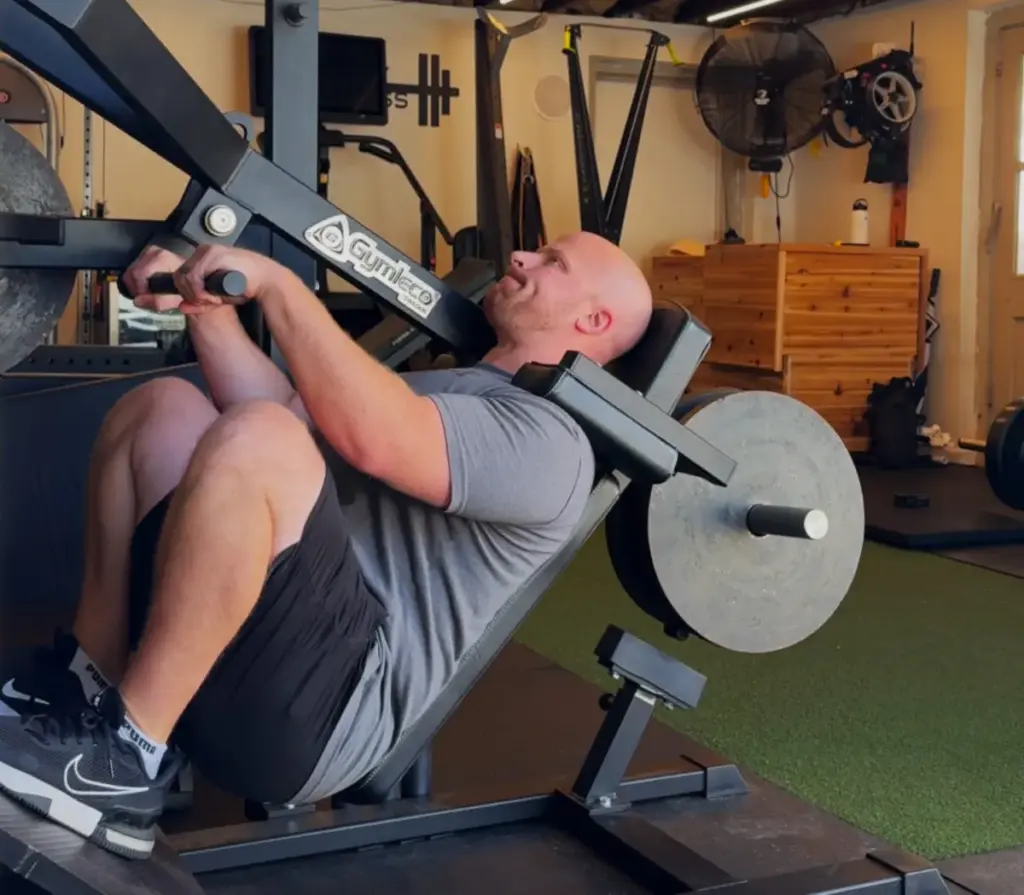
The pendulum squat bridges this gap. By securing the user’s shoulders beneath dense pads and pressing the back firmly against an angled backrest, axial spinal loading is virtually eliminated. However, unlike a standard leg press, the user’s torso maintains an upright, squat-like posture relative to the moving platform, and the pivoting arm creates an arced descent.
The Weight Calibration Phenomenon
One of the most common user errors observed by strength coaches is the "ego load." When first stepping onto a pendulum squat, lifters routinely attempt to load the weight horns with the exact tonnage they would use on a traditional 45-degree leg press or barbell squat.
This is an immediate miscalculation. Because of the mechanical advantage provided by the pivoting lever arm and the specific resistance profile, users only require a fraction of their normal working weight to achieve extreme muscular tension and high-intensity fatigue. A weight that feels manageable on the first three repetitions can rapidly induce profound quadriceps failure by the eighth or ninth rep due to the continuous tension curve and the deepened knee flexion permitted by the arced track.

Specifications and Spatial Footprint
- Apparatus Type: Lever-based Pendulum Squat
- Primary Target Muscle Groups: Quadriceps (vastus lateralis, vastus medialis, rectus femoris), Gluteus Maximus, Hamstrings (as stabilizers)
- Estimated Retail Price: ~$3,800 (excluding freight/shipping costs based on location)
- Delivery Method: Ships fully welded and pre-assembled on a commercial pallet
- Build Quality: Heavy-gauge Swedish steel, commercial-grade upholstery, high-density padding
Official Guidelines: Step-by-Step Execution and Coaching Tips
Mastering the Gymleco Pendulum Squat requires strict adherence to setup protocols to ensure maximum efficacy and joint safety. Because the machine operates on a fixed arc, subtle adjustments in foot placement can dramatically alter the muscular emphasis of the movement.
Step 1: Entering and Positioning
- Step into the center of the machine’s carriage, ensuring ample room to maneuver.
- Position your shoulders firmly beneath the padded yokes, pressing your back flat against the upholstered backrest.
- Step forward onto the heavy-duty diamond-plate foot platform.
Coaching Tip: Foot placement dictates muscle recruitment. For general quad dominance, position your feet shoulder-width apart with your toes sitting just shy of the bolt imprint on the platform. Adjust slightly higher or lower based on individual height and femur length to ensure deep knee flexion without excessive ankle strain.
Step 2: Unracking the Weight
- Prior to loading heavy plates, perform a deliberate calf raise or upward push against the shoulder pads to elevate the carriage slightly.
- Reach forward and disengage the primary safety lockout arm.
- Lower the safety handle completely out of the path of descent.
Step 3: Executing the Repetition
- Brace your core tightly, maintaining full contact between your lumbar spine and the back pad.
- Inhale and smoothly descend along the arced track, dropping into as deep of a squat as your hip mobility comfortably allows. The smooth curve of the pendulum naturally guides you into a deeper hole than a standard linear hack squat might permit.
- At the bottom of the movement, drive forcefully through your midfoot and heels against the platform, exhaling as you extend your knees and hips back to the starting position.
Future Outlook: The Role of Specialized Machinery in Modern Training
As the fitness landscape continues to evolve, the pendulum squat represents a broader philosophical shift in strength training: the prioritization of target-specific mechanical loading over archaic dogma. For decades, fitness culture treated the barbell back squat as an unavoidable rite of passage, regardless of an individual’s structural limitations, previous injuries, or spinal health.

Today, the democratization of high-end commercial equipment for home gyms and private training studios signals a more nuanced, longevity-focused approach to hypertrophy and athletic performance. Machines like the Gymleco Pendulum Squat prove that lifters no longer have to sacrifice their lower backs to achieve world-class lower-body development.
Looking ahead, we can expect manufacturers to continue refining these biomechanical hybrids. While smart technology and digital resistance will continue to dominate certain sectors of the fitness market, the enduring demand for heavy, durable, friction-engineered steel apparatuses highlights a fundamental truth: when it comes to building raw human strength and muscle mass, precision engineering remains unmatched. For the dedicated home gym owner or elite facility director willing to invest the space and capital, the pendulum squat has firmly cemented its status as the gold standard of leg day evolution.