Executive Overview
Physical coordination is often taken for granted until it fails. Whether it is stumbling on an uneven pavement, struggling to catch a flying object, or failing a simple cognitive-motor challenge like patting your head while rubbing your stomach, poor coordination can manifest as both an everyday nuisance and a significant barrier to athletic performance. While clumsiness is frequently dismissed as an unchangeable personality trait or genetic misfortune, contemporary physical therapy and neuro-motor science reveal a different reality. Coordination is a skill, much like playing an instrument or speaking a foreign language; it is a dynamic capacity that can be systematically trained, reinforced, and dramatically improved at any stage of life.
The human body’s capacity to execute smooth, purposeful, and efficient movements is the result of an intricate, lightning-fast biological symphony. This system relies on continuous, flawless communication between the central nervous system, the brain, visual inputs, vestibular systems in the inner ears, proprioceptive sensors embedded within muscles and joints, and the musculoskeletal framework itself. When a breakdown occurs within this complex multi-system network—whether due to neurological processing delays, physical deconditioning, or transient physiological stressors like sleep deprivation and dehydration—movement becomes uncalibrated and clumsy.
To bridge the gap between neurological intent and physical execution, experts advocate for targeted movement protocols that reinforce the brain-body connection. Dr. Gabriela Van Sickle, a renowned physical therapist, certified functional manual therapist, and co-founder of Functional Physical Therapy, emphasizes that targeted neuro-muscular exercises can rewire these pathways. By integrating four foundational movements—the dead bug, the bear crawl, the standing toe tap, and the standing knee drive—individuals can systematically challenge their motor control, enhance cross-body communication, and build a resilient, highly coordinated physical framework.
Detailed Chronology: The Evolution of Neuro-Motor Understanding
To appreciate modern approaches to physical coordination, it is essential to understand how scientific and medical communities have historically viewed the relationship between the brain and movement.
Early Observations and the Cartesian Divide
For centuries, medical philosophy separated the mind from the body, viewing the physical form as a mere mechanical vessel operated by a non-physical consciousness. Early anatomical studies focused heavily on isolated muscle groups and skeletal structures, largely ignoring the complex neural infrastructure required to make those muscles move in a harmonious sequence. Clumsiness was broadly attributed to "bad humors," innate nervous constitutions, or spiritual lack of balance, leaving little room for remedial physical intervention.
The Rise of Neurological Mapping (Mid-20th Century)
As neurology advanced through the mid-20th century, scientists began mapping the motor cortex and identifying how specific regions of the brain correspond to bodily movements. Researchers discovered that the brain does not merely send blunt "move" signals to individual muscles; rather, it orchestrates complex, multi-joint movement patterns. This era marked the birth of modern motor control theory, which recognized that learning a physical skill involves structural changes in the brain—a concept we now understand as neuroplasticity.
The Functional Movement Revolution (21st Century)
In recent decades, physical therapy shifted away from purely isolated, single-joint rehabilitation toward integrated, functional movement paradigms. Clinicians and researchers like Dr. Gabriela Van Sickle recognized that true physical capability relies on how well different body segments communicate during dynamic, multi-planar tasks. Rather than prescribing exercises that target muscles in isolation, modern sports science prioritizes movements that challenge the entire kinetic chain, emphasizing cross-body integration, core stability, and vestibular-ocular coordination. Today, training coordination is no longer viewed as the exclusive domain of elite athletes; it is recognized as a fundamental pillar of lifelong functional health, longevity, and injury prevention.
Supporting Context & Metrics: The Anatomy of Movement and Dysfunction
Understanding why coordination fails requires a detailed look at the biological infrastructure that governs human motion. Movement is not a localized event; it is a systemic collaboration involving multiple sensory and motor pathways.
The Multi-System Symphony of Coordination
According to Dr. Van Sickle, coordination relies on the seamless communication of several distinct biological systems:
- The Central Nervous System (CNS): The command center comprising the brain and spinal cord, responsible for planning, initiating, and overseeing all motor output.
- The Visual System: Provides spatial awareness, depth perception, and environmental tracking, allowing the body to adjust its positioning relative to surrounding objects.
- The Vestibular System: Located within the inner ears, this system continuously monitors head position, spatial orientation, and balance against gravitational forces.
- Proprioceptors: Specialized sensory receptors located in muscles, tendons, and joints that relay constant data to the brain regarding muscle length, tension, and joint angles (the body’s internal GPS).
- The Musculoskeletal System: The effector organs—bones, joints, and skeletal muscles—that execute the physical actions commanded by the CNS.
When these systems operate in harmony, movements appear fluid, effortless, and precise. However, because so many independent variables contribute to the process, the margin for error is substantial.
External and Internal Disruptors
Coordination is exceptionally sensitive to transient physiological fluctuations. Research in sports medicine and kinesiology indicates that even minor disruptions can degrade reaction time and motor control:
- Sleep Deprivation: Lack of restorative sleep impairs cognitive processing speed, slows neural transmission, and diminishes prefrontal cortex function, directly impacting fine and gross motor coordination.
- Dehydration: Fluid loss alters electrolyte balance, reducing the efficiency of electrical signaling across nerve and muscle cells, which can manifest as muscle cramping, tremors, and sluggish reflexes.
- Acute and Chronic Stress: Elevated cortisol and adrenaline trigger a "fight or flight" response, narrowing sensory awareness, increasing muscle tension, and disrupting the delicate timing required for complex motor tasks.
Quantitative Metrics of Motor Improvement
While subjective feelings of clumsiness are common, physical therapists utilize standardized metrics to evaluate and track improvements in coordination:
- Reaction Time Testing: Measuring the milliseconds elapsed between a visual or auditory stimulus and a physical response.
- Single-Leg Balance Duration: Quantifying the seconds an individual can maintain stable posture on one limb with eyes open versus eyes closed.
- Cross-Body Synchronization Scores: Assessing error rates during reciprocal movement patterns (e.g., marching or crawling tests) over timed intervals.
Clinical data demonstrates that consistent, targeted neuro-motor training can yield measurable improvements in these metrics within as little as four to six weeks, highlighting the remarkable adaptability of the human nervous system.
Official Statements and Expert Insights
To gain deeper professional insight into the mechanics of coordination and the practical application of corrective exercises, we turn to the expertise of Dr. Gabriela Van Sickle.
Deconstructing the Brain-Body Connection
"Coordination relies on communication between the brain, nervous system, eyes, inner ears, sensory receptors in the muscles and joints and the muscles themselves," explains Dr. Van Sickle. This intricate network is why physical awkwardness is so common. "When so many systems contribute to the process, there are many opportunities for malfunction. Even factors such as stress, lack of sleep and dehydration can negatively affect coordination and reaction time."
Despite these challenges, Dr. Van Sickle offers an encouraging perspective on human adaptability: "Thankfully, coordination—like any attribute—is something that you can work on and improve."
The Prescription for Neuro-Motor Health
To help individuals bridge the gap between cognitive intent and physical execution, Dr. Van Sickle outlines four essential exercises designed to reinforce the brain-body connection. Each movement has been selected for its unique ability to challenge cross-body synchronization, core stability, and spatial awareness.
1. The Dead Bug
- Prescription: 2-3 sets | 8-10 repetitions per side | 30-60 seconds rest between sets.
- Execution & Purpose: "This exercise challenges coordination between the upper body and lower body while strengthening the core," says Dr. Van Sickle. "It requires the brain to control multiple body segments moving in opposite directions while maintaining trunk stability, necessary for walking and stair climbing."
- Progression: As the movement becomes more natural and core strength improves, practitioners can increase the total number of repetitions per set.
2. The Bear Crawl
- Prescription: 2-3 sets | 20-30 seconds duration | 45-60 seconds rest between sets.
- Execution & Purpose: "Bear crawls challenge whole-body coordination by requiring the arms, legs, core and nervous system to work together," notes Dr. Van Sickle. "They involve cross-body movement patterns—right arm with left leg and vice versa—which help improve timing, body awareness, balance and motor control."
- Progression: Practitioners can scale the challenge by progressively increasing the duration of continuous crawling.
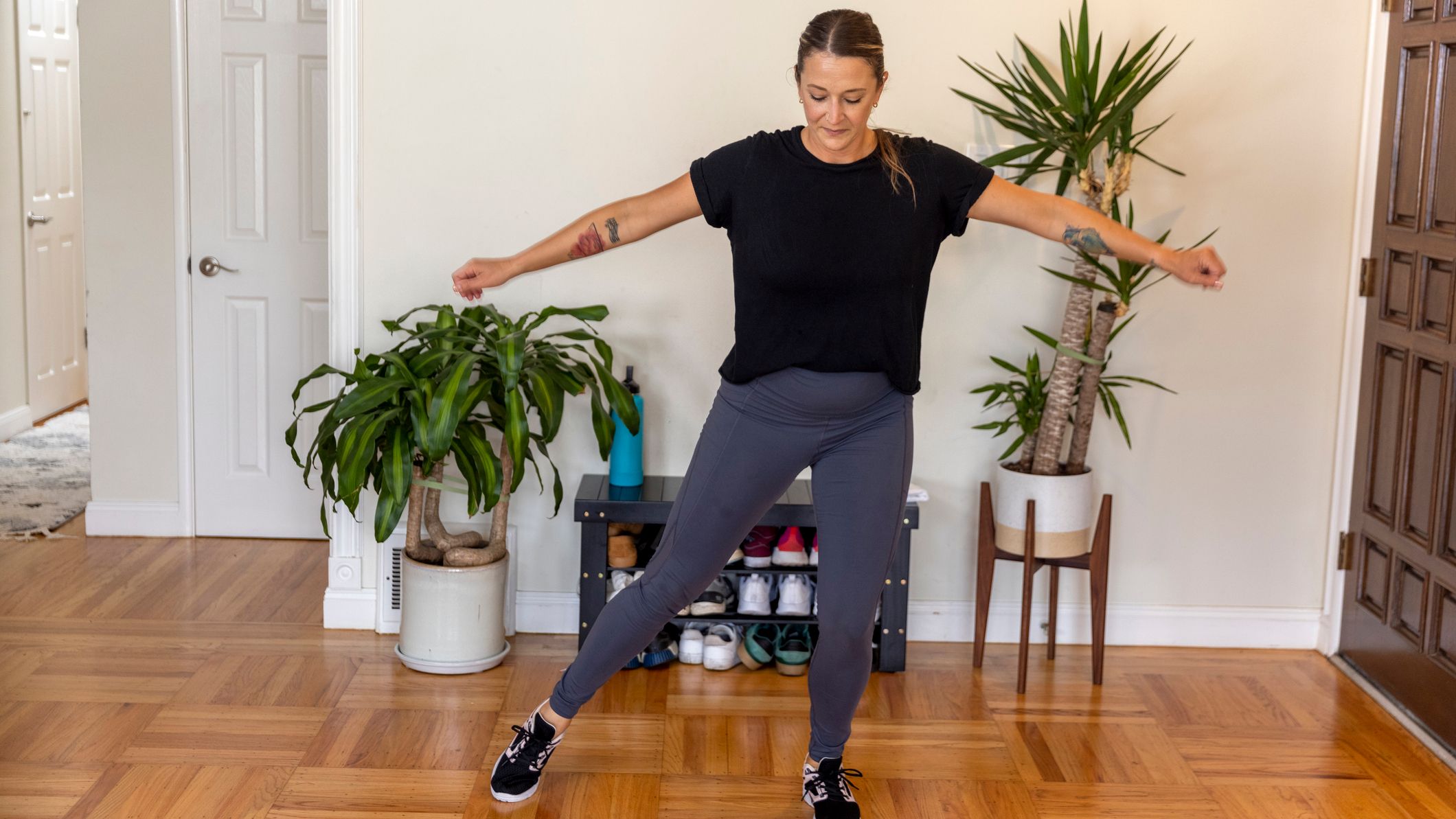
3. The Standing Toe Tap
- Prescription: 2 sets | 10 repetitions per side | 30-60 seconds rest between sets.
- Execution & Purpose: "This exercise combines balance and coordination by challenging you to maintain stability on one leg while reaching across your body," explains Dr. Van Sickle. "Crossing the midline requires communication between both sides of the brain and helps improve body awareness, motor control and coordination during everyday activities and sports."
- Progression: To advance, practitioners can imagine standing in the center of a clock face and tap their moving foot across all numbers, including those positioned behind the standing leg.
4. The Standing Knee Drive
- Prescription: 2-3 sets | 8-10 repetitions per side | 45-60 seconds rest between sets.
- Execution & Purpose: "This exercise combines balance, core stability and cross-body coordination," says Dr. Van Sickle. "Lifting one knee while reaching with the opposite arm mimics the natural movement pattern used during walking and running. It challenges the brain and body to coordinate movements across multiple joints while maintaining postural control."
- Progression: Rather than adding speed, practitioners should focus on slow, highly controlled execution to maximize neural adaptation.
Future Outlook: The Next Frontier in Neuro-Motor Training
As sports science, neurology, and physical therapy continue to converge, the future of coordination training promises to be increasingly sophisticated and personalized.
Technological Integration and Virtual Reality
The integration of digital health technologies is transforming how clinicians diagnose and treat coordination deficits. Virtual reality (VR) and augmented reality (AR) platforms are emerging as powerful tools in physical therapy, allowing practitioners to place patients in immersive, highly controlled environments that challenge visual-vestibular processing and reaction times in real-time. By gamifying neuro-motor rehabilitation, these technologies enhance patient engagement and accelerate neural rewiring.
Lifelong Neuroplasticity and Healthy Aging
One of the most profound realizations in modern neuroscience is that neuroplasticity—the brain’s ability to reorganize itself by forming new neural connections—persists throughout the human lifespan. While aging naturally introduces declines in vestibular function, visual acuity, and muscle mass, targeted coordination training acts as a powerful neuroprotective agent. Future public health initiatives are expected to place greater emphasis on multi-planar, cross-body movement routines for older adults, framing coordination training not merely as a tool for athletic enhancement, but as a critical strategy for fall prevention, cognitive preservation, and independent living.
Conclusion: Empowering the Physical Self
Clumsiness and poor physical coordination are not immutable life sentences. By understanding the complex, multi-system symphony that governs human movement and actively engaging with targeted neuro-motor exercises like those prescribed by Dr. Gabriela Van Sickle, anyone can train their brain-body connection. Through consistent practice, mindful pacing, and a commitment to challenging cross-body movement patterns, individuals can transform awkwardness into agility, unlocking a higher level of physical confidence, functional health, and lifelong vitality.