Executive Overview
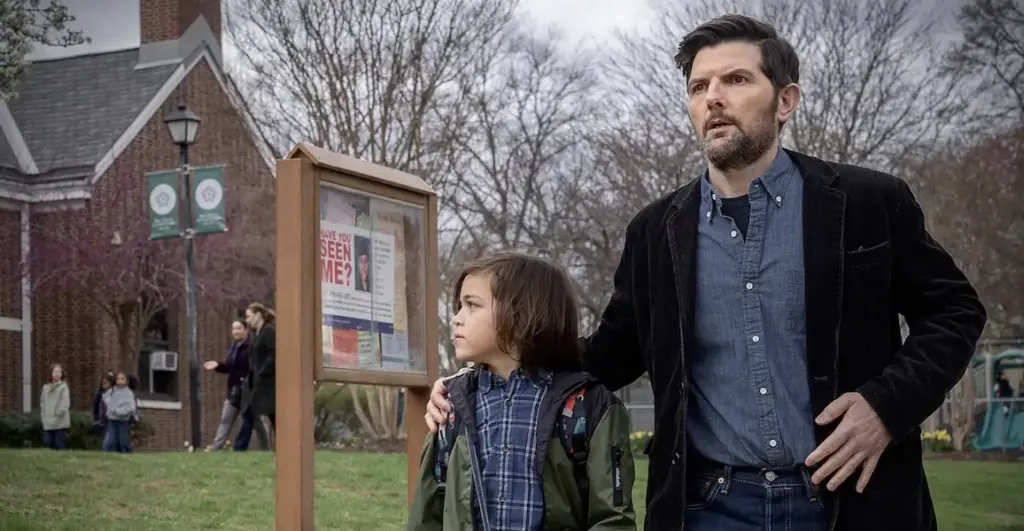
Netflix’s grim, atmospheric psychological thriller The Whisper Man has gripped global audiences since its weekend premiere on August 31, 2026. Directed by New Zealand filmmaker James Ashcroft and adapted from Alex North’s 2019 bestselling crime novel of the same name, the feature film plunges viewers into a perpetually overcast, bleak cinematic landscape. The narrative follows Tom Kennedy (Adam Scott), a grieving crime novelist whose life collapses when his young son, Jake (Acston Luca Porto), is abducted under circumstances chillingly reminiscent of a dormant murder spree. To rescue his son, Tom is forced into an uneasy alliance with his estranged father, Pete (Robert De Niro), a retired detective who once locked away the original perpetrator.
Central to the film’s suffocating, claustrophobic tone is its distinct visual palette, heavily reliant on a gritty, lived-in physical geography. Rather than relying on soundstages and digital green screens, director James Ashcroft and his production team turned to the state of New Jersey. Across Union, Bergen, Passaic, Hudson, Essex, Middlesex, and Somerset counties, the production transformed real-world architectural anomalies, century-old residences, abandoned industrial quarries, and historic correctional facilities into the fictional, ominous New Jersey town of Garretton.
This comprehensive report details the granular filming locations, logistical challenges, production metrics, and creative rationales behind the Garden State’s transformation into one of 2026’s most talked-about cinematic backdrops.
Detailed Chronology: Mapping the Production Across the Garden State
The physical realization of The Whisper Man required an aggressive, multifaceted regional shoot that spanned numerous municipalities and counties throughout New Jersey. Capturing the authentic, weathered decay demanded a logistical strategy that kept the crew constantly on the move.
1. The Kennedy Residence: Plainfield’s Century-Old Museum Piece
The emotional and structural core of the film centers on the creaking, historic home that Tom Kennedy and his son Jake move into—a residence intended to represent a fresh start, which instead becomes a trap laden with ghosts. For this critical anchor point, location scouts scoured Central New Jersey before securing a sprawling, century-old property in Plainfield.
According to James Ashcroft, the location felt less like a standard film set and more like an archaeological dig.
“Tom’s house—that, in particular, was like a museum,” Ashcroft remarked in an interview with Decider. “The house was well over 100 years old, and had its own history and idiosyncrasy. So it felt like another character. The owner had a very, very rich history.”
While reports from industry publication NJBIZ confirm that the Plainfield property was utilized for both expansive exterior establishing shots and core interior sequences, certain specialized environments required controlled studio environments. Notably, the movie’s tense, shadowy basement scenes—vital to the psychological unraveling of the plot—were constructed on custom-built soundstages to allow for precise lighting and camera choreography.
2. Pete’s Refuge: Scotch Plains
In stark contrast to Tom’s sprawling, chaotic new home, the residence of Tom’s retired-cop father, Pete (Robert De Niro), required a tighter, more utilitarian aesthetic. Production selected a residential property in Scotch Plains, a quiet suburban township in North Central New Jersey. The location provided the necessary visual shorthand for an aging, isolated law enforcement officer living in self-imposed exile from his family and community.
3. Reunions and Reminiscing: Westwood Diner
The narrative turning point where an emotionally exhausted Tom first confronts his estranged father is grounded in a quintessential Americana institution: the roadside diner. To film this tense, dialogue-heavy reunion, the production unit set up camp at the Westwood Diner Pancake House in Westwood, Bergen County. The location’s classic neon-and-vinyl aesthetic offered a stark, public contrast to the private familial trauma unfolding between the characters.
4. Behind Bars: Rahway Prison and Hudson County Corrections
A significant plot thread hinges on the characters visiting the incarcerated serial killer Frank Carter (portrayed by Michael Keaton). In the universe of The Whisper Man, the facility is referred to as "Rahway Prison," an explicit nod to the historic, colloquial name of the real-world East Jersey State Prison in Woodbridge Township, New Jersey.
Production utilized the imposing, historic exterior architecture of the Woodbridge facility to establish the formidable scale of the maximum-security prison. However, interior sequences required modern operational facilities. For these scenes, the crew shifted operations to the Hudson County Corrections and Rehabilitation Center in Kearny, New Jersey, providing a secure, authentic backdrop for the high-stakes psychological chess matches between the investigators and the captive killer.
5. Institutional Backdrops: Westfield and Montclair
Supporting story arcs required community infrastructure that felt weathered and lived-in. For Jake Kennedy’s elementary school, production utilized Wilson Elementary School located in Westfield, New Jersey.
Meanwhile, the fictional Garretton police station—where the frantic search for the missing boy is coordinated—was brought to life inside a repurposed institutional building: the former United Way headquarters in Montclair, which currently houses the nonprofit organization Family Promise of Essex County.
6. Natural and Industrial Landscapes: Houdaille Quarry and Branch Brook Park
To cement the bleak, gray tone demanded by the script, Ashcroft utilized dramatic natural and industrial geography across the state. Key sequences were captured amid the brutalist, jagged rock faces of the Houdaille Quarry in Springfield, New Jersey. These stark, barren landscapes underscored the cold, isolating dread of the manhunt. Conversely, sequences requiring haunting, autumnal foliage and sprawling open-air dread utilized the winding pathways and historic stone bridges of Branch Brook Park in Newark.
Supporting Context & Metrics: The Logistics of a New Jersey Shoot
Filming a sprawling crime thriller across multiple disparate counties is an exercise in immense logistical coordination. For director James Ashcroft, stepping into the American Northeast for the first time presented a distinct cultural and operational learning curve.
- First-Time Directing in the Garden State: Ashcroft, a native of New Zealand whose prior directorial efforts leaned heavily into raw, visceral tension, noted that the sheer pace of a multi-location state shoot was demanding. “I really loved getting to know New Jersey as a state. Logistically, some days it could be quite a tough ask, because we really were jumping all around the place in New Jersey,” Ashcroft admitted.
- The County Footprint: Production footprints extended far beyond primary metropolitan zones. Official regional reporting indicates active filming jurisdictions spanning seven distinct New Jersey counties:
- Union County
- Bergen County
- Passaic County
- Hudson County
- Essex County
- Middlesex County
- Somerset County
- Economic and Industrial Integration: The production benefited heavily from New Jersey’s robust film tax credit program, which has increasingly incentivized major studios like Netflix to bypass traditional studio hubs like Los Angeles and Atlanta in favor of the Northeast’s diverse architectural topography. By blending centuries-old residential Victorians, modern correctional architecture, rugged industrial quarries, and municipal structures, The Whisper Man achieved a geographic realism that artificial set-building struggles to replicate.
Official Statements and Creative Vision
The creative choices behind The Whisper Man were driven by a desire to strip away glossy Hollywood artifice in favor of genuine grit. Adapting Alex North’s complex, trauma-laden narrative required an environment that felt oppressive, cold, and inescapable.
Director James Ashcroft emphasized that the physical architecture chosen for the film was treated as active cast members rather than passive backdrops. Speaking on the century-old Plainfield house, Ashcroft noted:
"The house was well over 100 years old, and had its own history and idiosyncrasy. So it felt like another character. The owner had a very, very rich history, and that energy bled directly into the walls of our production."
Cinematographically, the choice to lean into New Jersey’s natural overcast weather patterns during the late-season shoot eliminated the need for excessive artificial diffusion. The gray skies of the Garden State became synonymous with the mental state of the characters—each location serving as an external manifestation of grief, estrangement, and the haunting legacy of generational trauma.
Future Outlook: The Impact on New Jersey’s Film Economy
The massive global streaming success of The Whisper Man on Netflix serves as another marquee victory for New Jersey’s aggressive push to position itself as a premier East Coast destination for high-end cinematic production. With major studio infrastructure continuing to expand across the state—including massive developments in Newark, Bayonne, and Jersey City—productions are increasingly looking to the Garden State not just for tax incentives, but for its unparalleled visual diversity.
For fans of Alex North’s source material and lovers of high-tension psychological thrillers, The Whisper Man has permanently anchored the fictional town of Garretton into the physical reality of northern and central New Jersey. As studios continue to seek out authentic, tactile environments over digital fabrication, the historic homes, quarries, and institutions that hosted Adam Scott, Robert De Niro, and Michael Keaton are poised to become literary and cinematic tourism landmarks for years to come.