
Executive Overview
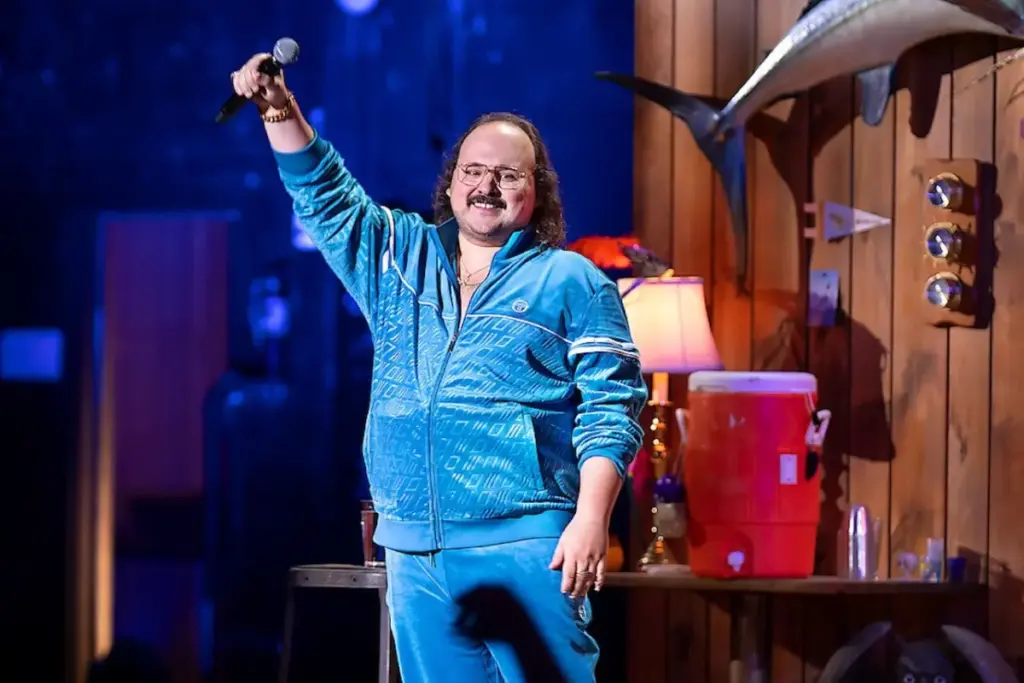
It has been an extraordinary twelve months for comedian Stavros Halkias, a trajectory culminating in his latest career milestone: his second hourlong Netflix stand-up special, Uncle Stav. Filmed live at the historic Lyric Theatre in his hometown of Baltimore, Maryland, and directed by indie auteur Matt Johnson (Nirvanna The Band The Show, Tony), the special captures a performer operating at the absolute peak of his powers.
Yet, the road to the Lyric was paved with literal obstacles. Halkias was forced to postpone the taping by three months following a scooter accident this April that left him with a broken arm. True to form, the injury goes entirely unmentioned in the set—Halkias has larger targets in his crosshairs. Uncle Stav presents a comedian who is not merely resting on his laurels following a string of major acting breakthroughs—including a scene-stealing role in the Oscar-nominated film Bugonia alongside Jesse Plemons and Emma Stone, a fictionalized Anthony Bourdain biopic titled Tony, and a triumphant return for Season 3 of Netflix’s hit comedy series Tires—but is aggressively evolving his comedic voice.
Clocking in as a masterclass in modern observational humor, Uncle Stav bridges the gap between populist charm and sharp socio-political critique. Balancing heavy, self-deprecating weight loss updates with biting cultural commentary on artificial intelligence, modern dating, corporate greed, and the systemic failures of late-stage capitalism, Halkias proves that his distinctive brand of "dirtbag" charm has matured into a sophisticated, highly lucrative cinematic experience. For comedy enthusiasts and casual viewers alike, Uncle Stav easily earns a definitive STREAM IT verdict.
Detailed Chronology: From Baltimore Balconies to Global Streaming Dominance
To fully appreciate the cultural weight of Uncle Stav, one must look at the physical and metaphorical journey Halkias took to reach the stage of the Lyric Theatre.
The Setback and the Setup
In April of this year, Halkias suffered a severe scooter accident resulting in a broken arm—an injury that forced a three-month delay on his highly anticipated sophomore Netflix taping. While lesser comedians might have used the cast as an opening prop for low-hanging sympathy laughs, Halkias chose to ignore the sling entirely. He treated the stage not as a hospital ward, but as a celebratory homecoming.
A Homecoming Rooted in Reverie
The choice of venue was deeply personal. Opened in 1894 as Baltimore’s premier concert hall and the historical home of both the city’s symphony and opera company, the Lyric Theatre holds formative memories for the comedian. Halkias reflected on sitting in the back row of the balcony at age 18 to watch Chris Rock command the exact same stage. "And now culture has degraded to the point that I get to play these kinds of theaters," he jokes during the hour, heavily understating his own ascent.
The Cinematic Collaboration
Behind the camera, the special benefits immensely from the distinct visual grammar of director Matt Johnson. Known for his chaotic, boundary-pushing style in independent cinema, Johnson frames the Baltimore crowd not merely as an audience, but as active participants in a living, breathing ecosystem. Throughout the hour, running subplots involve an overly enthusiastic front-row audience member and an abruptly ejected heckler, establishing a meta-narrative layer that hints at something far more cinematic than a standard, static comedy recording.
Supporting Context & Metrics: The Evolution of "Stavvy"
Halkias’s meteoric rise is underscored by a unique matrix of digital ubiquity, critical acclaim, and box-office momentum.
The Multi-Hyphenate Momentum
- The Cum Town Genesis: Long before headlining major theaters, Halkias built a fiercely loyal, cult-like following co-hosting the Cum Town podcast alongside Nick Mullen and Adam Friedland. Heralded in the late 2010s as a cornerstone of the so-called "dirtbag left"—a movement characterized by progressive economic views delivered with total disregard for elite social proprieties—the podcast set records as one of Patreon’s top earners.
- The Hollywood Pivot: Halkias has successfully transitioned from audio-only media to high-profile cinematic projects. His breakout dramatic and comedic chops were put on display in Yorgos Lanthimos’s orbit via the Oscar-nominated Bugonia. He followed this with a lauded summer performance as a chef in the fictionalized Anthony Bourdain film Tony (also directed by Matt Johnson).
- Television Stardom: Fans of his television work welcomed his return as Dave, the lovable dirtbag store manager, in the third season of Netflix’s workplace comedy series Tires.
Weight, Geometry, and Cultural Metamorphosis
Halkias approaches his physical transformation with characteristic bluntness. He reveals he had shed 70 pounds by the time Uncle Stav was filmed, yet remarkably still finds himself swimming in his XXXL wardrobe.
"Do you know how fat you have to be to not be medically cleared for stand-up comedy?" he asks the roaring crowd, chalking up his previous baseline to living his best life over a 900-day period—a lifestyle he compares to "the day you give a dog before you euthanize it."
Rather than cruising into a comfortable, King of Queens-style suburban domesticity typical of sitcoms past, Halkias jokes that he possesses "the cheeks of a minor Disney character." In one of the special’s standout physical bits, he breaks down the harrowing physical reality of modern intimacy for an overweight man in his late 30s, jokingly suggesting that his sheer geometry would require him to be "lowered from the ceiling Mission: Impossible style" to engage in romance. This bit translates brilliantly into one of the special’s official promotional teasers, showcasing his knack for high-energy physical comedy.
Official Observations & Material Breakdown
The heart of Uncle Stav lies in its fearless, highly relatable commentary on contemporary absurdity. Halkias dissects the modern socio-political landscape with an uncanny ability to merge low-brow silliness with high-brow cynicism.
1. Artificial Intelligence and the "Fake Economy"
Halkias takes direct aim at the tech sector’s relentless crusade to force artificial intelligence down the public throat. He diagnoses AI not as a technological revolution, but as definitive proof of systemic economic artifice.
- "We basically invented Google that calls you handsome, and they’re pretending it’s a technological breakthrough."
2. The Gamification of Gambling
In a sharp critique of modern convenience, Halkias laments how tech bros and online apps have completely ruined gambling. He draws a hilarious contrast between the gritty, atmospheric safety of traditional mob-run or Native American casinos—where a gambler at least had to contemplate the weight of geopolitical history or the distinct peace of mind knowing "the-Mafia’s-not-to-kill-you good"—versus the dystopian banality of a get-poor-quick scheme glowing on your smartphone.
3. Healthcare, Riots, and Civic Duty
Channeling a populist rage reminiscent of European labor movements, Halkias explores the public reaction to high-profile corporate crimes, noting that the killing of a major healthcare CEO yielded shockingly minimal systemic benefits for ordinary citizens. Why? Because, as Halkias deadpans: "We don’t riot enough in this country."
4. Police and Cultural Obsessions
Halkias delivers razor-sharp critiques of law enforcement customer service skills ("Every cop talks to you like you just f—ed their girlfriend") while saving his most pointed cultural strikes for manufactured outrage. Attacking public figures like Ben Shapiro and J.K. Rowling who obsess over cancel culture and police the identities of transgender individuals, Halkias offers a devastatingly simple defense of marginalized communities:
- "There’s like 80 trans people total, and half the country wants to be very rude to them for some reason. You gotta respect what trans people are up to. They’re trying to get hot against God’s will."
Future Outlook: What Uncle Stav Means for the Future of Stand-Up
The release of Uncle Stav marks a critical turning point for modern stand-up comedy. For years, the industry has wrestled with a false binary: comedians must either conform to sanitized, algorithm-friendly corporate standards or lean exclusively into toxic, defensive edge-lord comedy. Stavros Halkias obliterates this dichotomy.
By leaning fully into his "dirtbag" roots while simultaneously expanding his creative boundaries alongside visionary directors like Matt Johnson, Halkias proves that sincerity and vulgarity are not mutually exclusive. He loves who he is, he loves what he is doing, and crucially, he wants his audience to share in that unbridled joy.
As streaming platforms continue to search for fresh formats that bridge traditional stand-up with cinematic storytelling, Uncle Stav sets a gold standard. With his film career accelerating, his television presence locked in, and his global stand-up following larger than ever, Stavros Halkias has firmly established that his unique brand of chaotic, joyful self-deprecation is here to stay.
Uncle Stav is currently streaming globally on Netflix.