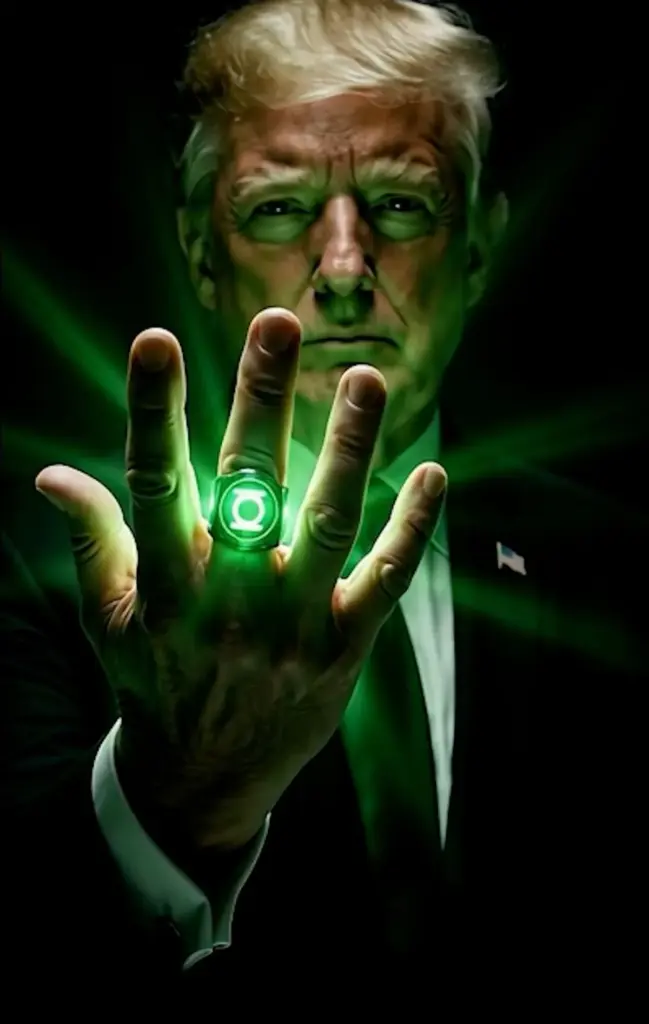
On Monday, September 7, 2026, the digital footprint of the Commander-in-Chief sparked an immediate political firestorm, bringing long-simmering questions regarding presidential fitness back to the forefront of American public discourse. Over a compressed window of approximately ten minutes, 80-year-old Donald Trump unleashed a flurry of eccentric and digitally manipulated imagery across Truth Social. The posts ranged from AI-generated visual pastiches—including a mirror-gazing former President Barack Obama and an arm-wrestling match with the late WWE icon Hulk Hogan—to altered geopolitical designations and controversial aesthetic proposals for military uniforms.
The online episode swiftly drew sharp rebukes from political commentators, independent analysts, congressional leaders, and executive-level state officials. While supporters often dismiss such unconventional online behavior as high-frequency political trolling or standard-issue digital engagement, critics argue that the volume and surreal nature of the content point toward a deeper, more concerning psychological decline.
The incident has revitalized formal and informal discussions surrounding Section 4 of the 25th Amendment of the United States Constitution—the legal mechanism designed to address presidential inability. As debates intensify over governance, distraction tactics amid ongoing foreign policy maneuvers, and the mental stamina required for the highest office in the land, this latest digital episode serves as a significant inflection point in contemporary American politics.
Detailed Chronology of the Truth Social Blitz
The sequence of events unfolded rapidly during the federal holiday, catching both supporters and adversaries off guard. Digital researchers and political commentators immediately began tracking the cadence and composition of the digital onslaught as it materialized in real time.
The Ten-Minute Window of Surreal Content
Beginning shortly after midday, the President’s verified account on Truth Social began publishing a relentless stream of content. Independent journalist Aaron Rupar captured the speed of the updates, compiling a screen recording that demonstrated a rapid-fire series of bizarre uploads executed within a ten-minute span.
Among the standout pieces of media distributed during this blitz were:
The Obama Mirror Image: An artificial intelligence-generated picture depicting former President Barack Obama staring directly into a mirror, only to see Donald Trump’s reflection looking back.
The Hogan Arm Wrestle: A digitally rendered image showing Trump locked in an intense arm-wrestling contest with the late professional wrestling superstar Hulk Hogan.
Space Force Conceptual Gear: Newly proposed aesthetic designs for Space Force personnel that drew immediate, widespread comparisons on social media to totalitarian uniforms from historical regimes and cinematic science-fiction villains.
Geopolitical Redefinitions: A text-and-image post arbitrarily renaming the state of New Mexico as "New America," alongside a separate post officially dubbing his private Mar-a-Lago estate in Palm Beach the "southern White House."
Political commentator Harry Sisson meticulously documented the progression of the posts with timestamps, publicly declaring on social media that the sequence resembled an active mental health episode and calling for immediate executive intervention.
[TIMELINE OF THE DIGITAL EPISODE]
-------------------------------------------------------------------------
12:15 PM EST - Initial wave of text-based brags regarding presidential legacy.
12:18 PM EST - Release of AI-generated Hulk Hogan arm-wrestling imagery.
12:21 PM EST - Publication of the Obama mirror graphic.
12:23 PM EST - Distribution of controversial Space Force uniform concepts.
12:25 PM EST - Geopolitical designation posts ("New America" & "Southern White House").
-------------------------------------------------------------------------
The Legacy of the "Stable Genius" Defense
This latest digital episode directly recalls a well-documented chapter from Trump’s political history. During his first term in office, facing persistent media questions regarding his psychological fitness and temperament, the former reality television star famously took to social media in January 2018 to defend his cognitive capabilities.
In that historic tweet, Trump declared himself to be "like, really smart" and a "very stable genius," asserting that his transition from businessman to television personality and subsequently to the presidency on his first attempt qualified him not merely as smart, but as a genius of exceptional mental stability. The recurrence of these themes in 2026 demonstrates a persistent reliance on self-aggrandizing rhetoric whenever his fitness for office is called into question.
Supporting Context, Psychological Analysis, and Public Metrics
The debate over presidential cognitive health is not merely a partisan talking point; it is a complex intersection of political science, constitutional law, and public perception.
The Optics of Digital Communication in the Modern Era
In contemporary politics, social media serves as a direct line between the head of state and the electorate, bypassing traditional journalistic filters. However, when the content shared shifts from policy proposals or diplomatic updates to surreal, AI-generated entertainment and whimsical self-mythologizing, it alters the psychological contract between the leader and the public.
For the administration’s base, these posts are often interpreted as authentic expressions of a populist leader who refuses to adhere to conventional political norms—a masterclass in trolling political opponents and dominating the daily news cycle. Conversely, for moderates, independents, and critics, the output is viewed through a clinical lens, raising urgent alarms about judgment, executive focus, and the capacity to manage complex global crises.
The Broader Political and Economic Backdrop
Critics of the administration have been quick to point out the timing of these digital distractions. New Mexico Governor Michelle Lujan Grisham highlighted that the President’s focus on renaming states and generating internet memes coincided with severe economic anxieties felt by ordinary American families.
While the White House engaged in what state officials termed "coloring on maps," the broader American public continued to grapple with:
Volatile energy costs and soaring retail gas prices.
Inflationary pressures at local grocery stores and supermarkets.
Diminished access to affordable healthcare services.
A deepening housing affordability crisis that has increasingly locked younger generations out of homeownership.
Furthermore, these domestic anxieties run parallel to ongoing, highly sensitive foreign policy engagements, including military tensions in the Middle East. Political analysts argue that surreal social media distractions risk trivializing the gravity of these concurrent crises, projecting an image of an administration detached from the day-to-day realities of its citizenry.
Official Statements and Political Reactions
The fallout from the Labor Day posting spree triggered immediate condemnation from lawmakers, state executives, and family members alike, reflecting a broad consensus among critics that the behavior had crossed a definitive line.
Congressional Alarm and Demands for Oversight
Congresswoman Chellie Pingree issued a scathing statement following the release of the posts, rejecting the common political defense that the President was merely "trolling" or "being Trump."
"This is truly unhinged behavior from the President of the United States," Pingree stated. "And I don’t want to hear ‘oh, it’s just Trump being Trump’ or that he’s ‘trolling.’ Enough. None of this is normal or okay. Republicans cannot keep shrugging this off. Congress, the Cabinet, and everyone around him has a responsibility to stop enabling this dangerous behavior and start asking whether he is fit to hold this office."
State-Level Pushback
The administration’s decision to rebrand New Mexico as "New America" drew a swift, forceful rebuke from New Mexico Governor Michelle Lujan Grisham. In an official response, the Governor emphasized both the historical dignity of her state and the stark contrast between online theatrics and substantive governance:
"Our state’s name is not up for debate. It’s been ours since before the United States existed," said Governor Lujan Grisham. "What is up for debate? Who’s showing up for working families. While the President tries to distract Americans from his disastrous foreign conflicts, gas prices keep soaring… While the White House wastes time coloring on maps, Nuevo México is busy doing the work."
Familial and Diplomatic Disapproval
The criticisms extended beyond traditional political adversaries to include family members. Mary Trump, a clinical psychologist and vocal critic of her uncle, offered a blunt assessment of his mental state on social media:
"Donald is decompensating in real time—just look at the insanity he’s posted on social media today," she wrote. "By refusing to invoke the 25th Amendment, Republicans prove once again that they are willing to ignore the Constitution to protect him at our expense."
International observers also weighed in. Former BBC Washington Correspondent Nick Bryant shared one of the controversial posts with a concise evaluation that resonated widely among foreign policy analysts: "This is not the output of a very stable genius…"
Future Outlook: Constitutional Mechanisms and the Path Ahead
As the political dust settles from the Labor Day holiday, the core questions raised by the incident remain unresolved. The invocation of the 25th Amendment is an extraordinary constitutional remedy, historically envisioned for instances of severe physical incapacitation or acute medical emergencies. Under Section 4, the Vice President, alongside a majority of the principal officers of the executive departments (the Cabinet), must declare that the President is unable to discharge the powers and duties of office.
While it remains highly unlikely that a loyal Cabinet or a divided Congress will initiate such a dramatic constitutional procedure absent a total medical crisis, the public debate itself carries profound political weight.
Key Implications for the Coming Months:
The Campaign Narrative: Opposition parties are expected to weaponize the digital episode in upcoming legislative and gubernatorial campaigns, framing the administration as erratic and unfit for prolonged global leadership.
Media Strategy Shifts: Observers will closely monitor whether White House communications teams attempt to institute stricter guardrails around the President’s personal electronic devices or if the unfiltered social media strategy will continue unabated.
Voter Perception: Public polling in the wake of the incident will test whether swing voters view these online episodes as harmless eccentricities or as genuine red flags regarding executive competence.
Ultimately, the events of September 7, 2026, underscore the volatile intersection of modern digital culture and high-stakes executive governance—leaving the American electorate once again to grapple with the profound implications of a presidency conducted largely in the public eye through the medium of viral social media posts.