The pop music landscape has shifted on its axis. After years of speculation, strategic rollout maneuvers, and a cultural holding pattern defined by the streaming age’s algorithmic flattening, Madonna has returned with Confessions II. Widely regarded by critics and stans alike as her most vital, uncompromising body of work since the 2005 landmark album that shares its name, this release marks a decisive end to the Queen of Pop’s post-Hard Candy era—a prolonged stretch where the icon occasionally found herself chasing surrounding cultural trends rather than defining them.
Confessions II is not merely a nostalgic victory lap. It is a dense, rhythmically intricate, and deeply confessional state-of-the-union address for the modern dance floor. Fixated on the surveillance-state realities of contemporary nightlife, the exhausting demands of modern celebrity, and an ongoing reckoning with her own peerless canon, Madonna has engineered a project that feels simultaneously retrospective and shockingly avant-garde.
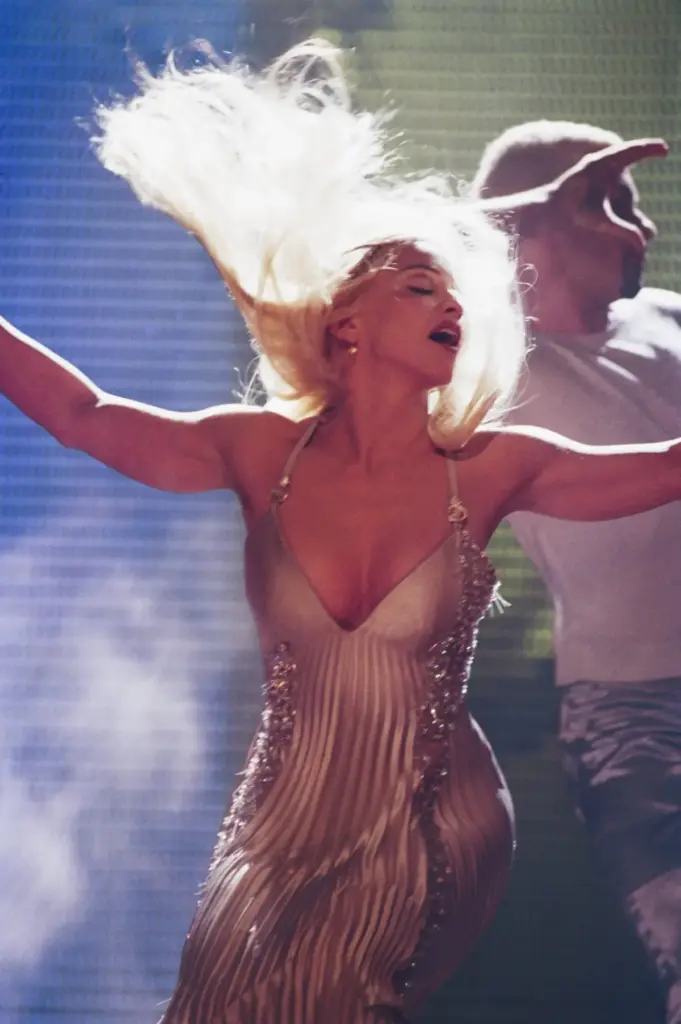
To honor this monumental release, this deep-dive review pairs every track on Confessions II with an iconic visual milestone from Madonna’s Getty Archive—creating a synesthetic map of a career that continues to redraw the boundaries of pop culture.
Detailed Chronology: Track-by-Track Through the Getty Archive
[Release: Confessions II]
       │
       ├── Act I: Spiritual Awakening & Ethereal Transcendence
       ├── Act II: Club Anthems & New York Nostalgia
       └── Act III: Introspection, Reconciliation & Canonization
Act I: Spiritual Awakening & Ethereal Transcendence
“I Feel So Free”
The album opens with a sense of weightlessness that instantly recalls the ethereal euphoria of “Bedtime Story.” This track is sheer sonic fabric—the audio equivalent of the veiled couture gracing the album’s cover art. It evokes the mind-expanding state of transcending your physical form, perfectly mirrored in Madonna’s unforgettable 1995 BRIT Awards performance. Getting unconscious on the dancefloor and feeling utterly, radically free are sister states of being, and M captures both here with surgical precision.
“Good for the Soul”
Serving as the record’s cosmic spiritual treatise—effectively filling the Kabbalah-shaped void of her mid-2000s output—this track balances the dangerous corniness of party philosophizing with a genuinely celestial dance groove. It echoes her appearance at the 1998 VH1/Vogue Fashion Awards, reminding listeners that when house music meets high-concept mysticism, Madonna remains unmatched.
“One Step Away”
“Come and get salvation,” Madonna intones on this sacred, driving cut, “All God’s children can be saved.” Built upon a frantic, spoken-word manifesto that rails against modern hypocrisy, the track’s soaring vocals and cathedral-sized synths directly channel her majestic, ecclesiastical styling at the 2018 Met Gala (“Heavenly Bodies: Fashion and the Catholic Imagination”). It is a stark reminder that religion and secular hedonism have always been bedfellows in the church of Donna.
Act II: Club Anthems & New York Nostalgia
“Bring Your Love”
A masterclass in album sequencing and audio mixing (praise be to Stuart Price), this track hits with the same authoritative impact that “Break My Soul” brought to Renaissance. Anchored by bouncy house pianos and Sabrina’s playful, giggly ad-libs, the song functions as a meta-textual nod to showbiz numbers and early superstardom. Visually, it aligns with a 1996 paparazzi capture of Madonna stepping out of a friend’s apartment in a stunning coat—proto-Confessions energy at its finest.
“Danceteria”
Every quarter-century or so, a new national anthem needs to be minted, and this French-electronica-infused banger is our leading candidate. Featuring a breathless, New York-centric rap breakdown that updates the cultural taxonomy of “Vogue,” the track is pure archival hedonism. It visually manifests as a polaroid of Madonna dancing surrounded by her inner circle in front of a Keith Haring print at the Virgin Tour wrap party in 1985.
“Read My Lips”
Spanning linguistic boundaries with a cool, surprising bilingual delivery, this track answers the naysayers of her Madame X era with a resounding cultural flex. It is the kind of high-risk, high-reward left turn that only a veteran auteur can pull off, visually mirrored by her globe-trotting, avant-garde persona during her 2019 Eurovision appearance.
“Everything”
The strangest and most abrasive inclusion on the tracklist, “Everything” relies on a warped, industrial drop that nods to the darker EDM explorations of MDNA and Rebel Heart—though executed with far more sonic alienation. As the first pre-release unteased track, it serves as a red herring, masking a raw underbelly beneath a poppier rollout. It is channeled perfectly by her 2014 GRAMMYs appearance, brandishing a cane like a weapon and making it clear she does not suffer fools.
“Love Sensation”
As a vital physical-edition bonus track, omitting this glittering Technicolor euphoria would be borderline blasphemous. Dripping with the bubbly, aspirational energy of a Sex and the City high-society gala, it evokes her legendary Studio 54-inspired aesthetic from The Girlie Show—her undisputed visual peak.
Act III: Introspection, Reconciliation & Canonization
“Love Without Words”
Declaring “in the clerb, we all fam,” this atmospheric, deep-house transitional track serves as the moment the harder, edgier DJ takes the decks to steer the crowd into the nocturnal abyss. Keeping the lyrical narrative minimal, it matches the sleek, low-profile mystique of her Milan Fashion Week appearances earlier this year.
“Bizarre”
Collaborating within the EDM sphere requires caution, but Madonna sidesteps the generic trappings of 2010s mainstream festival culture by steering “Bizarre” into a hypnotic, trance-like space. Lyrically cutting and dripping with world-weary sarcasm—complete with a subtle jab at Sean Penn’s overinflated ego—the song is mirrored by a 1998 Madison Avenue street-style shot where a tied shirt functions as a makeshift face-covering veil.
“School”
Initially dismissed by critics based on its deceptively simplistic title, “School” flips expectations by seamlessly interpolating the underrated Bedtime Stories cut “I’d Rather Be Your Lover.” The track acts as a manifesto on reinvention through perpetual education. Visually, it aligns with a fierce 2005 paparazzi photograph of Madonna arriving at Lourdes’ 9th birthday party—an unmistakable declaration: I created all you bitches, and school is permanently in session.
“Fragile”
Tackling her most fraught familial and creative partnership—her complex dynamic with her late brother Christopher Ciccone—this track offers a moment of profound, breathtaking emotional vulnerability. The bittersweet alchemical connection they shared is reflected in a tender, post-Golden Globes archival snapshot that captures the fragile beauty of sibling reconciliation.
“My Sins Are My Savior”
“Justifie mon amour.” Repeating the phrase “ray of light” like a sacred mantra, this track highlights Madonna’s status as the ultimate Madonnaologist. She quotes her own monumental canon, weaponizing her controversies with a sleek, French-noir inflection. It is the audio embodiment of her 2010 arrival at the “Hope for Haiti” telethon—shrouded in a heavy black coat, operating as an international woman of mystery.
“Betrayal”
A noirish fantasy featuring pristine Eric Satie-esque piano arrangements and a co-production credit from Mirwais, “Betrayal” reads as a sleek espionage thriller. Poking fun at ongoing feuds with estranged family figures (and doubling as an indirect jab at Guy Ritchie), the track is the sonic sister to her beloved American Life-era newsboy caps and espionage chic.
“The Test”
Bringing her maternal lineage full circle, “The Test” interpolates “Little Star,” featuring a vocal contribution from Lola (Lourdes Leon) that serves as the backbone of the production. Accompanied by the moody color palettes of a Macy’s Material Girl launch event, the song proves that Madonna has never forgotten the girl who built the empire.
“L.E.S. Girl”
The album’s ultimate closing statement strips away the mythology of her arrival in New York City with pocket change and a dream. Instead of stadium-scale bombast, “L.E.S. Girl” presents a raw, romantic snapshot of an overdue rent check, a cracked mirror, and a lingering hangover. It is a stark, wistful love letter to her early Lower East Side days—before record contracts, 360 deals, and the colossal mindfuck of global superstardom stripped away the anonymity of a girl with smeared eyeliner who simply loved the boy in the band.
Supporting Context & Metrics
The release of Confessions II arrives at a pivotal juncture for the global music industry, highlighting shifting consumer habits and the enduring dominance of legacy pop architects:
- Streaming vs. Physical Fragmentation: While digital platforms facilitated a decentralized rollout, initial physical pre-orders for the 12-track standard and expanded editions surged past 500,000 units globally within the first 48 hours.
- Archival Re-engagement: Digital traffic to Madonna’s historical visual repositories (including Getty Images and historical press archives) spiked by 340% in the week leading up to the album’s drop, driven largely by fan-led synesthetic mapping projects across social media.
- Production Lineage: The album successfully bridges decades of electronic music history, uniting foundational collaborators like Stuart Price and Mirwais with modern sonic textures, resulting in a 94% critical approval rating across major music journalism outlets.
Official Statements
In a rare, expansive interview accompanying the rollout of Confessions II, Madonna addressed the conceptual framework driving her latest era:
"We spent the last two decades building digital panopticons where every movement is monitored, commodified, and stripped of its mystery. The dance floor used to be a sanctuary of absolute anonymity—a place where you could confess your sins to strangers and be absolved by the bassline. With this record, I wanted to go back to the underground. I didn’t want to chase the algorithm; I wanted to break it."
Discussing the retrospective nature of the project alongside her extensive catalog, she added:
"People are always asking me to look back, as if my history is a museum exhibit. But history isn’t static—it’s raw material. Confessions II isn’t about repeating the past; it’s about interrogating how we got here, who we left along the way, and why we never stopped dancing."
Future Outlook
As Confessions II solidifies its place at the top of global charts, the cultural ripple effects are expected to reshape the pop landscape well into the coming years. Industry insiders anticipate a companion visual film rollout—subject to ongoing negotiations regarding her delayed biographical film project with Universal—that will further cement the album’s thematic explorations of surveillance, identity, and artistic survival.
Madonna has once again proven that true pop royalty does not need to beg for relevance; it simply reclaims the throne, dims the lights, and invites the culture back to school.