Executive Overview
The British entertainment industry is in mourning following the death of the legendary stage and screen actress Phyllida Law at the age of 94. A towering figure of British drama whose career spanned over half a century, Law passed away on July 27, though news of her peaceful passing was officially confirmed in August. According to a statement released by her management, she died "supremely peacefully at home, surrounded by all of her family."
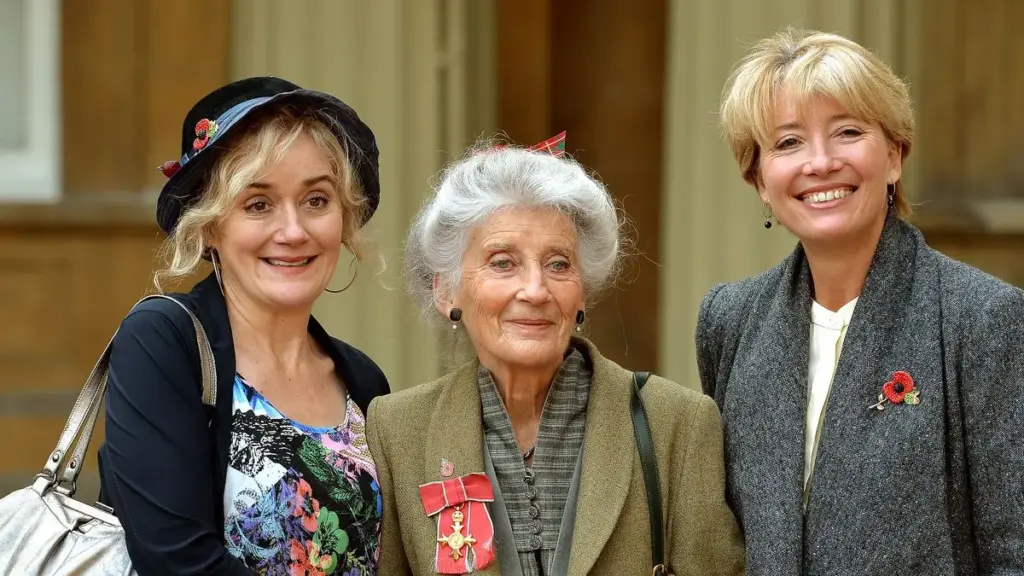
Law was not only celebrated for her formidable individual talent—which earned her an OBE for services to drama and charitable causes in 2014—but also as the matriarch of one of Britain’s most esteemed acting dynasties. She was the mother of celebrated actresses Dame Emma Thompson and Sophie Thompson, and the grandmother of actress and writer Gaia Wise.
Her passing closes a remarkable chapter in British theatrical and cinematic history. From classical stage work alongside theatrical royalty to memorable film collaborations with her daughters, Law’s career was defined by versatility, sharp comedic timing, and a profound emotional intelligence that illuminated every role she undertook. Tributes have poured in from across the arts community, honoring a woman who was as beloved for her warmth and generosity off-screen as she was respected for her discipline and brilliance on it.
Detailed Chronology: From Glasgow Dreams to West End Triumphs
Early Life and Artistic Beginnings
Born in Glasgow, Scotland, in 1932, Phyllida Law did not initially set her sights on the performing arts. In her youth, her primary artistic aspirations lay in the visual realm; she harbored a deep ambition to become a stage designer. However, the practicalities of the theatre world and her own latent artistic energies soon steered her toward the other side of the footlights.
She relocated to England to train at the prestigious Bristol Old Vic Theatre School, an institution renowned for breeding disciplined, classical actors capable of transitioning seamlessly between stage and screen. It was during these formative years that Law developed the vocal clarity, physical poise, and analytical approach to text that would become the hallmarks of her decades-long career.
Theatre Royalty and Classical Acclaim
Law’s transition from training to the professional stage was marked by a steady accumulation of respected credits in regional theatre before making her mark in London’s West End and beyond. Her stage career was characterized by an ability to inhabit complex, often eccentric characters with deep human empathy.
In 1971, she delivered a critically acclaimed performance alongside the legendary Sir Alec Guinness in John Mortimer’s poignant autobiographical play A Voyage Round My Father at the Theatre Royal Haymarket. Her portrayal showcased her ability to balance gravity and wit, earning her the admiration of both critics and peers.
Two years later, in 1973, Law demonstrated her range by appearing in Alan Bennett’s sharply observed satire Habeas Corpus at the Oxford Playhouse, a production that subsequently transferred to the West End to great commercial and critical success.
Her theatrical journey also encompassed musical theatre. In 1986, Law joined the original London cast of the hit musical La Cage Aux Folles at the London Palladium, taking on the role of Jacqueline. Her willingness to step into varied theatrical genres proved that she was an artist who resisted easy categorization, equally at home in high-brow drama and splashy West End spectacle.
Film and Television Stardom: A Family Affair
While Law’s theatrical pedigree was unimpeachable, her extensive resume across British television and international cinema cemented her status as a household name.
Her television career read like a roll-call of the most beloved British dramas of the late 20th and early 21st centuries. Viewers grew up watching her in classic children’s programming like Play School, before watching her mature into masterclasses of character acting in long-running prestige television. Her credits included appearances in The Unpleasantness At The Bellona Club, Midsomer Murders, Monarch Of The Glen, Rosemary & Thyme, The Sarah Jane Adventures, Foyle’s War, Doc Martin, and New Tricks.
On the big screen, Law established a reputation for adding distinct gravity and warmth to ensemble casts. Some of her most notable cinematic outings included Anna Karenina, Saving Grace, and Miss Potter.
However, some of Law’s most cherished cinematic moments were those shared with her family. Following the death of her husband, actor Eric Thompson—whom she married in 1957 and who tragically died of a heart attack in 1982 at the age of 53—Law raised their two daughters, Emma and Sophie, both of whom followed their parents into the acting profession.
Law’s professional intersection with her daughters yielded some of the most memorable collaborations in modern British cinema:
- 1992 (Peter’s Friends): Directed by Sir Kenneth Branagh (who was then married to Dame Emma Thompson), Law appeared alongside her eldest daughter in this bittersweet comedy-drama.
- 1993 (Much Ado About Nothing): Law reunited with Branagh and Dame Emma for this vibrant cinematic adaptation of Shakespeare’s comedy, filmed under the Tuscan sun.
- 1996 (Emma): In this cinematic adaptation of Jane Austen’s classic novel starring Gwyneth Paltrow, Law took on the role of Mrs Bates, while her daughter Sophie played her devoted daughter, Miss Bates—a delightful family casting choice that added layers of authentic familial tenderness to the production.
- 1997 (The Winter Guest): Marking the directorial debut of the late Alan Rickman, this stark, emotionally resonant drama featured Law and Dame Emma playing mother and daughter, a meta-textual casting that allowed the two powerhouses of acting to explore the complicated topography of maternal-filial bonds on film.
- 2005 (Nanny McPhee): Demonstrating her continued support for her daughter’s creative endeavors, Law took on a voice role in the whimsical family fantasy written by and starring Dame Emma Thompson.
Supporting Context & Metrics: A Life in Numbers and Accolades
To truly understand Phyllida Law’s contribution to the cultural landscape, one must look at the sheer breadth of her output and the enduring legacy she leaves behind.
- Career Span: Over 6 decades of continuous work across theatre, television, and film.
- Age at Passing: 94 years old (born 1932, died July 27, 2026).
- Family Legacy: Married to Eric Thompson (1957–1982); mother to Dame Emma Thompson and actress Sophie Thompson; grandmother to Gaia Wise.
- Major Honors: Appointed an Officer of the Order of the British Empire (OBE) in 2014 for her invaluable services to drama and her extensive work with charitable causes.
- Collaborative Milestones: Shared the screen with her daughters in multiple high-profile projects, creating a unique cinematic tapestry that intertwines personal and professional heritage.
Law’s work ethic was legendary. Long past the age when many actors choose to retire to the quietude of private life, she continued to accept roles that interested her, bringing the full weight of her experience and unshakeable technical skill to every set she stepped onto.
Official Statements and Tributes
The announcement of Law’s passing triggered an outpouring of grief, respect, and fond remembrance from colleagues, fans, and cultural institutions across the globe.
Her granddaughter, Gaia Wise, led the public tributes with a poignant message shared on Instagram accompanied by a striking photograph of Law. Simply and powerfully, Wise wrote:
"Rest well my queen."
Law’s management agency released a carefully articulated statement that captured the peace with which the veteran actress departed:
"She died supremely peacefully at home, surrounded by all of her family."
Throughout social media and industry forums, actors, directors, and writers who had the privilege of working with Law shared anecdotes highlighting her sharp wit, her profound professionalism, and her utter lack of pretension. Despite being part of British acting royalty, Law was famously down-to-earth, viewing her profession not as a vehicle for vanity, but as a craft built on hard work, collaboration, and observation of the human condition.
Future Outlook: Preserving a Timeless Theatrical Dynasty
While the physical presence of Phyllida Law has left the stage, her impact on British culture remains indelible. Her life and career serve as an inspiring blueprint for actors navigating the delicate balance between classical theatrical rigor and modern screen versatility.
Furthermore, Law’s legacy lives on vividly through her daughters, Dame Emma Thompson and Sophie Thompson, whose own stellar careers continue to shape the landscape of international cinema and theatre. The values of intellectual curiosity, rigorous text analysis, emotional fearlessness, and deep professional integrity that Law instilled in her daughters will undoubtedly be passed down through generations of the Thompson-Law family, ensuring that her artistic DNA remains active in the industry for decades to come.
As retrospectives are planned and her classic films and television performances are revisited by new generations of admirers, Phyllida Law will be remembered not merely as a mother to stars, but as a brilliant, multifaceted star in her own right—a magnificent queen of the British stage and screen whose light will never truly be extinguished.