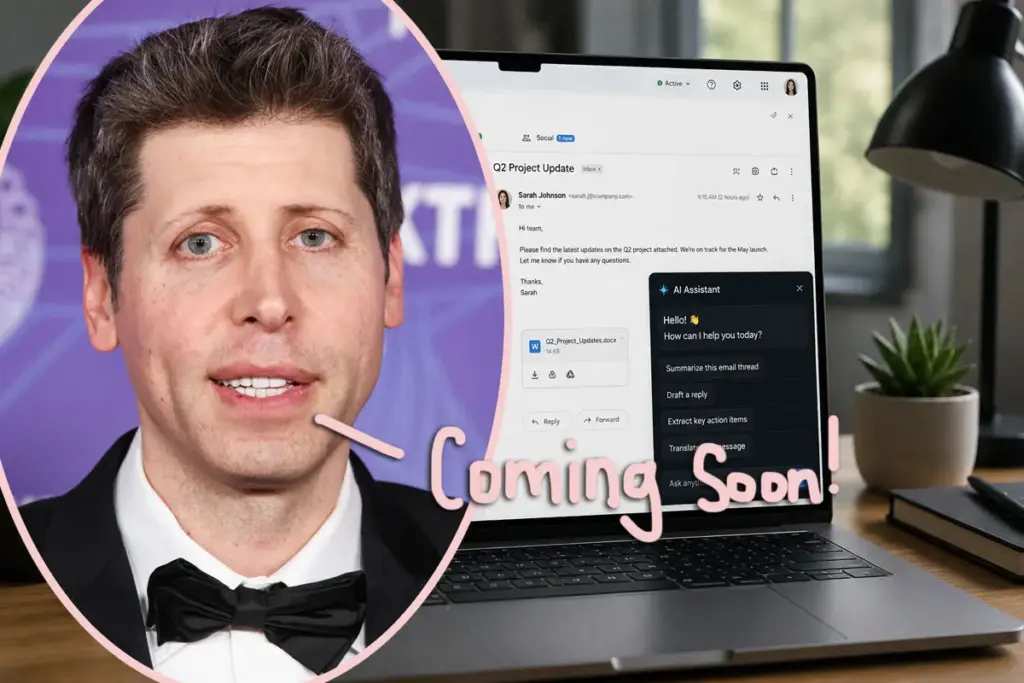
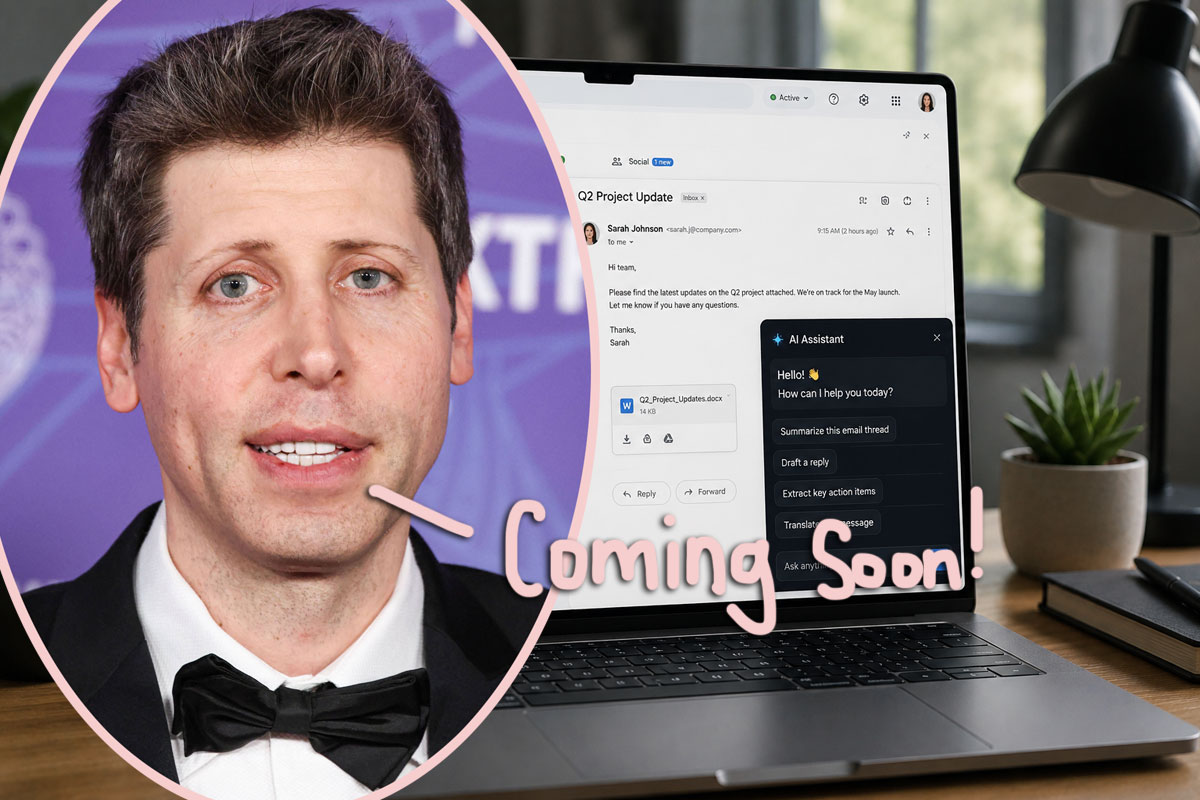
The landscape of artificial intelligence is teetering on the edge of a monumental architectural shift: moving from reactive, prompt-driven chatbots to passive, persistent ambient co-pilots. During an unannounced fireside conversation with tech founder and investor Cory Levy at Internapalooza—an annual gathering of Silicon Valley technology interns—OpenAI Chief Executive Officer Sam Altman revealed that the next generation of artificial intelligence models will capability-wise be equipped to continuously monitor, listen to, and analyze every digital interaction performed by a user in real time.
According to Altman, the industry is approximately "one model generation away"—a timeframe he estimated at roughly six months—from deploying AI systems capable of seamlessly integrating into a user’s desktop environment. These next-generation systems will possess the capability to read computer screens perpetually, ingest live audio feeds from video meetings, record calls, and cross-reference these inputs against private enterprise channels such as Slack, email, and internal documentation repositories.
While Altman framed this transformation as the ultimate resolution to cognitive overload for executives and knowledge workers, the prospect of an "always-on" digital observer possessing what he termed "perfect context of your whole life" raises momentous questions regarding data governance, workplace surveillance, cybersecurity vulnerabilities, and consent frameworks.
Detailed Chronology
===================================================================================================
                                CHRONOLOGY OF AMBIENT AI EVOLUTION
===================================================================================================
[ November 2022 ] ---------------------------------------------------------------------------------
  • OpenAI releases ChatGPT (GPT-3.5)
  • Established basic conversational query-and-response paradigm.

[ March 2023 - May 2024 ] -------------------------------------------------------------------------
  • Rollout of GPT-4 and GPT-4o multimodal models.
  • Integration of native vision, real-time voice, and document parsing capabilities.

[ Mid-2024 ] ---------------------------------------------------------------------------------------
  • Big Tech introduces OS-level integration concepts (e.g., Microsoft Copilot+ Recall).
  • Backlash over unencrypted background screen capture tools highlights privacy concerns.

[ August 2026 / Recent Event ] --------------------------------------------------------------------
  • Sam Altman addresses hundreds of Silicon Valley interns at Internapalooza.
  • Altman explicitly predicts that ambient, screen-watching, call-recording AI agents are 6 months away.

[ Projected: Late 2026 - Early 2027 ] -------------------------------------------------------------
  • Anticipated release of next-generation frontier models (GPT-5 class).
  • Commercial deployment of continuous-context AI operating system agents.
===================================================================================================
The Silicon Valley Address
Speaking before an audience of emerging software engineers and tech interns, Altman reflected on his early career trajectory—dropping out of Stanford University, rejecting traditional Wall Street paths such as Goldman Sachs, and securing initial seed capital from high-profile venture capitalists like Peter Thiel and Paul Graham for his first venture, Loopt.
However, the conversation shifted dramatically when host Cory Levy pressed Altman on the immediate technical horizon of generative AI and its impact on productivity workflows. Altman outlined a timeline that places enterprise-grade, continuous-surveillance AI tools directly onto consumer and corporate hardware within months rather than years.
The transition marked a departure from the historical framing of ChatGPT as a discrete destination—a website or application where users manually input text prompts—toward an ambient computing layer operating beneath the desktop operating system.
Supporting Context & Metrics
The Technological Mechanics of Ambient Context
To understand the scope of Altman’s prediction, it is necessary to examine the underlying hardware and software innovations required to achieve continuous visual and auditory context parsing. Traditional Large Language Models (LLMs) operate on discrete inference cycles: a user submits a prompt, the server processes the token sequence, and the model streams back a response.
By contrast, the "descendant of ChatGPT" envisioned by Altman relies on an architecture driven by continuous multimodal streams and vector-based episodic memory:
Continuous Visual Ingestion: Utilizing lightweight computer vision pipelines running locally or at the edge, the system performs continuous optical character recognition (OCR) and visual scene parsing on the user’s active monitor.
Audio Stream Serialization: Utilizing low-latency speech-to-text engines (such as advanced iterations of OpenAI’s Whisper model), the assistant transcribes and diarizes live voice channels, video conferences, and phone calls without manual activation.
Enterprise Integration (RAG Engine): Retrieval-Augmented Generation (RAG) modules bind local desktop interactions to cloud-hosted databases, syncing live activity against legacy emails, Slack channels, and internal corporate repositories.
Proactive Intervention Logic: Rather than waiting for explicit user prompts, the model maintains an active background loop. It compares the user’s current working state (e.g., drafting a customer sales deck) against historical enterprise data to surface real-time corrections, strategy suggestions, or context alerts.
Industry Comparisons and Precedents
OpenAI’s push toward ambient monitoring follows earlier, albeit controversial, attempts by major tech vendors to capture user context at the operating system level:
Feature / Metric
Microsoft Copilot+ Recall
Apple Intelligence
OpenAI Proposed Ambient Agent
Primary Capture Mechanism
Periodic background screen snapshots
On-device index of cross-app data
Continuous video/screen, audio, and API integration
Data Processing Location
Primarily local (NPU-bound)
Hybrid (On-device + Private Cloud)
Cloud-backed deep inference + edge preprocessing
Contextual Scope
Historical desktop search
App-specific personal context
Enterprise-wide, cross-platform active monitoring
Interaction Model
Searchable database (Passive)
Reactive assistance & summaries
Proactive, real-time suggestion engine
Initial Security Reaction
Severe critique due to plain-text SQLite storage risks
The primary bottleneck for enterprise adoption has historically been the trade-off between contextual awareness and security. When Microsoft initially revealed its "Recall" feature—which indexed desktop snapshots every few seconds—cybersecurity researchers pointed out that local malware could extract unencrypted SQLite databases containing sensitive user data. Altman’s explicit timeline suggests OpenAI believes it has solved the technical, contextual, and architectural efficiency hurdles required to render continuous streaming both computationally viable and commercially viable.
Official Statements
Sam Altman’s Remarks
During the session at Internapalooza, Altman outlined the functional mechanics and user-experience model of this forthcoming paradigm:
"I think we are close to a world where you can have, like, a descendant of ChatGPT watch your computer screen all the time, watch every meeting you’re in, like record every call, everything like that, have perfect context of your whole life, everything you see… You choose what information you want it to have, but it can go, you can connect it to your email or docs or Slack or whatever."
Acknowledging the immense administrative strain placed on modern corporate leadership and knowledge workers, Altman framed this invasive level of access as a necessary evolution in executive leverage:
"And then you have this thing that is not making decisions for you, but if you’re like the CEO of a startup, there’s always, like, more stuff to do than you can do, and context you can’t all keep track of. You can’t, like, read every piece of customer feedback every day. And you can just have this thing that’s, like, working alongside you, and as you’re, like, typing out a sales pitch to a customer or, like, writing a strategy doc, it’ll just say, like, ‘Hey, maybe here’s another idea,’ or ‘I think you’re making a mistake here. You should consider this,’ or ‘I can do this thing for you to help.’"
When asked directly by host Cory Levy to provide a definitive timeline for when this capability would transition from internal research laboratories to functional enterprise software, Altman responded:
"I think we’re only like one model generation away from this actually being incredibly useful. And I think that will change, hopefully, at least for me, change the way I work… Best guess on timing? Like sometime in the next six months."
+-----------------------------------------------------------------------------------+
|                         ALTMAN'S VISION OF WORKFLOW SHIFT                         |
+-----------------------------------------------------------------------------------+
|                                                                                   |
|   OLD PARADIGM (Prompt-Based)          NEW PARADIGM (Ambient / Persistent)        |
|  -----------------------------        -----------------------------------         |
|  • User opens browser/app             • System runs passively in background      |
|  • User drafts manual prompt          • Agent continuously reads screen/audio    |
|  • AI responds to isolated input      • Agent proactively intervenes with context|
|  • Zero context of off-platform work  • Full integration with corporate stack    |
|                                                                                   |
+-----------------------------------------------------------------------------------+
Technical and Regulatory Challenges
While the benefits to executive productivity are highlighted by technology advocates, the deployment of "always-on" recording and screen-parsing agents introduces severe legal, regulatory, and corporate policy hurdles.
1. Multi-Party Consent and Wiretapping Laws
In many legal jurisdictions—including eleven U.S. states such as California, Pennsylvania, and Massachusetts—recording a phone call or audio conversation requires the explicit consent of all parties involved ("two-party" or "all-party" consent laws). An AI agent passively recording every call or background ambient audio stream in a professional setting risks violating statutory wiretap laws unless explicit automated disclosures are delivered to every meeting participant.
2. GDPR and "Right to be Forgotten"
Under the European Union’s General Data Protection Regulation (GDPR), individuals possess the right to request the deletion of their personal data (Article 17). If an ambient AI continuously logs enterprise meetings, customer support calls, and desktop screens containing third-party personal identifiable information (PII), constructing mechanisms to selectively redact or erase specific individuals from a continuous vector memory pool presents a deep technical challenge.
3. Corporate Surveillance and Employee Rights
The integration of passive ambient tracking blur the line between a personal productivity assistant and corporate "bossware." If an employer mandates or facilitates the deployment of AI models that watch screens and listen to audio feeds, questions arise regarding:
The monitoring of off-task, personal activities conducted on corporate hardware.
The potential use of ambient logs by HR departments to evaluate worker performance, focus metrics, or active working hours.
The legal ownership of the "episodic memory database" generated by an employee during their tenure.
Future Outlook
Altman’s declaration that ambient context systems are a mere six months away indicates that the upcoming flagship model release from OpenAI—often speculatively labeled in industry circles as GPT-5 or its successor architecture—will not merely improve benchmarks in logic and coding, but will fundamental change the point of interaction between human and computer.
The Emerging Enterprise Stack
As organizations prepare for the integration of ambient AI, enterprise technology leaders (CISOs and CIOs) are anticipated to split into two distinct operational camps:
Aggressive Productivity Adopters: Organizations, particularly venture-backed startups and high-velocity technology firms, that will enforce full-stack integration of ambient agents to minimize administrative overhead, eliminate manual documentation, and accelerate strategic decision-making.
Zero-Trust Enterprise Containment: Regulated industries—including healthcare (governed by HIPAA), financial services (FINRA/SEC), and defense sector contractors—that will likely ban or severely restrict real-time screen scraping and audio capture pending air-gapped, locally processed, and audit-compliant solutions.
+-----------------------------------------------------------------------------------+
|                        ENTERPRISE ADOPTION DIVERGENCE                             |
+-----------------------------------------------------------------------------------+
|                                                                                   |
|  HIGH-VELOCITY STARTUPS / TECH FIRMS      REGULATED ENTERPRISES (FINANCE/HEALTH)   |
|  -----------------------------------      -------------------------------------   |
|  • Full ambient authorization enabled     • Strict ban on local screen-scraping   |
|  • Cloud-synced real-time audio logs      • Air-gapped, zero-retention deployments|
|  • Proactive AI co-pilots in Slack/Docs   • Extended legal review of consent laws |
|  • Priority: Speed & Cognitive Relief    • Priority: Compliance & Zero Data Leak |
|                                                                                   |
+-----------------------------------------------------------------------------------+
Ultimately, the transition toward ambient artificial intelligence marks the beginning of a profound transformation in human-computer interaction. The historical boundary separating desktop productivity tools from user consciousness is rapidly dissolving. As OpenAI and its industry rivals race to deploy systems capable of watching, listening, and synthesizing every facet of digital existence, society faces a stark choice: embrace unprecedented cognitive leverage at the cost of total digital transparency, or construct strict regulatory and technological guardrails before the passive digital observer becomes permanently embedded in daily life.