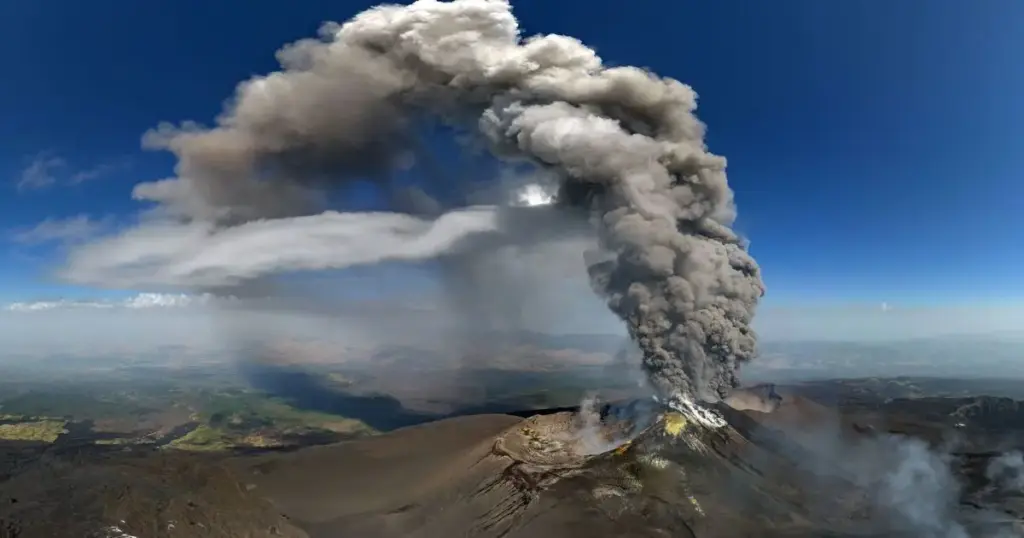
British holidaymakers and international travelers are facing severe travel disruption across Sicily following a dramatic escalation in volcanic activity at Mount Etna, Europe’s highest and most active volcano. The latest explosive phase—centered on the volcano’s Voragine crater—has forced aviation authorities to impose strict caps on incoming flight capacity at Catania Airport, sending shockwaves through peak summer holiday itineraries.
The renewed activity, which began in early August 2026, has blanketed parts of the region in ash, resulting in rolling flight delays, cancellations, and restricted airspace designations. Compounding the ongoing operational chaos, local authorities confirmed a tragic fatality on the mountain slopes late Sunday evening, underscoring the lethal unpredictability of Italy’s most famous geological giant. With a yellow alert level active and strict perimeter ordinances enforced, civil protection agencies are urging absolute vigilance from both residents and tourists as the region grapples with the dual pressures of natural hazards and paralyzed transport hubs.
Detailed Chronology: The Escalation of Events
The latest chapter in Mount Etna’s ongoing volcanic cycle began to unfold in earnest on Sunday, August 17, 2026. Just hours after Catania Airport—formally known as Catania-Fontanarossa Airport—had celebrated a temporary reopening that briefly restored optimism among stranded holidaymakers, nature abruptly reversed the progress.
Sunday Evening: False Hope Shattered
Hopes for a return to standard operational schedules were dashed late Sunday when the Voragine crater underwent a sudden, intense burst of explosive activity. Live video feeds from the region quickly captured dramatic scenes of thick plumes of ash and glowing debris being hurled high into the Sicilian sky. The immediate byproduct of this atmospheric contamination was the restriction of local airspace. Airspace sectors B1 and B2 were swiftly closed by aviation authorities due to heavy concentrations of volcanic ash drifting across flight paths, posing severe ingestion hazards to jet engines.
Initially, incoming flight capacities were drastically throttled down to a maximum of just five arrivals per hour on Monday morning. By late morning, airport management revised the caps upward slightly, permitting up to 10 incoming aircraft per hour. This restriction is slated to remain in force until 12:00 PM local time on Tuesday, August 18, 2026.
Ongoing Disruption at Catania Airport
While departing flights remain technically unrestricted by the airport authority, the knock-on effects of restricted arrivals have created a logistical bottleneck. By 10:00 AM on Monday, airport arrival and departure boards displayed widespread disruption. At least nine outbound departures suffered significant delays, and high-profile cancellations—such as a Transavia France service bound for Paris Orly—crystallized the frustration for travelers trying to exit the island.
Travelers have been strongly advised to bypass standard assumptions, verify flight statuses directly with their respective carriers, and monitor real-time updates before initiating their journeys to the airport terminal.
Tragedy on the Slopes: Fatal Lightning Strike
Amid the unfolding aviation crisis, tragedy struck the upper reaches of Mount Etna late Sunday evening, overshadowing the logistical difficulties with a grim reminder of the mountain’s raw and unforgiving environment.
At approximately 8:00 PM on August 17, a 30-year-old American tourist was struck by lightning while caught in a severe, localized thunderstorm on the volcano. According to local emergency reports, the individual was located within a restricted area of the mountain—zones established to protect the public from active hazards.
Emergency services were immediately mobilized. The Fire Brigade dispatched its specialized Drago 142 helicopter to navigate the treacherous weather conditions and extract the victim. The injured tourist was airlifted in critical condition to Cannizzaro Hospital. Despite the rapid response of medical personnel and advanced trauma interventions upon arrival, the tourist was pronounced dead shortly after being admitted.
The incident has prompted renewed warnings from local authorities regarding the extreme hazards of unauthorized trekking on Etna, where sudden meteorological shifts can turn benign outings into lethal encounters within minutes.
Supporting Context and Metrics: Understanding Mount Etna
To fully appreciate the scope of the current disruption, it is vital to examine the geological framework of Mount Etna and the metrics governing its current eruptive phase.
Anatomy of a Giant
Rising majestically on the east coast of Sicily, Mount Etna stands as Europe’s tallest active volcano, soaring to an elevation of approximately 3,330 meters (though its exact height fluctuates due to recurring summit collapses and growths). The volcano features a complex summit structure dominated by four primary crater areas:
The Northeast Crater
Voragine (currently the epicenter of the latest explosive activity)
Bocca Nuova
The Southeast Crater
Each of these primary summit craters spans roughly 200 meters in diameter, according to data from Italy’s Civil Protection Department. Beyond the main summit, Etna’s sprawling flanks are pockmarked by hundreds of secondary cones and lateral vents, formed over thousands of years of persistent volcanic activity.
The Current Eruptive Phase and Safety Protocols
Etna’s current cycle of activity has been active on and off since August 7, 2026. The Italian Civil Protection Department maintains a yellow alert level for the volcano, the second tier in a four-color warning system that scales from green (normal) through yellow and orange up to red (maximum emergency).
To mitigate risks to human life during active lava flows and ash ejections, regional authorities enacted a strict legal ordinance on August 13. This regulation mandates that all unauthorized individuals must maintain a minimum distance of 200 meters from active lava flows and designated hazard zones. The fatal lightning strike involving the US tourist occurred inside one such restricted zone, highlighting the critical importance of adhering to these municipal safety mandates.
Official Statements and Travel Guidance
The management of Catania-Fontanarossa Airport, alongside national civil aviation bodies (ENAC) and the Italian Civil Protection Department, has maintained a continuous flow of public communication to manage the crisis.
In an official operational update released on Monday morning, Catania Airport stated:
"Flight operations are partially limited to 10 aircraft per hour until 12:00 PM tomorrow, Tuesday, August 18. There are currently no restrictions on departures, but passengers are strongly urged to verify their flight statuses directly with airlines before heading to the terminal."
Airlines operating routes between the UK and Sicily—including budget carriers and legacy operators alike—have activated flexible rebooking policies for affected passengers. Travel insurance experts remind holidaymakers to keep all receipts for meals, accommodation, and alternative transport incurred during the disruption, and to request written confirmation of cancellations or delays directly from carriers to support future compensation claims under EU passenger rights regulations (where applicable).
Future Outlook: What Travelers Should Expect
As the Italian civil authorities and vulcanologists from the National Institute of Geophysics and Volcanology (INGV) continue to monitor Mount Etna’s seismic and atmospheric signatures, the immediate future remains fluid.
Short-Term Outlook (Next 24–48 Hours): The current cap of 10 incoming flights per hour will remain strictly enforced through midday on Tuesday, August 18. Travelers slated to fly into Catania should anticipate rolling delays as airlines attempt to consolidate passenger manifests and manage turnarounds with constrained runway slots.
Medium-Term Outlook: Volcanic activity on Etna is notoriously difficult to forecast. While past cycles have seen explosive phases subside within days, the persistence of ash plumes in sectors B1 and B2 suggests that airspace restrictions could be extended if meteorological winds continue to push particulate matter toward the airport corridors.
Advisory for British Holidaymakers: Tourists currently in Sicily or planning imminent departures to the island should maintain constant communication with their tour operators and airlines. Those planning independent excursions on Mount Etna are reminded to respect all safety cordons, check local weather forecasts meticulously, and avoid restricted zones under all circumstances to prevent further strain on local rescue services.