Executive Overview
In the high-stakes, emotionally turbulent landscape of daytime television, few elements capture an audience’s attention quite like a visceral, raw physical confrontation between legacy characters. Recent episodes of ABC’s enduring daytime drama General Hospital delivered precisely that, treating viewers to an intense, emotionally fraught showdown between teenage characters Danny (played by Asher Antonyzyn) and Rocco (played by Finn Carr). While the on-screen altercation was thick with adolescent angst, unresolved familial tension, and high-octane drama, the reality behind the cameras paints a remarkably different picture.
Far from the hostility projected onto millions of living room televisions, the sequence was a masterclass in collaborative physical storytelling, technical precision, and peer camaraderie. Asher Antonyzyn recently pulled back the curtain on the production process, sharing an exclusive behind-the-scenes look via social media that details the meticulous orchestration required to bring the fictional brawl to life. Through a combination of expert stunt choreography, transformative prosthetic makeup artistry, and the genuine off-screen friendship between the two young actors, General Hospital successfully executed one of its most talked-about physical sequences of the season.
This report examines the anatomy of the Danny-and-Rocco fight sequence, analyzing the technical contributions of the production crew, the collaborative synergy between the young performers, the overwhelmingly positive reception from both fans and veteran cast members, and the broader implications of centering complex narrative arcs on the show’s next generation of talent.
Detailed Chronology: From Rehearsal Room to Broadcast
To understand the impact of the Danny and Rocco confrontation, one must examine the systematic approach the production team and actors took to transform a dramatic script into a believable, high-impact television event. The creation of the scene unfolded across several distinct phases of television production, moving from page to physical execution.
Phase 1: Script Analysis and Safety Briefings
Long before any simulated punches were thrown, Antonyzyn and Carr sat down with their scripts to dissect the emotional underpinnings of the scene. Soap opera fight choreography is rarely just about physical combat; it is an extension of character psychology. The narrative required both actors to channel the pent-up frustrations of their respective characters, ensuring that every shove, block, and strike felt motivated by narrative history rather than gratuitous violence.
Once the emotional beats were established, safety protocol took center stage. Given the physical nature of the sequence, the production’s resident stunt coordinator stepped in to establish strict boundaries. Safety is paramount in daytime television production, where tight shooting schedules leave little room for accidental injuries. The coordinator mapped out precise spatial pathways for the actors, ensuring that camera angles would enhance the illusion of impact while completely safeguarding the performers.
Phase 2: Choreography and Practical Rehearsals
The transition from theory to practice was captured vividly in rehearsal footage shared by Antonyzyn. In a short video clip from the set, the stunt coordinator is seen guiding the young actors through a step-by-step breakdown of a critical punch sequence.
The mechanics of cinematic fighting rely heavily on forced perspective and controlled contact. During the rehearsal, the stunt coordinator stood directly behind Finn Carr, holding his hand up as a strategic target space adjacent to Carr’s face. As Antonyzyn wound up and threw the simulated strike, his fist connected securely with the coordinator’s padded palm rather than his co-star’s skin. Simultaneously, Carr executed a textbook physical reaction—jerking his head backward and selling the kinetic force of the blow as though the connection had been absolute and devastating.
This specialized blocking requires split-second timing. If the puncher’s hand and the receiver’s reaction fall out of sync by even a fraction of a second, the illusion shatters for the viewer. Following a successful run-through of the choreography, Antonyzyn and Carr demonstrated their off-screen bond by clasping hands in celebration, psyching each other up for the high-pressure environment of the live-action take.
Phase 3: The Transformation (Makeup and Prosthetics)
While the choreography provided the movement, the General Hospital makeup department provided the undeniable visual evidence of the brawl’s severity. Crafting convincing physical damage requires a delicate balance of theatrical artistry and realism.
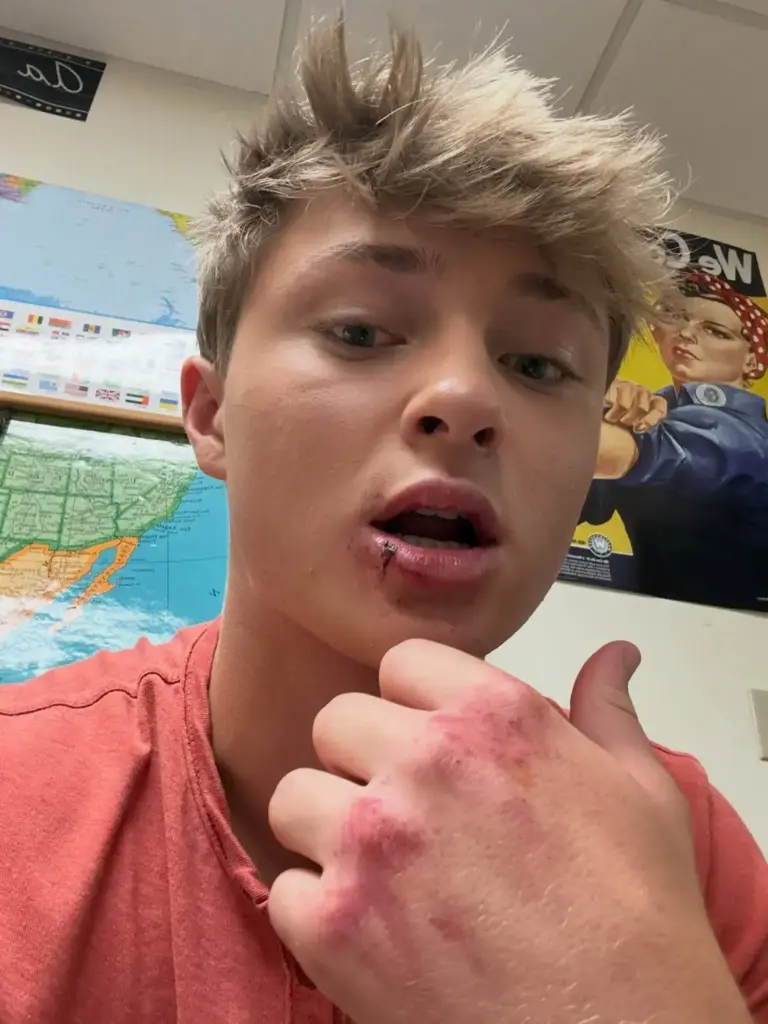
Following the completion of principal photography for the sequence, Antonyzyn documented the aftermath in the makeup chair. The results were striking: hyper-realistic bruised knuckles and a swollen, bloodied lower lip. By utilizing specialized cosmetic pigments, theatrical blood gels, and textured skin simulations, the makeup crew transformed clean-cut actors into bruised combatants, grounding the emotional fallout of the fight in undeniable physical reality.
Phase 4: Broadcast and Post-Production Reception
The culmination of these preparatory steps aired to widespread critical and fan acclaim. Viewers took to social media platforms in droves to praise the raw intensity brought forth by Antonyzyn and Carr. The seamless integration of stunt work, steady-cam operation, editing rhythm, and prosthetic design allowed the sequence to transcend standard daytime fare, delivering an authentic cinematic experience within the traditional multi-camera studio format.

Supporting Context & Metrics: The Rise of Youth Talent in Daytime Drama
The success of the Danny-and-Rocco storyline highlights a broader evolution within the soap opera genre. Historically, daytime dramas relied heavily on veteran performers to drive marquee storylines, while younger characters often served as background elements or catalysts for adult melodrama. However, contemporary audience metrics and demographic shifts have necessitated a pivot toward generational storytelling.
Generational Shifts in General Hospital
General Hospital, which has maintained a continuous broadcast presence since 1963, has continuously reinvented its canvas by introducing offspring of core legacy families. Characters like Danny Morgan (son of Jason Morgan and Sam McCall) and Rocco Falconeri (son of Dante Falconeri and Lulu Spencer) carry the heavy narrative weight of decades of Port Charles history.
When these characters engage in conflict, it is not merely an isolated teenage spat; it is an ideological and emotional clash rooted in the complex webs woven by their parents and grandparents. Casting young actors who possess the technical capacity to handle heavy dramatic lifting—and the physical discipline required for stunt work—is essential for the longevity of the series.
Production Efficiency and Safety Metrics
Executing physical altercations on a daily serial schedule presents unique logistical challenges:
- Time Constraints: Unlike feature films that may afford weeks of pre-production fight training, daytime television often limits stunt preparation to a matter of hours.
- Safety Records: General Hospital’s stunt department maintains a pristine safety record through rigorous pre-blocking sessions, ensuring that complex physical sequences are executed without compromising the health or safety of the cast.
- Digital Engagement: Behind-the-scenes content shared by young stars like Antonyzyn serves as an invaluable metric for audience engagement, driving cross-platform traffic from Instagram and TikTok back to traditional linear and streaming broadcasts.
Official Statements and Social Media Reactions
The transparency displayed by Asher Antonyzyn on social media sparked an overwhelmingly positive public response, transforming a fictional feud into a celebration of collaborative artistry.
In his original Instagram post, Antonyzyn expressed deep gratitude for the collaborative environment on set:
"A little behind the scenes from the Danny and Rocco fight today 👊. Huge shoutout to the @ghmakeupcrew and our awesome stunt coordinator for making us look like we actually beat each other up 🤤. And of course, my bro @finn_car08 for making this scene so much fun to film."
The post quickly became a digital hub for the General Hospital community, drawing enthusiastic comments from both devoted fans and seasoned industry veterans within the cast:
- Ryan Paevey (who portrayed Nathan West/Cassius): Chime in with peer validation, commenting, "Hell yeah man 🙌🙌."
- Katelyn MacMullen (portraying Willow Corinthos): Demonstrated generational support by posting three approving clapping hand emojis.
- Kayden Brenna Tokarski (portraying Scout Cain): Celebrated the young actors’ dedication with three high-intensity fire emojis.
This digital camaraderie underscores a supportive studio culture where experienced performers actively uplift and mentor the younger generation of talent, fostering an environment conducive to creative risk-taking.
Future Outlook: What Lies Ahead for Port Charles’ Next Generation?
As the dust settles on the immediate aftermath of the Danny and Rocco brawl, the narrative trajectory of General Hospital points toward even greater narrative complexity for its teenage demographic. Physical altercations in Port Charles rarely occur in a vacuum; they inevitably ripple outward, forcing parents, guardians, and authority figures to intervene, thereby reigniting long-dormant feuds among the adults.
Narrative Ramifications
The friction between Danny and Rocco raises critical questions for their respective families:
- Parental Interventions: How will Dante Falconeri and the wider Corinthos-Morgan clan react to the escalation of hostilities between the boys?
- Emotional Fallout: Will the physical confrontation serve as a catalyst for genuine reconciliation, or will it entrench the characters deeper into a bitter adolescent rivalry?
- Character Growth: For actors Asher Antonyzyn and Finn Carr, handling such demanding dramatic and physical material solidifies their status as anchors for the show’s future narrative arcs.
Conclusion
The behind-the-scenes revelation of how Danny and Rocco’s fight came to life offers a fascinating glimpse into the mechanics of modern daytime television. By blending rigorous stunt coordination, exceptional prosthetic artistry, and genuine off-screen friendship, Asher Antonyzyn and Finn Carr elevated a standard soap opera script into a masterclass of collaborative performance. As General Hospital continues to bridge its storied past with an evolving future, the dedication of its rising stars ensures that the drama in Port Charles will remain as compelling, visceral, and expertly crafted as ever.