Executive Overview
The juxtaposition of state resources along northern France’s picturesque Opal Coast has ignited a sharp cross-Channel political controversy. While French law enforcement agencies struggle—and, according to critics, frequently fail—to intercept a rising tide of illegal migrant crossings into the United Kingdom, dozens of police officers, tactical vans, and temporary security infrastructure remain permanently stationed outside an empty, high-value coastal property linked to French President Emmanuel Macron and his wife, Brigitte.
The seaside villa, located in the affluent and fashionable resort town of Le Touquet, has become the epicenter of a growing diplomatic and fiscal friction point. Acquired through a family real estate entity connected to the French First Lady, the property is currently undergoing extensive renovations. Yet, the heavy deployment of state-funded security guarding a largely vacant building site stands in stark contrast to the chaotic operational realities unfolding just a few miles away.
Along the same stretch of coastline, people-smuggling syndicates are operating with increasing impunity, deploying heavily loaded "mega dinghies" packed with record numbers of asylum seekers bound for British shores. The situation has intensified political pressure on both sides of the English Channel. In London, the Labour government faces renewed scrutiny over a controversial £662 million funding package disbursed to Paris under a bilateral border-security agreement. Critics argue that British taxpayers are effectively bankrolling a porous French policing apparatus that appears unable—or, as some allege, structurally instructed—to prevent illegal maritime departures.
As watchdog organizations, opposition lawmakers, and taxpayers demand accountability, the incident underscores deep-seated frustrations regarding the allocation of public resources, the efficacy of contemporary border management strategies, and the optics of executive protection amid a continent-wide migration crisis.
Detailed Chronology: The Opal Coast Paradox
To understand the scale of the current controversy, one must examine the geography and timeline of events unfolding across northern France’s Opal Coast. Le Touquet, historically known as "Paris-Plage," is an upscale destination celebrated for its grand architecture, pristine beaches, and status as a favored holiday retreat for the French political elite. Situated roughly 20 miles south of Boulogne-sur-Mer, it offers a tranquil escape from the urban pressures of Paris.
However, over the past year, the idyllic nature of the region has been overshadowed by the relentless mechanics of human trafficking. International criminal gangs have systematically adapted their operational tactics. Historically, small-boat launches were concentrated around the bottleneck ports of Calais and Dunkirk, where heavy French police deployments forced smugglers to innovate. In response, traffickers have pushed further south along the coastline, exploiting the vast, unmonitored expanses of sandy beaches in and around Le Touquet and neighboring municipalities.
The operational shift has yielded devastating results. According to regional reports, small-boat departures from southern launch points have surged. Last month, emergency services were forced to execute a high-risk rescue operation after nearly 100 migrants were stranded on a stricken vessel launched directly from Le Touquet’s beach. Just days later, on August 13, a staggering "mega dinghy"—carrying an unprecedented 230 individuals—successfully set sail for the UK from Berck-sur-Mer, located a mere nine miles south of President Macron’s private property.
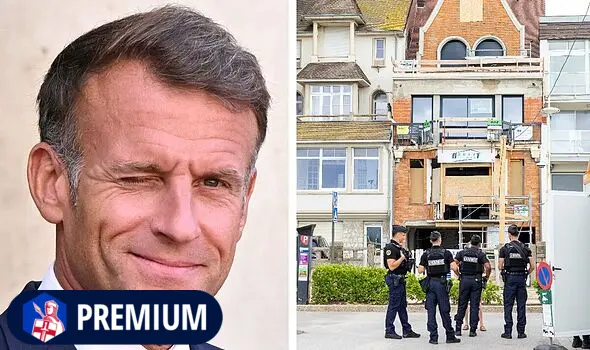
Simultaneously, journalists visiting the upscale neighborhood near Boulevard du docteur Jules Pouget documented a startling scene. Despite the acute operational strain facing French maritime and land units along the coast, a heavy police presence was firmly established around a residential building site. The site, overlooking a municipal car park just yards from the sea, is the future holiday home of the French president, who is slated to complete his final term in office in May next year.
The security deployment includes dozens of uniformed officers, multiple tactical support vans, and two specially erected temporary police huts. For residents, tourists, and visiting observers, the sight of a heavily fortified police perimeter guarding an empty construction site while small boats depart unchecked a short distance away has crystallized a profound disconnect in state priorities.
Supporting Context & Metrics: Financial Flows and Operational Realities
At the heart of the political storm lies a web of financial agreements and contested operational metrics. In an effort to curb unauthorized Channel crossings, the UK government under Labour has committed substantial financial resources to assist French authorities. Under the terms of a bilateral pact, British taxpayers have handed over a staggering £662 million to bolster French police forces, upgrade surveillance technology, and enhance coastal patrols.
Yet, British lawmakers and immigration watchdogs argue that the return on investment has been dismal. Data cited by parliamentary critics indicates that the prevention of Channel crossings has plummeted by roughly 50 percent over the past year. Furthermore, leaked or exposed operational directives have suggested that French police officers are frequently under administrative instruction to avoid aggressive physical interventions while migrants are actively attempting to launch their vessels, citing severe safety risks to both officers and migrants in the surf.
The financial architecture surrounding President Macron’s property has also drawn intense scrutiny. Public records indicate that a building permit has been issued for the substantial extension and renovation of the Le Touquet property. The structure is officially owned by a civil real estate company (Société Civile Immobilière, or SCI) known as SCI Bremselati. Registered at an address historically tied to the French First Lady, corporate registry filings on the French equivalent of Companies House link the entity directly to both Emmanuel and Brigitte Macron.
For British and French taxpayers alike, the financial intersection of £662 million in UK border aid and the state-funded protection of a private presidential asset has proven incendiary. The property, situated in an exclusive enclave, sits squarely within the operational zone where state-backed security is most heavily concentrated, highlighting a systemic allocation of manpower that critics argue prioritizes political protection over public safety and border integrity.
Official Statements and Political Fallout
The revelations have prompted swift and severe condemnations from opposition politicians and fiscal watchdog organizations in both the United Kingdom and France.
Weighing in on the controversy, Chris Philp MP, the Conservative Shadow Home Secretary, delivered a scathing critique of both French enforcement strategies and the current UK government’s approach to border management:
"French police can apparently spare dozens of officers to guard an empty building, but cannot stop mega dinghies launching a few miles down the same coast. Channel crossings preventions are down by half over the past year and, as we exposed earlier this month, French police are under instruction not to intervene when immigrants are attempting to cross.
The only way we can stop the crossings is by having a proper deterrent. If people know they can stay in the UK, get put up in a hotel and claim benefits then they will keep risking these dangerous journeys.
That’s why the Conservative BORDERS plan leaves the ECHR, bans asylum claims from illegal entrants and deports illegal immigrants rapidly on arrival. And that’s why we will stop non-citizens claiming benefits, and why we will restrict Indefinite Leave to Remain (ILR) and citizenship. This is how we will control our borders and end illegal immigration."
The fiscal implications have drawn equal outrage from domestic spending watchdogs. John O’Connell, chief executive of the TaxPayers’ Alliance, expressed deep concern over the utilization of public funds:
"Taxpayers will be outraged if French officers are guarding elite beachside boltholes while small boats launch nearby.
Ministers have handed France hundreds of millions to stop Channel crossings, yet gangs still appear able to launch mega dinghies from its beaches.
The government must demand results for every penny, not let taxpayers bankroll another failing border deal, and finally stop the boats."
In response to growing inquiries, journalistic outlets have formally approached the French Ministry of the Interior for comment regarding the specific operational calculus governing the deployment of tactical units to the Le Touquet building site versus the wider Opal Coast patrol network. As of publication, comprehensive clarifications from Parisian officials remain pending.
Future Outlook: The Road Ahead for Cross-Channel Relations
As Emmanuel Macron prepares to vacate the Élysée Palace in May of next year, the political legacy of his administration’s handling of irregular migration will undoubtedly remain a central point of contention. The intersection of domestic real estate controversies and international border security failures has exposed the fragility of bilateral cooperation between London and Paris.
For the UK government, the mounting pressure to demonstrate tangible results on small-boat arrivals threatens to unravel existing financial agreements with France. With millions of pounds in public funds transferred across the Channel without a corresponding reduction in successful crossings, domestic political momentum is shifting rapidly toward more unilateral, hardline deterrence measures. Proposals to bypass international legal frameworks, accelerate deportations, and overhaul the domestic welfare eligibility for non-citizens are gaining traction among conservative policymakers.
Meanwhile, along the Opal Coast, criminal smuggling networks continue to exploit the geographical realities of an expansive, thinly policed shoreline. Unless French authorities recalibrate their operational priorities—shifting tactical assets away from private presidential properties and toward active coastal interdiction—the optics of heavily guarded empty villas juxtaposed against launching "mega dinghies" will continue to symbolize a profound systemic failure in European and British border governance.
The coming months will test the resolve of both governments. Whether enhanced financial packages can be tied to strict, verifiable operational Key Performance Indicators (KPIs) remains to be seen. What is certain, however, is that public tolerance for perceived administrative hypocrisy—wherein state protection is seemingly reserved for the elite while national borders remain porous—has reached a critical breaking point.