Executive Overview
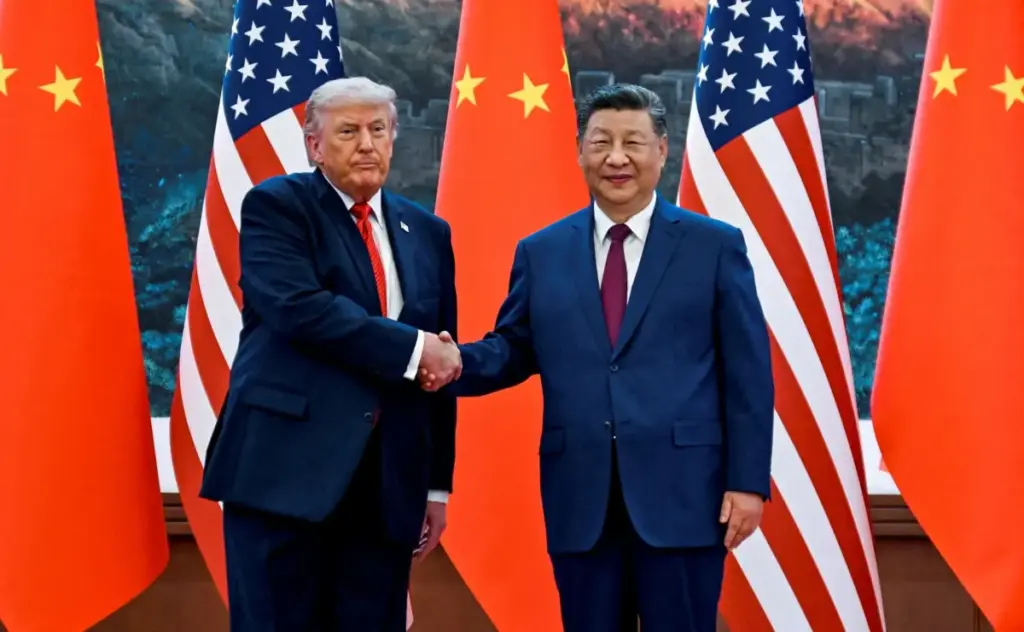
The arrival of Chinese President Xi Jinping and First Lady Peng Liyuan at Joint Base Andrews in Maryland set the stage for one of the most high-stakes, politically fraught diplomatic encounters of the decade. Marked by contrasting body language, immediate political friction within the United States, and an ongoing constitutional battle over media access, the three-day state visit underscores the delicate and often volatile relationship between the world’s two largest economic superpowers.
As President Donald Trump greeted his counterpart on the tarmac—a break from decades of diplomatic protocol that immediately drew ire from within his own party—a roaring military flyover offered a stark metaphor for the tensions underpinning the summit. While Trump visibly winced and braced himself against the concussive blast of overhead fighter jets, President Xi stood entirely unmoved, projecting an image of stoic detachment.
Beyond the theatricality of the tarmac, the summit arrives at a critical juncture for global geopolitics. Over the next three days, Washington and Beijing are slated to tackle an ambitious, thorny agenda spanning international trade, technological dominance, regional security in the Indo-Pacific, and the future of Tehran. Yet, even before the first formal bilateral talks could commence, the visit was shadowed by domestic dissent, Republican backlash against what critics termed a "lavish" reception for an "oppressive dictator," and a landmark federal court ruling ordering the immediate restoration of press credentials for several major U.S. news outlets.
This comprehensive report examines the nuances of the arrival ceremony, the mounting geopolitical and domestic pressures facing the White House, the legal fallout surrounding the administration’s media restrictions, and the broader implications for U.S.-China relations.
Detailed Chronology: The Tarmac Arrival and Initial Encounters
The state visit began under clear Maryland skies at Joint Base Andrews, where a red carpet had been meticulously rolled out alongside a full military honour guard and marching band. The visual tableau was designed to mirror the reception afforded to President Trump during his state visit to Beijing in May, when Chinese officials greeted him with elaborate ceremonies, red carpets, and troops standing at rigid attention.

The Fighter Jet Incident
The most arresting visual moment of the arrival occurred as the presidential fleet—including Air Force One and advanced F-35 fighter jets—loomed in the background. As the Chinese leadership disembarked, a planned military flyover roared across the airspace.
President Trump, standing at rigid attention to render a formal military salute, was caught off guard by the overwhelming acoustic and physical force of the jets passing overhead. Visible tension crossed his face as he winced against the deafening roar. In sharp contrast, President Xi remained utterly impassive. Flanked by Madame Peng, Xi did not look up, maintaining a stone-faced and unflinching posture throughout the display. Analysts and body language experts immediately seized on the contrast as a symbolic prelude to the negotiations ahead—one leader visibly reactive to domestic pageantry, the other projecting unyielding composure.
Breaking Protocol
Following the flyover, President Trump and the First Lady descended to the tarmac in the presidential limousine, affectionately known as "The Beast," to personally greet President Xi and Madame Peng at the base of the aircraft stairs. The two delegations engaged in an extended, cordial conversation on the tarmac for several minutes.
This personal gesture marked a significant departure from modern protocol. It is the first time in 11 years that a sitting U.S. President has personally met a visiting foreign head of state at the airport rather than awaiting them at the White House portico. While intended as a diplomatic courtesy—and potentially reciprocating the high-level hospitality Trump experienced in Beijing earlier in the year—the airport greeting immediately ignited a firestorm among hardline conservatives and traditional foreign policy hawks within the Republican Party.
Supporting Context & Metrics: Domestic Backlash and Geopolitical Stakes
The decision to roll out the red carpet for Beijing’s leader exposed deep ideological fissures within the Republican coalition. Critics argue that treating Xi Jinping to a full state welcome normalizes an adversarial regime and undercuts Washington’s posture as a defender of global democratic norms.

Congressional Opposition
The dissent found its most vocal expression on the floor of the United States Senate. Senator Roger Wicker of Mississippi, once a reliable ally of the administration, launched a blistering critique of the White House’s hosting strategy.
"Had the White House asked me for advice, I would have suggested the president not invite Xi Jinping to Washington for such a lavish welcome," Senator Wicker declared from the Senate floor. "During every minute of dialogue, our commander-in-chief should keep in mind that his guest is a brutal, unelected and oppressive dictator who seeks to dominate his neighbours and whose massive military arsenal is aimed directly at the United States of America."
Such remarks highlight the narrow tightrope the administration must walk. While the White House is eager to project strength and secure tangible economic concessions, domestic critics are watching closely for any sign of appeasement.
The Core Agenda: Trade, Technology, and Taiwan
Despite the political theatre, substantive policy discussions remain the core objective of the three-day summit. Both superpowers recognize that their economic fates are inextricably linked, even as strategic competition intensifies. Key topics on the agenda include:
- Bilateral Trade: Rebalancing trade deficits, addressing intellectual property theft, and reviewing existing tariff structures established during previous diplomatic skirmishes.
- Artificial Intelligence and Technology: Navigating the race for technological supremacy. Interestingly, defense and tech analysts note that despite fierce competition in semiconductors and quantum computing, neither Washington nor Beijing can afford to apply the brakes on artificial intelligence development without ceding catastrophic strategic advantage.
- Geopolitical Flashpoints: Addressing regional security concerns regarding Taiwan, maritime disputes in the South China Sea, and the evolving diplomatic posture toward Tehran.
Official Statements and the Legal Battle Over Media Access
The diplomatic choreography of the summit unfolded against the backdrop of an unprecedented constitutional clash between the executive branch and the domestic press corps.

The White House Press Ban and Judicial Intervention
In the days leading up to Xi Jinping’s arrival, the White House instituted a strict media blackout concerning the airport arrival, enforcing a ban that barred journalists from prominent U.S. outlets—specifically CNN, MS NOW, and Politico—from covering the events at Joint Base Andrews. In a rare display of journalistic solidarity, staff reporters from Fox News, CBS, and NBC stood down and refused to cross the virtual picket line, leaving the official press pool severely depleted.
The ban sparked an immediate legal challenge. During an emergency hearing in federal court, Justice Department attorney Michael Velchik urged U.S. District Judge Timothy Kelly to withhold any injunction until after the conclusion of the state visit, arguing that executive privilege extended to logistical press management during high-security international summits.
Judge Kelly summarily rejected the government’s plea. Issuing a temporary restraining order, the judge ruled that the barred news outlets were "likely to succeed" in demonstrating that the White House had deprived them of adequate due process under the law. The court ordered that press access be restored immediately for a 14-day period, forcing the administration to scramble and re-accredit the affected journalists just as the state visit got underway.
Ironies of the Past
Commentators and political historians were quick to point out the cyclical nature of political rhetoric surrounding diplomatic receptions. During Barack Obama’s presidency in 2012, a then-private citizen Donald Trump took to social media (then Twitter) to lambaik the Obama administration for affording Xi Jinping a "full honours ceremony with music and cannons," calling the decision "so wrong." Fourteen years later, facing the realities of executive office, President Trump found himself orchestrating an equally, if not more, elaborate display—complete with rolling red carpets, military bands, and roaring F-35s.
Future Outlook: What to Expect from the Remainder of the Summit
As the state visit moves past its dramatic opening moments, attention shifts squarely to the closed-door negotiations and high-profile ceremonial events scheduled over the next 48 hours.

- The Bilateral Sessions: Over the next two days, working groups comprising senior cabinet officials, trade representatives, and national security advisors will attempt to hammer out text on contentious trade agreements and AI safety protocols. While breakthroughs on existential issues like Taiwan remain unlikely, incremental agreements on communication channels and trade compliance are expected.
- The State Dinner: Scheduled for Thursday evening, the formal state dinner will test the administration’s ability to balance opulence with political optics, especially under the watchful eye of skeptical lawmakers on Capitol Hill.
- Cultural and Historical Engagement: A planned excursion to the National Archives—where the leaders are scheduled to view foundational American documents, including the Declaration of Independence and the Constitution—is intended to project historical continuity and democratic values, though critics argue it risks providing undue visual validation to an authoritarian guest.
Ultimately, while the image of President Trump wincing beneath the roar of fighter jets while President Xi stands impassive will likely endure as the defining snapshot of the arrival, the true measure of the summit will be determined by whether these two global titans can steer their formidable nations away from confrontation and toward managed coexistence.