Executive Overview
For over a decade, J. Cole has occupied a rare, almost singular space in contemporary hip-hop. He bridges the gap between mainstream chart dominance and deeply introspective, lyrical consciousness. As the hip-hop community watches him traverse his current era, the atmosphere surrounding his live performances has shifted palpably. What was once heralded as a standard victory lap across arenas has transformed into something much more intimate, raw, and vulnerable: a public processing of legacy, mortality, and artistic completion.
At the center of this transformation is The Fall-Off tour—a massive live undertaking that has run concurrently with revelations about the rapper’s career trajectory. Far from a definitive curtain call or a final goodbye to the genre, The Fall-Off serves as the narrative climax of the "J. Cole" persona. It is the final chapter of a meticulously crafted story that began years ago. However, the emotional toll this journey is exacting on the North Carolina lyricist has caught many by surprise.
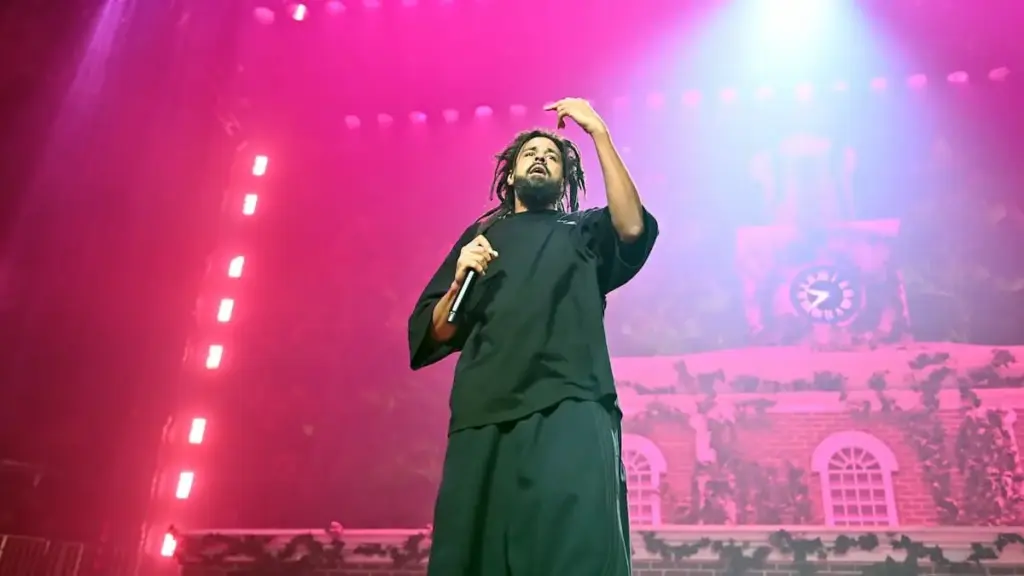
Recent stops on the tour—most notably a poignant evening in Cleveland, Ohio—have highlighted a man grappling with the immense gravity of his own catalog. When a visibly choked-up Cole found himself unable to finish fan-favorite anthem "Love Yourz," letting thousands of voices carry the weight of the chorus instead, it was more than just a memorable concert moment. It was a manifestation of years of built-up pressure, artistic introspection, and an overwhelming wave of gratitude. This report examines the intricate narrative structure of The Fall-Off, the profound significance of his career milestones, and why this tour represents a psychological watershed moment for one of hip-hop’s most reflective icons.
Detailed Chronology: The Anatomy of an Emotional Tour Stop
The signs that The Fall-Off tour would be different from anything J. Cole had attempted before began appearing early in the run. Observers noted a distinct lack of the usual bravado that often accompanies arena rap tours. Instead, audiences were treated to a retrospective atmosphere, where every song felt weighted with historical context.
The emotional climax of this tour crystallized in Cleveland, Ohio. Mid-set, as the opening chords of 2014 Forest Hills Drive standout "Love Yourz" echoed through the venue, the crowd erupted into a deafening roar. The song, widely recognized as a generational anthem of gratitude and self-worth, has always commanded a special reverence from Cole’s fanbase. Yet, what happened next transcended a typical live performance.
As Cole stepped up to the microphone to deliver the first verse, the sheer volume and passion of the crowd singing every single word back to him stopped him in his tracks. Visibly moved, the 41-year-old MC lowered his head, covered his face, and succumbed to tears. The emotional dam had broken. For the remainder of the track, Cole surrendered the performance entirely to the audience, pacing the stage while wiping away tears as thousands of fans carried his message back to him.
Footage of the emotional display immediately flooded social media platforms like X (formerly Twitter) and TikTok, sparking widespread discussion among hip-hop enthusiasts. Comments flooded in expressing concern and deep empathy for the artist.
- "J. Cole might be going through the toughest times right now, for real,"* one fan posted.
- “Bro has been so emotional throughout the whole Fall-Off tour. You can tell this means everything to him,” another noted.
This Cleveland performance was not an isolated incident. Across multiple cities, attendees have reported seeing a more fragile, reflective version of the rapper—one who pauses frequently between songs to converse with the crowd like old friends, meditating on the passage of time and the fragility of success.
Supporting Context & Metrics: Unpacking The Fall-Off and the "J. Cole" Character
To understand why The Fall-Off tour is eliciting such profound emotional responses, one must examine the conceptual framework underpinning the album and the broader J. Cole mythos. For years, fans speculated that The Fall-Off would signal an abrupt, permanent retirement from music. However, Cole has since clarified that his artistic journey is more nuanced than a simple walk into the sunset.
In recent interviews and lyrical admissions, Cole has reframed his relationship with the genre. He has described several of his past projects not as chapters of his life story, but as "lyrical exercises"—strenuous physical and mental conditioning designed to sharpen his pen.
"It’s just lyrical exercise," Cole explained when discussing how he views some of his earlier mixtapes and albums. "It’s me practicing to get to ‘The Fall-Off,’ which is the continuation of the J. Cole story. Jermaine’s life story in the form of this J. Cole character."
This distinction is crucial. By viewing "J. Cole" as a character—an avatar created by Jermaine Cole to navigate the treacherous waters of the music industry—the rapper has effectively created a narrative boundary. Once The Fall-Off concludes that narrative arc, the character’s story is complete.
However, this does not mean the real-life Jermaine Cole will never touch a microphone again. Instead, any future verses, guest appearances, or occasional releases will exist purely as "exhibitions." They will be athletic displays of skill rather than structural pillars of a grand life narrative. This realization—that he is orchestrating the final act of a multi-decade conceptual masterwork—explains why the weight of the tour feels so immense. He is closing a book he spent his entire adult life writing.
Official Statements and Retrospective Insights: The Legacy of 2014 Forest Hills Drive
The emotional resonance of playing a track like "Love Yourz" goes back to a foundational pivot point in Cole’s career: the release of 2014 Forest Hills Drive. The album, which famously went double platinum with zero features, was a critical and commercial triumph that cemented his elite status. Yet, behind the scenes, its release represented something much more vital for the artist: exhaustion followed by long-overdue relief.
In a candid 2021 interview with SLAM Magazine, Cole reflected on the psychological state he was in immediately after dropping the album. For the first time in his professional life, he was able to exhale.
"It was after I got off tour, and I could breathe. I was like, ‘Damn,’" Cole recalled, letting out a heavy sigh of relief. *"For the first time, I felt comfortable in a good way. I allowed myself to just chill, watch TV, play video games. Simple s that [people] do, but I don’t do. S that before I wouldn’t allow myself to do, because it was like, ‘Yo, I got way bigger s** to do, way bigger fish to fry.’ I wouldn’t even give myself the pass of watching a whole [TV] series."
That period of forced stillness forced Cole to confront a terrifying question familiar to many workaholics and high-achievers: Now what?
At that juncture, retirement crossed his mind seriously. He had achieved commercial success, secured critical acclaim, and proven his point to the rap world. But when he audited his own artistic drive, he realized he wasn’t finished.
"And when I asked that question, it was strictly from an ability standpoint, a fulfillment standpoint," Cole elaborated. *"Like, did you max out your skill? Did you max out your abilities, or did you leave s** on the table in terms of pushing yourself? And at that time, I remember feeling like, ‘No, no, you didn’t.’ The truth was very clear."
That refusal to leave potential on the table led directly to the creation of subsequent masterpieces, relentless feature runs, and ultimately, the construction of The Fall-Off. Yet, looking back from the vantage point of the current tour, the distance between the hungry young artist of Forest Hills Drive and the weathered veteran standing on stage in Cleveland is staggering. The tears in Cleveland were not just for the song; they were for the journey it took to get from that exhausted breathing room in 2014 to the mature reflection of today.
Future Outlook: The Next Evolution of Jermaine Cole
As The Fall-Off tour continues to make its way across major markets, industry analysts and die-hard fans alike are looking toward the horizon. What does the post-character landscape look like for J. Cole?
If his recent statements hold true, the conclusion of this album cycle will not mean the total evaporation of his voice from hip-hop. Instead, it marks the liberation of Jermaine Cole from the narrative obligations of the "J. Cole" storyline. Freed from the pressure of building a cohesive, chronological artistic autobiography, future musical endeavors—if any materialize—will likely be driven by pure impulse, collaboration, and a love for the craft rather than the burden of legacy building.
Furthermore, Cole’s increasing willingness to show vulnerability on stage points toward a broader cultural shift within hip-hop itself. For decades, the genre demanded an unyielding armor of toughness, particularly from its biggest stars. By openly weeping in front of thousands of fans, overwhelmed by the beauty of his own lyrical creation, Cole continues to redefine what strength looks like for a modern rap icon.
Ultimately, The Fall-Off tour will be remembered not merely as a string of sold-out arena dates, but as a cathartic communal ritual. It is a space where an artist and his audience can look back at an extraordinary body of work, acknowledge the blood, sweat, and tears required to build it, and mutually accept that all good stories must eventually reach their breathtaking, emotional conclusion.