Executive Overview
Television history is littered with bold swings that fall flat, particularly when a series pivots away from its primary premise right at the midpoint of its inaugural season. Yet, HBO’s ambitious sci-fi-meets-neo-noir drama Lanterns—co-created by Chris Mundy, Damon Lindelof, and Tom King—has managed a rare feat. Following a bloody, high-stakes collision between alien forces, the interstellar Green Lantern Corps, and Zoe the Manhunter that left the small, unsuspecting town of Rushville, Nebraska, hanging in the balance, the series abruptly answers the viewer’s implicit question: Now what?
Rather than coasting on the exhaust of its explosive first-act climax, Lanterns pivots into a character-driven murder mystery. The narrative shifts its focus from a sprawling cosmic war to a localized whodunit: Who killed Hal Jordan? The power ring has changed hands—torn from Hal’s living grip by John Stewart, only to be delivered to Lianna the Guardian as John stubbornly rejects the cosmic burden—and the dust has settled over Rushville. What remains is a complex web of small-town politics, familial trauma, corporate architectural scheming, and extraterrestrial fallout.
As Lanterns maps out its post-climax trajectory, it borrows structural cues from prestige dramas like True Detective while carving out a distinct niche in the DC television landscape. This analysis examines the tectonic narrative shifts of the series’ pivotal mid-season episodes, dissecting the political friction, character evolutions, and narrative stumbling blocks defining this ambitious HBO venture.
Detailed Chronology: The Road to Rushville and Beyond
To understand where Lanterns stands now, one must retrace the harrowing sequence of events that led to Hal Jordan’s assassination and the subsequent legal and emotional nightmare engulfing John Stewart.
The Setup and the Crime
The narrative doubles back to resolve the chilling flash-forward that opened the series premiere: the discovery of Hal Jordan’s lifeless, frozen body in the Rushville, Nebraska football stadium. Hours prior to his murder, John Stewart was manipulated into visiting Rushville by his estranged mother, Bernadette—a woman whose toxic influence casts a long shadow over John’s life. Bernadette lured John under the false pretense that Hal wished to apologize for past grievances.
While the apology was a fabrication, Hal confirmed a brutal truth that cut John to the quick: a genuine friendship existed between Hal and John’s mother. The ensuing argument ended in physical violence, with John breaking Hal’s nose before storming off. Hours later, Hal was executed at point-blank range with a 9mm bullet in the middle of the stadium.
The circumstantial evidence against John is staggering. Even though viewers know John had already departed town, his fractured relationship with the local sheriff, Kerry Kane, and the freshly broken nose on the deceased’s face present an insurmountable optics problem.
Enter Guy Gardner and the Local Backlash
John’s attempts to keep a low profile are short-lived. He inevitably clashes with Kerry’s ex-husband, Billy Macon, and a contingent of armed local thugs. The catalyst? John triggers a "Lantern-Signal" left behind by the sector’s new replacement Green Lantern: Guy Gardner.
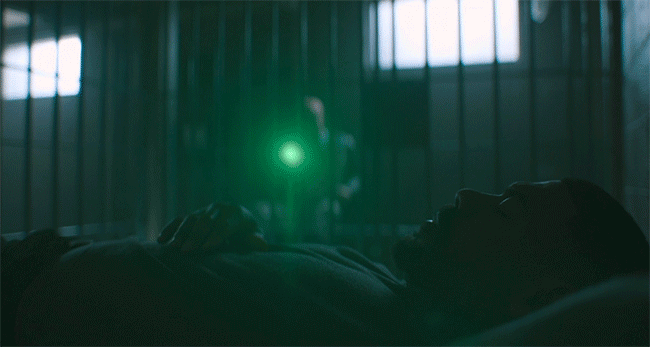
Portrayed with chaotic relish by Nathan Fillion, Gardner—a blonde, bowl-cut-sporting athletic director—was drafted into the Corps after Hal burned out and John refused the gig. The citizens of Rushville, already hostile toward extraterrestrial interference, are doubly enraged to witness a disgraced former Lantern activating the beacon. Unsurprisingly, picking a fistfight with John Stewart yields broken teeth for the locals. John enjoys a brief, tense family dinner with Kerry and her teenage son, Noah, before the law catches up to him, landing him in a holding cell until his brother Marcus arrives with bail.
Familial Dynamics and Corporate Realities
John’s civilian life outside the Corps is defined by sharp contrasts. Sporting a bold, newly minted goatee, John works as an architect specializing in survivalist panic rooms for individuals and municipalities, running a successful firm alongside his brother Marcus. The proceeds of this venture fund the recording career of their other brother, Andre.
Despite their professional success, the familial dynamic remains uniquely dysfunctional. Marcus and Andre jokingly refer to John as "Chosen"—a lingering jab at his green past and perceived parental favoritism. Yet, this familial favoritism has yielded little emotional stability: their mother remains eccentric, and their father literally shoots up his retirement home simply to command John’s attention.
John’s professional obligations demand his presence in Midway City, where he is slated to pitch an underground bunker system capable of housing tens of thousands. Instead, he remains trapped in Rushville, compelled by a strange sense of duty to organize a proper funeral for Hal Jordan.
Supporting Context & Metrics: Deconstructing the Lore and Production Choices
The world-building of Lanterns relies heavily on contrasts between cosmic grandeur and the claustrophobic paranoia of rural America. Analyzing the structural mechanics of the series reveals both its triumphs and its missteps.
The Bureaucracy of Burial
Organizing Hal Jordan’s funeral requires navigating bizarre interplanetary logistics. Guy Gardner is dispatched to outer space simply to retrieve a proper uniform and decommissioned ring. The eulogy itself—written by Hal and delivered via his ex-girlfriend, Carol Ferris—presents a fascinating psychological portrait of a space cop grappling with mortality. Blending delusions of cosmic grandeur with genuine existential dread, Hal’s final written words ("I hope I mattered") underscore the heavy psychological toll of wearing the ring.
Determined to find the killer, John digs up Hal’s body, pries off the decommissioned ring, and unlocks a digitized doppelgänger of his predecessor. This holographic backup reacts to the news of its own demise with profane, pitch-perfect dismay, opening up new avenues for investigative partnership.
Narrative Friction Points
While the central mystery is compelling, certain world-building choices stretch suspension of disbelief to its breaking point:
- The Rushville Paradox: Rushville is depicted as a town full of fully armed, highly trained civilian militias indoctrinated to fight Green Lanterns on sight. The notion that Hal Jordan—the very Lantern responsible for a massive percentage of local casualties—could walk around unarmed without being immediately executed feels wildly implausible. Furthermore, the mild social pushback Sheriff Kerry Kane faces for openly dating Hal fails to compute against the town’s militant xenophobia.
- Pop Culture Crap-Shoots: The series’ persistent reliance on Harry Potter references—such as the "Spazkaban" space prison—feels increasingly dated and tonally jarring. Aligning the universe’s space cops with references to a franchise tied to modern sociopolitical controversies risks alienating viewers, unless the writers are intentionally framing Hal and Guy as insufferable "Harry Potter adults."
Official Statements and Creative Vision
The creative team behind Lanterns—anchored by showrunners and writers Chris Mundy, Damon Lindelof, and Tom King—has been vocal about subverting traditional comic book adaptations. Eschewing standard universe-building templates, the trio has opted for a grounded, atmospheric procedural framework.
Speaking on the structural mid-season pivot, production insiders have emphasized that the series is designed as an examination of institutional justice. By introducing three distinct archetypes of Green Lanterns—Hal Jordan, Guy Gardner, and John Stewart—the narrative interrogates the systemic philosophy of the Guardians of the Universe.
"When you give mortal beings infinite power, you aren’t just testing their morality; you are exposing the flaws of the institutions that chose them," notes a source close to the production.
The revelation that the Manhunters—the robotic precursors to the Green Lanterns—were engineered by the Guardians themselves serves as a thematic anchor. Each Lantern represents a different flavor of ego and hubris, forcing John Stewart’s rejection of the ring to read not as cowardice, but as a clear-eyed moral imperative against a corrupt cosmic hierarchy.
Future Outlook: Now What?
As Lanterns charges into the second half of its inaugural season, the stakes have fundamentally shifted. Hal Jordan is gone, but the hunt for his assassin has transformed the series into a gripping metaphysical whodunit.
The introduction of dangling plot threads—such as the cosmic-cube vault locked inside Hal’s storage locker, the emergence of decoy-Hal’s digital consciousness, and a teenage extortionist named Maggie shaking John down for battle reparations—ensures that Rushville will remain a powder keg.
Ultimately, Lanterns has successfully answered the daunting question of its own mid-season structural collapse. By trading space battles for small-town neo-noir investigations, the series proves that the most compelling science fiction is often found not in the vastness of the cosmos, but in the muddy, complicated terrain of human accountability. The Guardians may design the rings, but the true test is whether anyone can wield them without losing their soul.