Executive Overview
At the intersection of global artistic mastery and localized environmental vulnerability lies A Song for the Snow Lion, a striking 21-minute short film slated for its premiere at the prestigious Telluride Film Festival. The project brings together two titans of their respective creative fields: legendary cellist Yo-Yo Ma and acclaimed Bhutanese auteur Pawo Choyning Dorji. Built around a fragile ecosystem and an enduring Himalayan folktale, the film addresses one of the defining crises of the modern era—the rapid, catastrophic retreat of Himalayan glaciers and the downstream existential threats they pose to billions of lives.
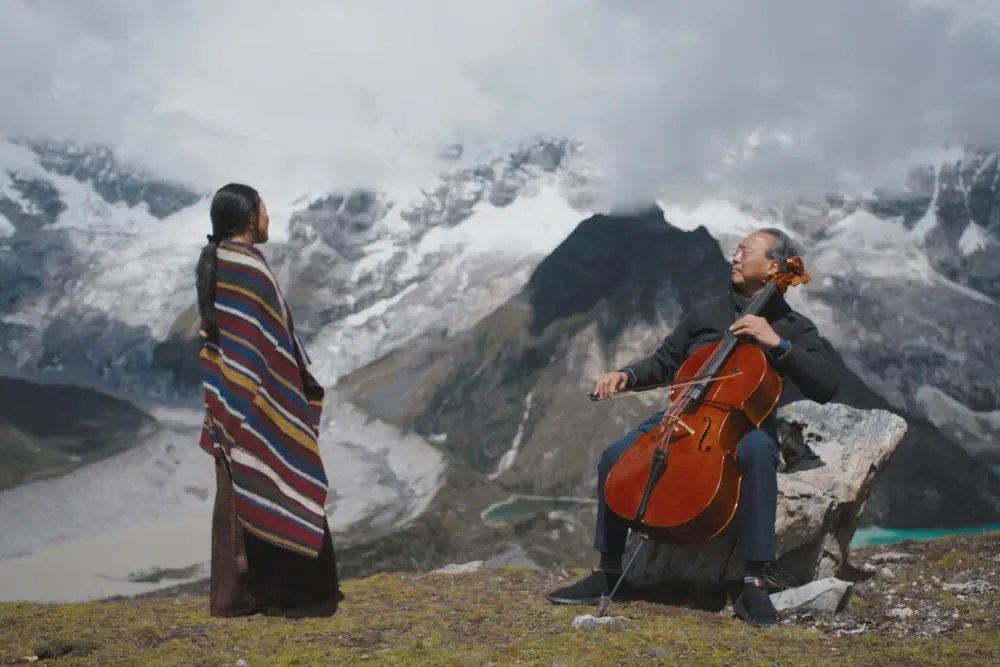
What began as an informal inquiry from a musician searching for a visual medium to express climate anxiety evolved into an arduous, high-altitude pilgrimage. Shot at staggering elevations exceeding 5,500 meters (18,100 feet) in Bhutan’s remote Lunana Valley, the production embraced the physical hardships of the landscape to forge a cinematic and musical offering. Starring 10-year-old Kinley Karma Lhazing—a child from a local yak-herding family—alongside Bhutanese folk singer Kelden Lhamo, the short film uses myth, music, and the raw sounds of nature to translate abstract climate data into a visceral cultural warning.
As Variety unveils the official first trailer, A Song for the Snow Lion positions itself not merely as a piece of eco-cinema, but as a cultural artifact that argues humanity’s survival and the planet’s health are inextricably bound together.
Detailed Chronology: From a Musician’s Wish to an 18,000-Foot Production
The Genesis of a Cross-Cultural Collaboration
The genesis of A Song for the Snow Lion traces back to Yo-Yo Ma’s long-standing fascination with the Kingdom of Bhutan. For years, the world-renowned cellist had sought an opportunity to visit the carbon-negative Himalayan nation, drawn by its pristine landscapes, unique cultural heritage, and its position at the headwaters of major Asian river systems. This desire crystallized after Ma viewed Pawo Choyning Dorji’s previous cinematic works: the Oscar-nominated breakout hit Lunana: A Yak in the Classroom and the acclaimed political satire The Monk and the Gun.
Impressed by the poetic resonance of Dorji’s storytelling, Ma initiated contact with the director. Initially, the cellist envisioned a straightforward music video addressing global warming and the recession of Himalayan ice sheets. Dorji, however, rejected the conventional music video format. Instead, he proposed a narrative short anchored in a folktale from his own childhood—a story that frames environmental stewardship not through clinical scientific charts, but through the myth of the snow lion, a celestial guardian said to inhabit the exact altitude where glaciers survive.
The Pilgrimage to Lunana
Translating this vision to the screen required entering one of the most punishing environments on Earth. Production took place in the Lunana Valley, a remote enclave situated over 5,500 meters (18,100 feet) above sea level. Devoid of modern infrastructure, the location was reachable only by a grueling 14-day trek from the nearest accessible road. The entire production operated entirely on solar battery power, reflecting the filmmakers’ commitment to ecological sustainability.
For Dorji, the arduous journey was not a logistical hurdle to be minimized, but an essential component of the artistic process. In Bhutanese tradition, the physical difficulty of reaching a sacred site imbues the journey with spiritual value; a blessing cannot be received through comfortable arrival.
The physical toll on the cast and crew was immense. Yo-Yo Ma suffered from altitude sickness during the arduous shoot, yet persevered to perform the film’s climactic musical sequence alongside Bhutanese folk singer Kelden Lhamo. Looking down from the freezing heights at shimmering glacial lakes, Ma was struck by the latent power of the landscape, vividly imagining the torrential rush of water those melting formations could unleash upon the valleys below.
The Real-Time Climax
In a striking convergence of art and reality, the film captured an unscripted, terrifying moment of environmental collapse. Immediately after the cameras stopped rolling on Ma and Lhamo’s climactic performance, a massive glacier fractured in the distance, violently calving into the glacial lake below.
Rather than treating the incident as a disruption, the production team recorded the thunderous sound and integrated it directly into the closing moments of the film. For Dorji and his crew, the event carried profound symbolic weight: the production had ascended the mountain to make an artistic offering to the spirit of the ice, and in its final moments, the ice answered back.
Supporting Context & Metrics: The Science and Symbolism of Glacial Retreat
The Ecological Stakes in the Himalayas
While A Song for the Snow Lion relies on the language of myth, its foundation rests on alarming, empirically verified scientific realities. The Hindu Kush Himalaya region, often referred to as the "Third Pole," contains the largest volume of ice outside of the polar caps. These glaciers serve as the primary water tower for Asia, feeding major river systems—including the Ganges, Brahmaputra, Mekong, and Yangtze—that sustain nearly two billion people downstream.
Recent scientific assessments indicate that Himalayan glaciers are melting at an unprecedented rate due to accelerated global temperature increases. According to international glaciological studies, these ice masses could lose up to 80% of their volume by the end of the century if global carbon emissions are not drastically curbed.
The immediate dangers of this retreat were underscored by tragic flooding events in neighboring Nepal, which served as devastating reminders of the destructive potential unleashed by destabilized glacial lakes and unpredictable monsoon patterns.
The Mythological Framework
Dorji’s integration of the snow lion myth addresses a fundamental challenge in environmental communication: how to translate statistical data into emotional urgency.
[Scientific Data: Glacial Retreat]
        ↓
[Mythological Framework: The Snow Lion's Habitat]
        ↓
[Cultural Resonance: Protecting the Mountain Through Rebuttal of Apathy]
        ↓
[Artistic Translation: Music & Storytelling (Yo-Yo Ma & Kelden Lhamo)]
In Bhutanese folklore, the snow lion represents purity of action and the awakened mind. According to traditional lore, the creature lives exclusively where the glaciers remain intact. Dorji explains the pedagogical brilliance of this traditional construct: a child does not learn to protect fragile alpine ecosystems by reviewing emission charts or temperature graphs; a child learns preservation because they are taught that a living, sacred guardian makes its home upon the snow.
When the glacier vanishes, the snow lion’s habitat is destroyed, and the foundational stories that taught generations of mountain communities to revere and protect their natural environment vanish along with it.
Official Statements & Creative Perspectives
The collaboration between Yo-Yo Ma and Pawo Choyning Dorji represents a fusion of global musical eminence and regional cinematic voice. Both creators have spoken extensively about the philosophical and emotional stakes driving A Song for the Snow Lion.
Pawo Choyning Dorji on Modernization and Loss
Dorji’s career has consistently interrogated the friction between traditional ways of life and the relentless pressures of globalization. His previous works—Lunana: A Yak in the Classroom and The Monk and the Gun—examined the cultural shifts experienced by a secluded kingdom opening its borders to the outside world. With A Song for the Snow Lion, Dorji pivots from human-driven modernization to an inescapable planetary crisis:
"It’s the same question I am returning to, of what we stand to lose, except this time the answer isn’t in our hands. Our glaciers are melting away regardless of what we choose."
Reflecting on the unique challenges of directing a short-form narrative after helming feature-length films, Dorji noted the precision required to communicate complex themes within a compressed timeframe:
"Every shot had to carry more than one thing at once, the landscape had to be the character, the song had to be the theme… If the film leads even one person to care a little more about the earth we live on, then I will be a content and happy filmmaker."
He also draws a direct parallel between the act of storytelling and the psychological release of emotional burdens:
"As the little girl in ‘A Song for the Snow Lion’ tells us, to tell a story in Bhutan is to untie a knot… The glacier and the folktale are bound in exactly that way. The snow lion lives where the glaciers are. When the glacier goes, the snow lion has nowhere left to live, and the story that taught us to revere the mountain goes with it."
Yo-Yo Ma on Water, Music, and Shared Humanity
For Yo-Yo Ma, the collaboration was an exploration of how cultural expression can bridge the gap where scientific terminology and political discourse fall short. Addressing the interconnected nature of planetary health and human physiology, Ma noted:
"Thinking about water helps me understand that we are not separate from the earth and that our survival and the health of the planet are one. It is literal—we are more than half water—but it is also cultural. The flows of human history, of trade and ideas, conflict and creation, trace water: glaciers, rivers, deltas, oceans. Like music, water travels lightly, it knows no borders."
Reflecting on the emotional resonance of performing at 18,000 feet alongside local artists like Kelden Lhamo and young Kinley Karma Lhazing, Ma described the project as transformative:
"It was a life-changing experience, spending time with Pawo, meeting Kelden and performing with her at 18,000 feet… The kind of musical interaction I experienced with Kelden has been the engine of music’s evolution from the beginning. You hear a song, it speaks to you, you make it yours."
Addressing the wider geopolitical and environmental context—including the severe regional flooding in South Asia—Ma emphasized the dual imperative of fear and wonder:
"The tragedy in Nepal last month is a reminder of the stakes, for the region and for the world, a warning of nature’s capacity to be terrifyingly destructive… I hope the film also offers a celebration of our ability to create song and story, awe and wonder that bind us together in love and responsibility when words and facts fail."
Future Outlook: Festival Trajectory and Global Impact
As A Song for the Snow Lion prepares for its high-profile debut at the Telluride Film Festival, industry analysts and environmental advocates are watching closely to see how the short film will be received on the international festival circuit.
While its 21-minute runtime positions it outside traditional commercial distribution models, its pedigree—combining the cultural clout of Yo-Yo Ma with the distinctive auteurship of Pawo Choyning Dorji—guarantees intense interest from curators, critics, and global audiences alike.
Beyond its immediate festival run, the creators intend for the film to serve as a mobile advocacy tool. By pairing the haunting timbre of Ma’s cello with the raw, elemental beauty of the Lunana Valley and the poignant performance of 10-year-old Kinley Karma Lhazing, A Song for the Snow Lion transcends linguistic and geographic barriers. In an era where climate fatigue often dulls the public response to rising global temperatures, Dorji and Ma’s high-altitude collaboration offers a rare synthesis: a work of art that uses ancient myth and modern mastery to remind humanity of the fragile ice that underpins our shared existence.