Executive Overview
Television has long wrestled with the grim allure of true crime, but few modern creators approach the genre with the operatic abandon, grotesque satire, and psychological depth found in Ian Brennan and Max Winkler’s take on America’s most infamous axe-wielding historical figure. In Netflix’s Monster: The Lizzie Borden Story, the traditional boundaries of prestige drama are violently redrawn, substituted instead for a sensory overload of bodily fluids, class critique, and gothic romance.
Led by a powerhouse cast featuring Rebecca Hall, Charlie Hunnam, and Billie Lourd, the series transforms a dusty 19th-century murder mystery into a hyper-stylized fantasia. It is a world where surface-level Victorian propriety masks a rot so absolute that it literally erupts from the characters’ bodies in geysers of blood, bile, and bad oysters.
This comprehensive analysis explores the narrative architecture, sociopolitical subtext, and critical reception of the series’ most shocking sequences. By examining the show’s deliberate use of scatological satire, feminist martyrdom, and dangerous intimacy, we unpack how Monster redefines the boundaries of historical television—turning a classic tale of patricide into a deeply relevant meditation on institutional oppression, agency, and liberation through bloodshed.
Detailed Chronology: The Anatomy of an Uprising
The Feast of Folly and the Oystered Apocalypses
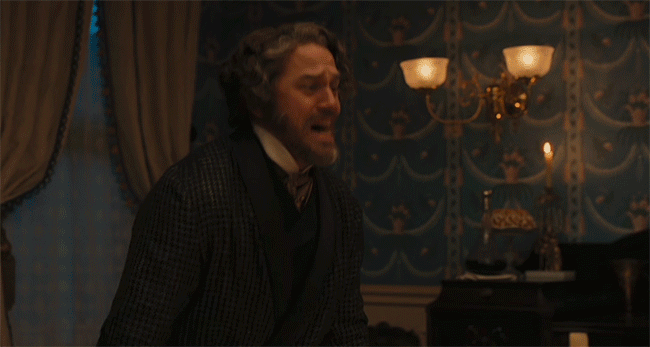
The narrative momentum of the series reaches an early, chaotic zenith during a family dinner that plays out like a Grand Guignol farce. Let us speak plainly of the sequence: it is an unrelenting torrent of bodily expulsion. Gushes and gouts of vomit, mixed with the noxious aftermath of tainted oysters, erupt from every available orifice in the bodies of Edward and Abby Borden (played with manic commitment by Charlie Hunnam and Rebecca Hall).
The dining room transforms instantaneously into a chamber of biological horrors. Hurling, heaving, gurgling, spraying, splattering, and oozing cascades over tablecloths and floorboards alike. Amidst this chaotic downpour, poor Lizzie Borden must nimbly dodge puddles of internal devastation as she calmly exits the room to seek help.
Yet, this scatological spectacle serves a precise satirical purpose rather than merely existing for shock value. Just moments before their internal systems experience catastrophic failure, Edward and Abby were chuckling gleefully over Mrs. Borden’s slaughter of Lizzie’s beloved doves earlier that day. Unbothered by cruelty, Abby had the sheer audacity to blame Lizzie for forcing her hand, while Edward screamed at his daughter to shut her mouth about her stupid birds and leave him in peace.
Underneath their accumulated wealth and obsessive fixation on surface-level propriety, the Bordens’ behavior is profoundly repulsive. The series asks a fundamental thematic question: should their physical presence on screen be any different?
The Failed Poisoning and the Pivot to Iron
The grand geyser of waste depicts the elder Bordens as simultaneously disgusting, pitiable, and infantile. While Lizzie’s severe menstrual bleeding represents her literal imprisonment by the biological expectations of her gender, Abby and Edward’s explosive sickness is simply an outward manifestation of their inner selves. It is who they are. Following the old axiom that you are what you eat, the series suggests that, in the world of the Bordens, you are also what you excrete.
Unfortunately for Lizzie and her co-conspirator Bridget (operating under the alias/role of Maggie), their initial attempt to poison the patriarch and matriarch with bad oysters hits an unexpected snag. Rather than quietly succumbing to lethality, the Bordens violently purge the toxins from their systems, expelling the poison via every possible exit route before it can finish the job.
Realizing that a biological approach is insufficient, Lizzie opts for a more fitting, hands-on form of execution: an axe. It is, crucially, the exact same instrument her wicked stepmother used to slaughter her innocent doves. In the harsh ecosystem of the Borden household, turnabout is fair play—or, as the subtext suggests, fowl play.
The Spark of Wrath
Up until the moment her mother’s hands faded to crimson and ended the lives of her beloved birds, Lizzie was hardly an eager participant in Bridget’s suggestions that they quietly do away with her parents. True, Lizzie stood to inherit a small fraction of a modest fortune—most of it unjustly slated to go to her universally despised sister, Emma (played with biting coldness by Billie Lourd). And true, the elder Bordens were thoroughly despicable creeps who arguably deserved a reckoning.
However, Lizzie does not truly snap until she is dealt unequivocal proof that her parents care nothing for her existence. While Bridget displays immense care—even ordering a steam-powered contraption designed to alter Lizzie’s physical reality—her parents view her merely as a domestic chattel and a financial burden.
Bound together by shared trauma and forbidden affection, Bridget and Lizzie share a charged moment amid caged-bird imagery, sealing their alliance with a kiss. “Maybe I should be your beau,” Bridget whispers provocatively, setting the stage for a partnership built on mutual survival and mutual destruction.
Supporting Context & Metrics
To fully appreciate the cultural impact of Monster: The Lizzie Borden Story, one must evaluate the structural pillars supporting its production and thematic resonance.
Key Creative Personnel & Cast
- Creators/Showrunners: Ian Brennan, Max Winkler
- Key Cast Members:
- Rebecca Hall as Abby Borden
- Charlie Hunnam as Edward Borden
- Billie Lourd as Emma Borden
- Jessica Barden as Nance O’Neal
- Platform: Netflix
Sociopolitical Themes Addressed
The series utilizes the historical framework of the 1892 Fall River murders to dissect contemporary anxieties regarding intersectional oppression. Lizzie Borden is positioned not merely as a historical anomaly, but as a lightning rod for culturally pervasive systemic failures:
- Ageism & Ableism: The systemic sidelining of unmarried women deemed past their prime economic or social utility.
- Misogyny: The absolute legal and financial ownership of women by male heads of household in late-19th-century America.
- Homophobia: The criminalization and suppression of queer desire, forcing emotional and physical intimacy into clandestine, dangerous corners.
- Emotional Abuse: The relentless, institutionalized gaslighting perpetrated by parental figures within wealthy domestic spaces.
Official Statements & Critical Reception
Critical discourse surrounding the series has focused heavily on its willingness to subvert historical drama tropes in favor of Grand Guignol expressionism.
In reviews evaluating the artistic choices of showrunners Ian Brennan and Max Winkler, television critics have lauded the production’s commitment to "lurid spectacle." Rather than presenting a dry, PBS-style historical reenactment, the creative team has constructed a theatrical fantasia that uses heightened reality to communicate emotional truths.
As noted by cultural commentators, the introduction of historical figures like the celebrated actress Nance O’Neal (Jessica Barden)—who arrives fresh off a theatrical interpretation of A Midsummer Night’s Dream after an irreverent bathroom introduction—adds layers of meta-commentary about performance, gender, and public perception.
"She’s well-traveled, she’s free-spirited, she’s cultured, she’s queer, she’s open to murder, she’s a hell of a cook," critics observe of the outsider archetypes sweeping into Lizzie’s orbit. "Most importantly, she’s the only person alive who sees Lizzie Borden as something other than a hopeless case. Indeed, she sees her as smart, vibrant—and worth killing for. That’s a poison anyone might be tempted to swallow."
Future Outlook
As Monster: The Lizzie Borden Story continues its run on Netflix, the trajectory of historical true-crime television has irrevocably shifted. The series demonstrates that audiences no longer demand clinical, sanitized retellings of historical atrocities. Instead, there is a voracious appetite for psychological expressionism—stories that utilize genre elements, body horror, and dark satire to unearth the hidden emotional violence of the past.
Future episodes promise further escalation as the impending arrival of Nance O’Neal looms over a household already teetering on the edge of complete biological and structural collapse. Whether the Bordens will survive long enough to host their esteemed theatrical guest remains to be seen, but one thing is certain: when the axe finally falls, it will do so with the full weight of a century’s worth of repressed feminine fury.