MYANMAR — In a devastating escalation of the nation’s ongoing civil conflict, a series of targeted air strikes has left at least 14 elderly civilians dead at a monastery in central Myanmar. The victims, who ranged in age from 50 to 70, had gathered at the religious sanctuary in Myaung township, Sagaing region, to participate in a peaceful Buddhist meditation retreat.
The attack, which occurred during the early hours of Friday morning, has sent shockwaves through local communities and intensified international condemnation of the military junta’s campaign against civilian populations. According to eyewitnesses, rescue workers, and pro-democracy opposition groups, the compound was struck twice in rapid succession—with the second bombing occurring precisely as emergency responders and volunteers were combing the smouldering rubble for survivors.
The incident underscores the growing peril facing non-combatants in Myanmar, where sacred spaces, schools, and hospitals have increasingly become casualty zones in a brutal war of attrition following the February 2021 military coup.
Executive Overview: The Anatomy of a Devastating Strike
The tragedy unfolded at approximately 9:00 a.m. local time on Friday at a monastery located in the village of Chhay Hoe O, situated roughly 70 kilometres (47 miles) west of Mandalay.
Civilians from surrounding areas had congregated at the religious site to observe a meditation retreat marking Buddhist Lent—a sacred period of spiritual reflection and discipline. Rather than finding sanctuary, the attendees were subjected to what local resistance fighters and humanitarian workers have described as a calculated and indiscriminate double-tap aerial bombardment.
- Casualty Toll: Fourteen individuals were confirmed dead at the scene. The victims comprised 11 men and three women, all aged between 50 and 70. Five of the deceased hailed from the immediate host village, while the remaining nine traveled from a neighboring township to partake in the spiritual retreat.
- Injuries: Alongside the fatalities, several Buddhist monks residing at the monastery sustained varying degrees of injuries from flying shrapnel and collapsing masonry.
- Tactical Profile: The assault utilized a double-strike methodology. A primary payload was dropped on the monastery buildings, followed by a secondary strike shortly thereafter, directly endangering rescue personnel and hindering the evacuation of the wounded.
- Perpetrator Context: While the Myanmar military junta has not yet issued a formal statement addressing the incident, local resistance organizations and regional monitors attribute the raid to the regime’s air force, which has grown increasingly reliant on aerial dominance to counter territorial losses on the ground.
Detailed Chronology: A Morning of Devotion Turned to Horror
To fully understand the harrowing nature of the attack, investigators and rescue workers have pieced together a detailed timeline of events from Friday morning in Chhay Hoe O village.
08:30 AM – Gathering for Reflection
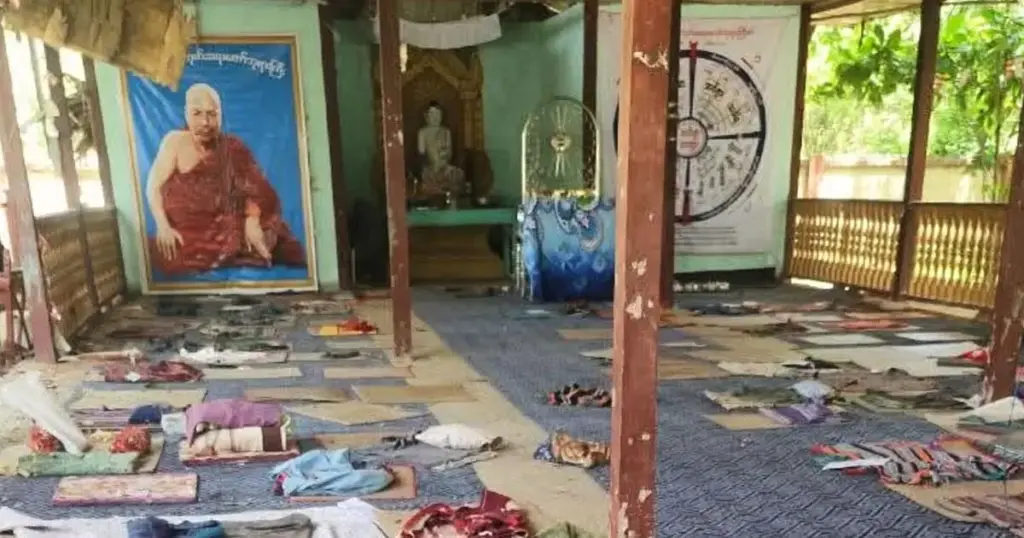
The atmosphere within the monastery grounds was serene. Worshippers had gathered early in the morning to settle into the meditation halls, laying out mats and preparing for hours of silent contemplation and prayer. Monks oversaw the proceedings, welcoming participants who had journeyed from neighboring districts to observe the holy season of Buddhist Lent.
09:00 AM – The First Blast
Without warning, the roar of an aircraft engine pierced the morning sky. Seconds later, the first of two air strikes impacted the monastery compound. The concussive blast tore through the meditation spaces, instantly killing multiple attendees and trapping others beneath heavy timber and concrete structures. Panic erupted as survivors staggered through dust and debris, searching for loved ones amidst the wreckage.
09:20 AM – The Rescue Effort Begins
Within minutes of the initial explosion, local volunteer rescue workers, pro-democracy militia members, and surviving villagers rushed to the scene. Disregarding the immediate danger, the makeshift rescue teams began lifting heavy rubble to extricate the trapped elderly worshippers and administer first aid to the wounded monks.

09:40 AM – The Second Strike
As volunteers worked frantically to pull survivors from the ruins, the military aircraft returned. According to a resistance fighter involved in the recovery operations, the jet launched a second payload directly onto the already devastated site.
"While we were trying to rescue people, the aircraft came to bomb a second time," recounted one opposition fighter, speaking under a pseudonym for security reasons.
The secondary explosion severely complicated rescue operations, forcing responders to scatter into adjacent fields for cover and delaying the evacuation of critically injured victims. By the time the area was deemed secure enough to re-enter, 14 lives had been extinguished, and personal belongings—including scattered meditation mats, torn robes, and prayer books—lay buried beneath ash and debris.
Supporting Context & Metrics: The Human Cost of Myanmar’s Civil War
The tragedy in Myaung township does not occur in a vacuum. It is part of a broader, systematically documented pattern of violence that has gripped Myanmar since the military junta, led by Senior General Min Aung Hlaing, seized power in a February 2021 coup. The coup violently ousted the democratically elected government led by Nobel laureate Aung San Suu Kyi, triggering nationwide civil disobedience that quickly metastasized into a full-scale armed revolution.
The Strategic Shift to Air Power
As the military (known as the Tatmadaw) has steadily lost ground to a coalition of ethnic armed organizations (EAOs) and People’s Defence Forces (PDFs) across various rural and border regions, it has become heavily reliant on its air superiority. Procured primarily from foreign suppliers such as Russia and China, the junta’s fleet of fighter jets and transport helicopters allows the military to project power into contested territories without risking heavy ground engagements.
However, this reliance on air power has disproportionately affected civilian infrastructure. According to independent human rights monitors and United Nations agencies:
- Targeting of Religious Sites: Monasteries, churches, and mosques—traditionally respected as safe havens and neutral zones during conflicts—have repeatedly been struck by artillery and air raids.
- Displacement Crisis: Over 2.8 million people remain internally displaced across Myanmar due to ongoing fighting, aerial bombardment, and the burning of villages.
- Casualty Accumulation: Documented air strikes across the country have killed thousands of civilians since 2021, with Sagaing and Chin states experiencing some of the highest concentrations of aerial attacks.
Vulnerability of the Elderly
Friday’s strike highlights the particular vulnerability of elderly demographics in rural Myanmar. Many younger adults have either fled the country, joined armed resistance groups, or sought employment in urban centers or abroad, leaving behind older generations to maintain ancestral homes, agricultural lands, and community traditions. The concentration of victims aged 50 to 70 at the Chhay Hoe O retreat reflects this shifting demographic reality in rural conflict zones.
Official Statements and International Response
As news of the double strike filtered out of the restricted communication zones in central Myanmar, human rights organizations and political bodies moved quickly to condemn the violence.
Resistance and Local Voices
Pro-democracy groups and local administrative bodies operating under the National Unity Government (NUG) have labeled the monastery bombing a war crime. Nway Oo Myaung, a prominent pro-democracy rebel operating in the Sagaing region, issued statements detailing the ages and home districts of the victims to counter potential military propaganda downplaying the civilian nature of the gathering.

Local humanitarian networks have appealed urgently for medical supplies, blood donations, and emergency surgical teams to treat the monks and civilians who survived the blast with severe trauma and shrapnel injuries.
The Silence of the Junta
True to standard operating procedure, Myanmar’s military regime has thus far declined to issue an official comment regarding the Myaung township air strikes. When previous strikes on civilian gatherings—such as the catastrophic bombing of a concert in Kachin State or the attack on a community gathering in Pazigyi—have drawn global outrage, the junta has routinely claimed that its operations targeted legitimate military objectives, framing resistance fighters as "terrorists" using civilian populations as human shields.
Independent investigators, satellite imagery analysis, and on-the-ground testimonies have consistently discredited these justifications, proving that strikes frequently hit purely civilian and religious gatherings.
Future Outlook: A Bleak Horizon for Myanmar’s Civilian Population
The bombing of the Chhay Hoe O monastery serves as a grim indicator of the trajectory of Myanmar’s civil war. With neither the military junta nor the fractured opposition forces achieving a decisive knockout blow, the conflict has settled into a grinding war of attrition characterized by asymmetric warfare and high civilian casualties.
Escalating Humanitarian Needs
Humanitarian agencies operating along the borders are warning of an impending catastrophe as monsoon seasons and military blockades restrict the flow of food, medicine, and fuel into regions like Sagaing. The destruction of local infrastructure—including clinics, schools, and now spiritual sanctuaries—severely degrades the social fabric holding rural communities together.
The Impunity Gap
Despite mounting evidence compiled by the UN Independent Investigative Mechanism for Myanmar (IIMM) and various international NGOs, accountability for war crimes remains elusive. The geopolitical complexities surrounding the conflict, combined with the junta’s diplomatic insulation by key international allies, have prevented robust intervention or enforcement of no-fly zones.
For the families of the 14 elderly worshippers killed in Myaung township, justice remains a distant hope. As survivors gather the scattered remnants of their peaceful retreat, their experience stands as a haunting testament to the high human toll paid by ordinary citizens caught in the crossfire of a forgotten war.