Executive Overview
In the upper echelons of fashion history, very few accessories achieve a level of cultural penetration that allows them to be identified by a single, mononymous name. Terms like the "Birkin," the "Kelly," or the "Speedy" immediately conjure precise silhouettes, socio-economic connotations, and distinct eras of design. Today, that rarefied pantheon has expanded to include a new modern titan: the Margaux.
Created by luxury powerhouse The Row—the critically acclaimed label founded by Mary-Kate and Ashley Olsen—the Margaux has rapidly evolved from an insider secret into one of the most coveted, scarce, and discussed designer handbags of the twenty-first century.
Unlike flashy logo-emblazoned pieces that defined previous decades of ostentatious consumption, the Margaux represents the apex of "stealth wealth." It relies entirely on immaculate construction, supple textures, sublime proportions, and quiet functionality. Even as shifting fashion trends flirt with more expressive, maximalist waves, the Margaux has cemented its position not as a fleeting seasonal fad, but as a permanent, enduring classic. Demand routinely dwarfs supply, pushing luxury shoppers toward secondary resale markets and commanding premium valuations. This is the definitive anatomy of how The Row engineered a silent revolution, crafting a bag designed to whisper rather than shout, and turning it into a cornerstone of contemporary luxury.
Detailed Chronology: The Evolution of a Legend
The Early Aughts Genesis: A Philosophy Without Logos
To understand the rise of the Margaux, one must first look back to the inception of The Row in the early 2000s. When Mary-Kate and Ashley Olsen set out to build a luxury fashion house, they did so with a singular, almost contrarian vision: to test whether an item could sell purely on the strength of its fit, fabric, and exceptional craftsmanship, devoid of external branding or overt logos.
The brand famously began its journey with the conceptualization of the ultimate white T-shirt. This minimalist blueprint dictated every product that followed. The Olsens envisioned clothes and accessories designed not to announce the wearer’s net worth to a room, but to offer personal comfort, timeless elegance, and effortless utility. The Margaux emerged from this exact philosophy years later, operating as a leather-goods embodiment of the brand’s foundational ethos.
Transitioning from Cult Favorite to Mainstream Obscurity-Chic
When The Row first introduced the Margaux to its handbag lineup, it operated under the radar. It appealed primarily to industry insiders, stylists, and editors who appreciated the subtle architectural lines and rich, unblemished leather.

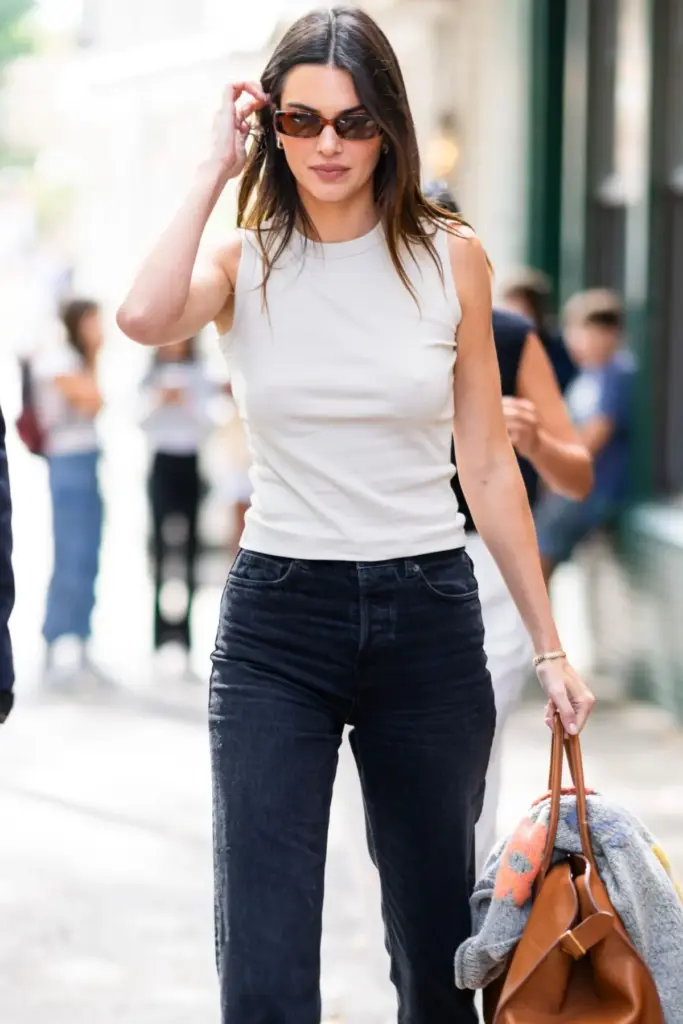
However, as cultural fatigue set in regarding logo-heavy accessories, the fashion pendulum swung heavily toward understated luxury. The Margaux captured the zeitgeist. It became a favorite among a high-profile, trend-setting roster of women—including Zoë Kravitz, Taylor Russell, Rosé, and Jennifer Lawrence. Rather than treating the bag as a fragile museum piece reserved only for red-carpet appearances or galas, these tastemakers began using it as a true 24/7 carryall. Paparazzi shots regularly captured the Margaux slung over shoulders on airport transits, stuffed with sweaters during unexpected summer temperature drops, and toted with a casual nonchalance that mirrored how the Olsen twins themselves wore their worn-in Birkins.
Runway Integration and Modern Iterations
Over the years, the Margaux has been reinterpreted in various colorways, finishes, and scale formats, firmly planting itself as a permanent pillar of The Row’s accessories portfolio.
- The Core Offerings: The brand’s official e-commerce platforms and flagship spaces routinely stock iterations in 10-inch, 12-inch, and 15-inch sizes. Classic colorways include foundational black, rich taupe, and deep chocolate brown, rendered in both smooth leather and tactile suede.
- Rare Variations: Limited runs have seen the bag crafted in lighter red-browns, rich tans, and even gold croc-embossed finishes—as memorably styled by Kendall Jenner.
- Runway Highlights: The bag occasionally makes triumphant cameos on seasonal runways. For the autumn/winter collections, it appeared in slouchy black leather complete with a refined silver buckle side strap, effortlessly paired against structured wool coats and textured trousers.
Supporting Context & Metrics: Scarcity, Resale Economics, and Design Philosophy
The Architecture of Understated Recognition
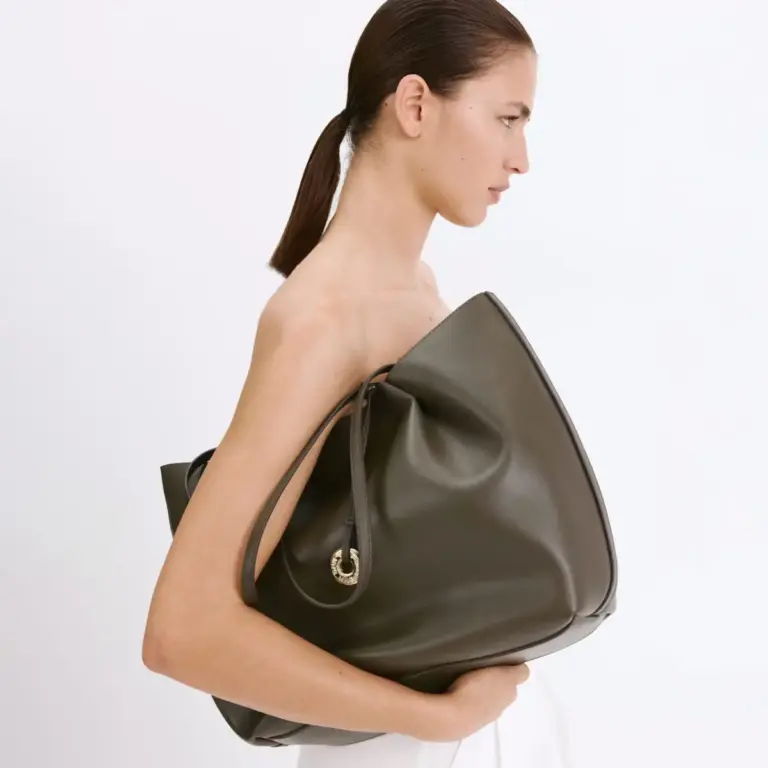
The Margaux’s design is an intriguing oxymoron: it is a completely logo-less bag, stamped only with a minuscule, foil-embossed motif discretely tucked away on the interior. It is recognizable precisely because of its lack of adornment. Its gently curving lines, soft profile, and lack of flashing hardware serve as a deliberate counter-narrative to decades of booming logos and flashy closures.
This design choice was far from accidental. It was a calculated exercise in restraint, proving that discerning consumers do not need metal plaques or monogram prints to recognize supreme quality.
The Functional Appeal
Unlike the micro-bags that dominated fashion weeks for years—pieces that offered negligible utility—the Margaux is fundamentally capacious. It champions grab-and-go practicality. Its deep interior compartments and sturdy top handles mean it functions as a true workhorse.
This duality—ultra-luxury pricing paired with everyday durability—creates a fascinating psychological loop for the consumer. Much like the vintage Hermès Birkins worn by Mary-Kate and Ashley Olsen over the past decade, which have naturally developed a weathered, beautiful patina over time, the Margaux is built to improve with age. While some purists keep their Margaux pristine inside dust bags, the true magic of the accessory is unlocked when it shows the gentle marks of a life well-lived.

The Supply-Demand Disconnect and Resale Market Dynamics
At the time of writing, brand-new Margaux bags are chronically sold out across official retail channels and TheRow.com. This severe supply deficit has fueled a booming secondary market.
Shoppers eager to secure the coveted accessory frequently turn to trusted resale platforms, such as eBay—which offers specialized Authenticity Guarantee services—and curated luxury outlets like Farfetch.
- Pricing Fluctuations: Due to extreme scarcity, secondary market pricing varies widely, often matching or exceeding original retail values depending on the specific leather, hardware, and size.
- Investment Status: A subset of modern buyers now view purchasing a Margaux as a secure financial asset, driving both collector interest and speculative acquisition.
Official Statements: The Vision of Mary-Kate and Ashley Olsen
The enduring resonance of The Row’s design philosophy lies in how intimately connected the founders are with their clientele. Unlike traditional luxury houses that design from a detached corporate ivory tower, the Olsen twins maintain remarkably close relationships with the women who buy their clothes.
In past interviews with British Vogue, Mary-Kate Olsen illuminated the collaborative, client-centric nature of their brand building:
"The whole exercise was to see whether, if something was made beautifully, in great fabric, with good fit, it would sell without a logo or a name on it… And it worked."
Expanding further on how seasonal collections take shape, Olsen noted the deeply personal approach the brand takes to functional luxury:

"I feel really fortunate to be very close with those women, and they really do dictate where we go season to season […] When we design, we’re designing for specific clients… We understand what their day looks like, how and when they travel."
This hyper-targeted approach explains why the Margaux resonates so profoundly. It was not dreamed up in a vacuum; it was engineered around the exact lifestyle requirements of modern, traveling, high-achieving women who demand both aesthetic purity and uncompromised utility.
Future Outlook: From Cult Object to Permanent Classic
In the fast-paced cycle of modern fashion, trends frequently oscillate between extremes. Recently, the pendulum has shown signs of swinging away from minimalist "quiet luxury" toward louder, more expressive design movements. Yet, remarkably, the Margaux has effortlessly weathered these shifts.
By avoiding the trap of seasonal gimmickry and focusing entirely on peerless craftsmanship, utility, and timeless proportions, The Row has successfully transitioned the Margaux from a transient cult buy into a bona fide modern classic.
Looking ahead, the trajectory of the Margaux suggests it will permanently occupy the upper echelons of luxury accessory design alongside historic icons. As long as women require bags that seamlessly transition from boardrooms to international flights while maintaining an aura of effortless elegance, the Margaux will remain the gold standard. It stands as a testament to a revolutionary premise: that true luxury needs no introduction, no loud hardware, and no visible logo to make an indelible mark on fashion history.