Executive Overview
In contemporary cinema, the intersection of sharp-edged comedy, human vulnerability, and existential mystery is a rare and hazardous terrain. Most filmmakers choose to keep these elements neatly compartmentalized, favoring digestible formulas over narrative dissonance. Yet, writer-director Jesse Eisenberg—following his critically acclaimed 2023 sophomore feature A Real Pain—has boldly ventured into this high-wire balancing act with his latest film, The Debut.
Described by critics as a dizzying, mind-bending collision of Christopher Guest’s mockumentary genius (Waiting for Guffman) and the unhinged, existential dread of the Coen brothers, The Debut is a small-town-theater comedy driven by monumental ideas. It plunges audiences headfirst into what can only be described as the "Twilight Zone of Sub-Broadway."
At the center of this surreal vortex is Mona Friedman, a hollowed-out suburban New Jersey homemaker brought to life by Julianne Moore in a performance of astonishing transformation. What begins as a gentle, satirical look at the earnest absurdity of local community theater rapidly unravels into a twisted psychodrama, a high-stakes thriller of self-actualization, and an unflinching exploration of identity. Supported by an exceptional cast that includes Paul Giamatti and Bernadette Peters, The Debut defies easy categorization, cementing Eisenberg’s status as one of the most distinctive and formally audacious writer-directors working in modern independent cinema.
Detailed Chronology: The Anatomy of a Breakdown and Breakthrough
To understand the trajectory of The Debut is to trace the radical disintegration and reconstruction of a human soul. The narrative unfolds with deceptive structural simplicity before descending into a rabbit hole of Method-acting madness.
Act I: The Stepford Zombie and the Brook Theater
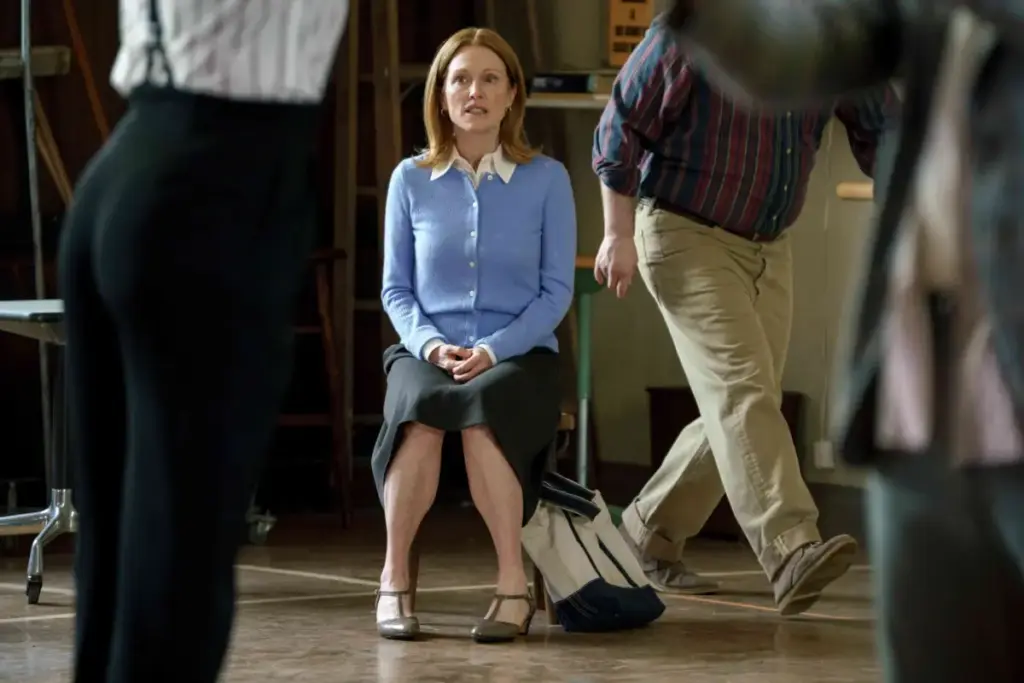
In the film’s opening sequence, set within the peeling paint and flickering marquee lights of the local Brook Theater, we are introduced to Mona Friedman (Julianne Moore). Mona is the quintessential invisible homemaker. Her twins, Matty (Joan Diamand) and Maya (Becca Suskauer), are practically adults yet emotionally checked out, while her husband, Howard (Patrick Fabian), is a stiff-necked, handsome narcissist who treats his wife like a living room accessory. With translucent skin, perpetually red-rimmed eyes, and an innate, crushing passivity, Moore projects the aura of a damaged, forgotten doll.
Seeking an elusive spark of purpose, Mona awkwardly stumbles into auditions for Nosy Neighbors, the community theater’s annual musical. Her initial audition is a disaster of timid whispers—so lifeless that her rejection is a foregone conclusion. The lead role instead goes to Serena Cherry (Bernadette Peters), an unyielding Broadway wannabe whose lobby headshots boast past glories as the lead in Evita.
Fate intervenes late one night when the musical’s eccentric, world-weary director, Jerry (Paul Giamatti), calls Mona in a panic. Serena has abruptly bowed out, and the production is hours away from collapse. Having illicitly swiped a handful of phone-number tags off a local flyer during auditions, Mona secures the part.
Act II: The Rehearsals and the Meisner Torture Session
Mona arrives at morning rehearsals to discover that Nosy Neighbors is an earnest, corny piece of third-rate hokum—essentially Jonathan Larson’s Rent reimagined by Christopher Guest’s fictional theater director, Corky St. Clair. The original songs, composed by Eisenberg himself, capture a pitch-perfect "Jonathan Larson-by-numbers" aesthetic.
Mona is cast as Miss Danielle, the building superintendent: a tough-nut character outfitted in a utility belt whose signature, hard-boiled line is simply, "Rent’s due!" For an actor with zero theatrical background beyond a childhood church choir, the challenge should be minimal. Instead, Mona delivers the line with the fearful deference of a librarian whispering a secret. She is a doormat in life and a total washout on stage.
Sensing an impending artistic catastrophe, director Jerry takes matters into his own hands, subjecting Mona to a brutal, private acting session. In a tour-de-force sequence that plays out like a Sanford Meisner exercise crossed with a psychological interrogation, Jerry forces Mona to demand a rent check from his hand, relentlessly pressing her on why she needs it.
The exercise strips away her defenses. Mona breaks down, unleashing a raw, visceral monologue about survival, terror, and the desperate fear of starving in an alleyway. In burning through her profound lack of self-identity, Mona is quite literally born as an actress. The tragedy—and the dark comedy—is that Jerry has unwittingly unleashed an uncontainable monster.
Act III: The Full-Method Descent and Hellscape
What follows is a brilliant subversion of the standard feel-good acting fable. Driven by Jerry’s unorthodox coaching methods, Mona takes her training into the real world. In one of the film’s most darkly hilarious sequences, Jerry tasks her with breaking into a random apartment building to practice her character’s authority; Mona seamlessly cons her way inside by impersonating the super and demanding to fix a toilet.
Emboldened by her success, Mona abandons her miserable domestic life entirely. She moves out of her family home and into a seedy, fleabag hotel characterized by buzzing electric lights, dripping faucets, and echoing, mysterious sounds vibrating through the thin walls. Here, the film slips gracefully into a dreamy, surreal hellscape.
Refusing to drop character, Mona adopts a startling new aesthetic. After shorting out the hotel’s electrical grid and accidentally singeing her eyebrows off, she fashions a janitorial jumpsuit and crafts a look that evokes a bizarre hybrid of Camille Paglia and Joan Jett as styled by David Lynch. Her new ethos is absolute: everything her character says and does in the musical must be anchored in radical, unyielding reality.
Supporting Context & Metrics: The Production Landscape
The Debut arrives at a fascinating juncture in contemporary independent filmmaking, positioning itself against a backdrop of shrinking mid-budget studio releases and an over-reliance on intellectual property.
- The Auteur’s Progression: Following his directorial debut, When You Finish Saving the World (2022), and his acclaimed 2023 tragicomedy A Real Pain, Eisenberg has rapidly established a distinct cinematic signature. While A Real Pain was deeply rooted in geographic and emotional realism, The Debut marks a thrilling departure, stretching the rubber band of reality until it snaps into pure satire.
- Casting Dynamics: The film relies heavily on the chemistry and contrasting energies of its leads. Julianne Moore, operating at the height of her interpretive powers, anchors the film’s wild tonal swings. Paul Giamatti acts as an essential audience surrogate—a weary theatrical romantic whose underlying melancholy and bone-deep frustration keep the film grounded as it threatens to float off into the ether.
- Musical Architecture: Eisenberg’s original score and songs for the fictional Nosy Neighbors serve a dual purpose. They function simultaneously as genuinely infectious, toe-tapping community theater numbers and biting parodies of earnest millennial rock-musicals.
Official Statements and Industry Insights
Speaking on the genesis of The Debut, Jesse Eisenberg noted in early promotional rounds that the film was conceived as an exploration of the performative nature of everyday existence.
"We spend our entire lives auditioning for roles dictated by our families, our spouses, and our workplaces," Eisenberg remarked. "I wanted to explore what happens when someone who has spent decades playing the victim finally gets a script that grants them permission to be formidable—even if that script was written for a third-rate community theater production."
Julianne Moore, whose transformative performance has already sparked early Academy Award buzz on the festival circuit, emphasized the liberation found in Mona’s downward spiral into Method acting.
"Mona doesn’t just learn how to act; she learns how to take up space," Moore explained in a recent interview with industry analysts. "The tragedy of her life was her invisibility. The comedy—and the terror—of her transformation is that once she is finally seen, she refuses to ever shrink back down."
Future Outlook: Critical Reception and Awards Trajectory
As The Debut prepares for its wide theatrical rollout via major distribution channels, industry forecasters predict a robust arthouse run followed by significant traction during the upcoming awards season.
While the film’s unique tonal blend—shifting fluidly between broad theatrical farce, psychological thriller, and existential comedy—may prove polarizing for mainstream audiences seeking conventional narratives, cinephiles and critics have embraced its eccentricities. The film’s ability to sustain narrative momentum while operating on multiple metatextual levels highlights Eisenberg’s growing maturity as a filmmaker.
Ultimately, The Debut succeeds because it recognizes the sacred absurdity inherent in artistic expression. Whether viewed as an affectionate homage to the wide-eyed passion of local playhouses, a sharp critique of self-help culture, or a thrilling one-woman psychodrama, Eisenberg’s latest masterwork proves that sometimes, the only way to find your true voice is to step entirely outside of your life—and onto a stage where the rent is always due.