The fashion landscape is in a constant state of nostalgic regurgitation, but every so often, a silhouette long relegated to the annals of sartorial irony makes a genuine, authoritative return. As the industry moves past the billowing volumes of balloon trousers, capris, barrel-leg jeans, palazzo pants, and casual drawstring iterations, a new contender has emerged from the archives. Stirrup pants—a definitive relic of the 1980s fitness and leisure boom—are officially back.
Far from being a mere novelty, this revived staple is dominating the runways for the Fall/Winter 2026-2027 season. Major luxury houses, including Stella McCartney, Mugler, Balmain, Marie Adam-Leenaerdt, and Jil Sander, have reinterpreted the design, infusing it with modern tailoring, high-end materials, and unexpected color theory. This resurgence is not happening in a vacuum; it coincides with an overarching cultural obsession with opulent 1980s aesthetics, mirrored across pop culture and literature.
However, unlike their spandex predecessors, the modern iteration of stirrup pants champions a refined, structural elegance. Designed to elongate the leg and anchor a structured silhouette, these pants represent a calculated pivot away from ultra-relaxed streetwear and toward a meticulously polished, ladylike aesthetic.
Detailed Chronology: The Revival on the Fall/Winter 2026 Runways
The journey of the stirrup pant back to high fashion did not happen overnight; it was meticulously engineered across several key European fashion capitals during the recent Fall/Winter 2026 collections.
Jil Sander and the Power of Minimalist Color
At Jil Sander, newly appointed creative director Simone Bellotti posed a provocative philosophical question to the audience: "Can something superfluous be considered essential?"
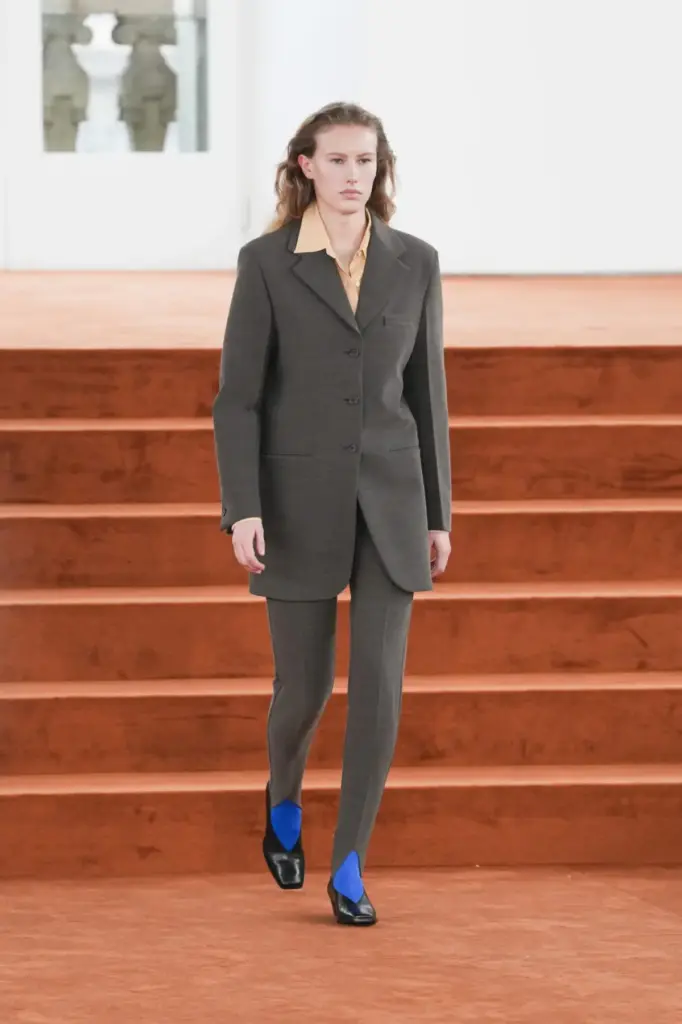
Exploring this tension, Bellotti introduced a series of neutral gray, workwear-inspired stirrup pants. The masterstroke of the collection, however, lay in the styling. The utilitarian gray wools and jerseys were sharply contrasted with flashes of brilliant cobalt blue shoes peeking out from beneath the structural foot loops. This subtle pop of color recontextualized a garment historically viewed as functional athletic-wear into an object of high-concept design.
Mugler’s 1980s Power-Dressing Extravaganza
If Jil Sander approached the trend with minimalist contemplation, Mugler leaned entirely into maximalist theater. Under the creative direction of Miguel Castro Freitas, the house delivered a masterclass in 1980s revivalism.
The runway was saturated with lush, oversized leather jackets, pronounced shoulder pads, and dramatic opera gloves. Amidst this high-octane display, stirrup pants played a foundational role. Executed in sophisticated pinstripes, deep plum, and classic khaki, these trousers featured expressive pleats at the waist. By pairing the fitted, foot-anchored base of the stirrup pant with architectural upper bodies, Mugler bridged the gap between retro nostalgia and futuristic edge.
Balmain’s Historical Homage
At Balmain, designer Antonin Tron anchored his collection in a late-1970s and early-1980s narrative, offering a tribute to Danielle Décuré, Air France’s first female pilot. Décuré famously took flight in 1975 wearing a bespoke uniform designed by Pierre Balmain.
Tron’s collection channeled this aviation-meets-luxury ethos through rich leathers, structured tailoring, and fluid, draped dresses. The incorporation of foot-securing trousers nodded to the utilitarian roots of activewear while maintaining the exacting standards of Parisian haute couture.
Supporting Context & Metrics: The Generational Shift and Market Dynamics
To understand why stirrup pants are experiencing this renaissance, one must examine the demographic shifts currently occurring within legacy fashion houses.
The Millennial Creative Director Effect
The designers spearheading this revival—such as Bellotti, Castro Freitas, and Tron—are predominantly in their forties. They represent a new generation of creative directors recently appointed to helm historic legacy brands. As children of the late 1980s and early 1990s, these designers possess a distinct, personal nostalgia for the visual ephemera of their youth. What consumers are seeing on the runway is a childhood memory filtered through decades of technical expertise and luxury craftsmanship.
The Shift in Market Proportions
For the past several seasons, the retail market has been dominated by voluminous silhouettes—think wide-leg trousers, exaggerated barrel jeans, and slouchy cargos. According to retail data and industry buyers, consumer fatigue is beginning to set in regarding extreme volume, paving the way for streamlined proportions.
"The stirrup legging has emerged as a key silhouette for fall 2026, signaling a shift away from the wide and barrel-leg shapes toward a more refined proportion," notes Kelsey Lyle, senior buyer at luxury retailer Moda Operandi.
Lyle points out that this return coincides with a broader macroeconomic and cultural movement toward ladylike tailoring. "Its return creates a balance between an elongated leg and a more structured jacket. While there’s an undeniable nod to ’80s dressing, it feels decidedly polished and modern."
Official Statements and Industry Insights
The reinvention of the stirrup pant is supported by a significant pivot in how luxury and contemporary brands source and construct stretch-textiles. No longer confined to the cotton-spandex blends of aerobic studios, contemporary stirrup pants utilize heavy double-knits, ponte di roma, fine wool-silk blends, and technical neoprene.
The High-Low Versatility
Industry insiders emphasize that the success of the 2026 iteration lies in its dual personality. On one hand, brands like Stella McCartney and Self-Portrait have engineered high-rise jersey versions that function seamlessly as elevated corporate wear when paired with blazers and pointed-toe heels. On the other hand, brands like Leset and Commando offer stretch-ponte and neoprene variations focused entirely on tactile luxury and uncompromised wearability.
Furthermore, independent styling experiments—most notably seen at Marie Adam-Leenaerdt—have shattered the rigid rules of corporate dressing. By pairing stirrup pants underneath voluminous, unstructured day dresses, layering them with oversized knit sweaters, or accessorizing them with button-downs and scrunched opera gloves, stylists are proving that the garment thrives on contradiction. When anchored by a casual pair of loafers, the stirrup pant transforms from an athletic relic into an avant-garde styling tool.
Future Outlook: How to Style the Trend for Fall/Winter 2026
As consumers prepare their cold-weather wardrobes, integrating stirrup pants requires a strategic approach to proportion and footwear. Here is how fashion experts recommend wearing the trend:
The Corporate Power Stance: Pair a high-rise, wool-blend stirrup pant in neutral gray or navy with an oversized, structured blazer featuring sharp shoulder pads. Let the stirrup secure itself cleanly over a sleek kitten heel or a vibrant, contrasting pump (channeling the Jil Sander runway).
The Layered Contrast: Take a cue from Marie Adam-Leenaerdt by wearing fine-gauge stirrup leggings under an asymmetric midi dress or an oversized tunic. Balance the lightness of the lower half with a heavy, slouchy knit sweater on top.
Off-Duty Elegance: For casual outings, opt for a heavier ponte-knit stirrup pant paired with a crisp, oversized poplin button-down and classic leather loafers. The juxtaposition of the structured foot loop against flat footwear creates an effortless, fashion-editor-approved aesthetic.
Conclusion
The return of the stirrup pant is a testament to fashion’s ability to recontextualize the past. By shedding its past associations with tacky aerobics gear and embracing precise tailoring, rich textiles, and modern proportions, the stirrup pant has officially graduated from a nostalgic novelty to an essential modern uniform for Fall/Winter 2026.