Executive Overview
In an era defined by digital ephemera and fleeting viral trends, cultural phenomena rarely achieve the status of enduring scripture. Yet, the internet has done precisely that for the Houston-born hip-hop icon Megan Thee Stallion. Coined by fans and amplified across TikTok, Instagram, and X (formerly Twitter), “Megalations”—a play on biblical verse notation—has evolved from a clever social media meme into a bona fide digital liturgy.
Drawn from the lyrical canon of the “Baddie Bible,” these affirmations and teachings function as a communal framework for self-possession, emotional survival, and the fierce rejection of male validation. When infidelity scandals break or relationships crumble, internet denizens do not merely commiserate; they turn to the scriptures of Thee Stallion. Lines like "Dick don’t run me, I run dick" are traded like emergency literature, serving as immediate, deprogramming interventions for those trapped in the delirium of unreciprocated affection or patriarchal gaslighting.
This canonization of Megan’s lyrics is far from accidental. It is the culmination of a deeply resonant career trajectory, one built on a foundation of profound personal resilience, academic perseverance, and an unapologetic articulation of Black feminist thought. As Megan navigates public grief, high-profile legal battles, and relentless misogynoir, her music has offered a blueprint for the modern "bad bitch"—a figure defined not by the male gaze, but by radical self-preservation, financial autonomy, and joy.
Detailed Chronology: From "Tina Snow" to the Book of Meg
The evolution of Megan Thee Stallion’s cultural hegemony can be traced through a meticulous chronology of artistic milestones, public trials, and unstoppable professional triumphs.
- Early 2018: Megan signs with 1501 Certified Entertainment, establishing herself as the first female rapper on the label and planting the seeds for a disruptive entry into mainstream hip-hop.
- June 2018: The release of her breakout EP, Tina Snow, introduces the world to her brazen, no-holds-barred alter ego, setting a new standard for explicit, self-assured lyricism.
- May 2019: Amid personal tragedy—including the loss of her mother and manager, Holly Thomas, who succumbed to brain cancer during the recording sessions—her standout track “Big Ole Freak” officially cracks the Billboard Hot 100, peaking at number 65.
- August 2019: The drop of "Hot Girl Summer" featuring Nicki Minaj and Ty Dolla $ign generates over one million YouTube views in 24 hours, cementing the hashtag and cultural ethos across social media.
- April 2020: The release of the "Savage (Remix)" with Beyoncé marks Megan’s first number-one hit on the Billboard Hot 100, a massive commercial victory occurring precisely as the world plunges into pandemic lockdowns.
- November 2020: Her debut studio album, Good News, arrives to widespread critical acclaim, debuting at number 2 on the Billboard 200.
- December 2021: Balancing superstardom with academic dedication, Megan graduates from Texas Southern University with a bachelor’s degree in health administration, later trademarking "Hot Girl Summer" in 2022.
- November 2023: The release of "Cobra," the lead single from her third self-titled studio album, Megan, lays bare the exhaustion of grieving and healing under a global microscope.
- April–June 2026: A wave of digital activism, sparked by revelations of ex-boyfriend Klay Thompson’s infidelity, transforms fan devotion into the widespread phenomenon of Megalations, culminating in a viral preview for a new, single-season anthem.
Supporting Context & Metrics: The Architecture of Resistance
The resonance of Megalations cannot be understood without examining the socio-cultural architecture of hip-hop and the specific burdens placed on Black women in the public eye.
Throughout hip-hop history, foundational artists—from Roxanne Shanté, MC Lyte, and Queen Latifah to Salt-N-Pepa, Missy Elliott, and Lil’ Kim—carved out spaces of self-definition. Megan Thee Stallion inherits this rich lineage, pushing the envelope further by explicitly deconstructing the Madonna-whore binary. In tracks like Savage (“Classy, bougie, ratchet / Sassy, moody, nasty”), she refuses single-dimensional packaging, demanding the right to embody multitudes.
Academic and cultural analysis underscores the gravity of this work. As Ebony L. Perro, Professor of Practice at Tulane University, notes in The Megan Movement: Defining and Exploring Hot Girl Rhetoric:
"She problematizes one-dimensional readings of Black womanhood and generates a language for her fanbase to challenge oppressive ideologies… Megan Thee Stallion’s hot girl rhetoric generates cultural phenomena that disrupt the respectable/ratchet binary for Black women."
The metrics of this movement are staggering. Digital footprint tracking reveals that posts utilizing the Megalations format—such as Megalations 4:16 or Megalations 3:12—frequently pull tens of thousands of likes and shares across TikTok and X. When New York-based actress and musician Mona Swain posted a video titled "please stand for the national anthem" set to the lyrics of Megan’s "Plan B," it rapidly amassed over 83,100 likes and 6,000 saves. The comment sections overflowed with digital testimonies: "in meg we trust," "exactly sis," and "PREACH, I just got out of a relationship where I was a bird."
Official Statements and Cultural Commentary
The ethos of the Megalations movement extends far beyond the recording studio, bleeding into mainstream pop culture spaces like reality television and public discourse.
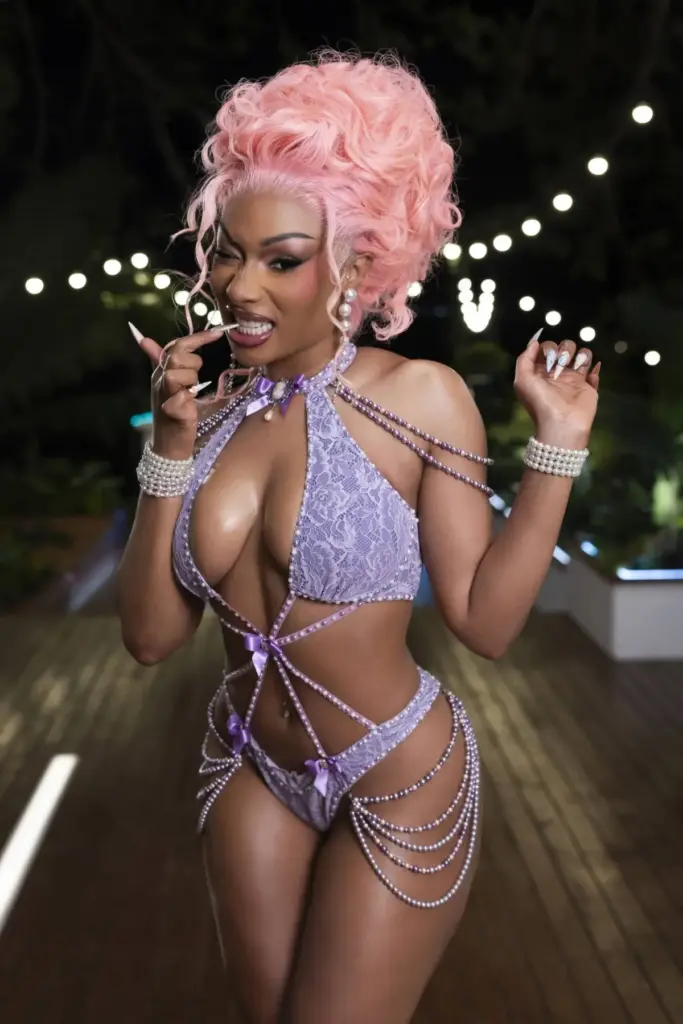
When Megan made a high-profile appearance on the cultural juggernaut Love Island, hosting a "Hot Girl Bakery" challenge dressed as a modern-day, sultry Marie Antoinette, her presence acted as a moral mirror for contemporary dating dynamics. Amid creeping "redpill" ideologies and misogynistic rhetoric circulating among male contestants, Megan delivered an unvarnished verdict. Addressing the villa, she reminded the women to "keep turning it up, keep putting on, and keep being hot girls doing hot girl things," before turning a sharp gaze toward the men with a loaded pause: "All the boys… y’all can step up the gentleman a little bit more."
Reflecting on why these lyrics serve as emotional armor, Mona Swain shared with PAPER:
"Songs like ‘Plan B’ feel empowering because they challenge the idea that women should shrink themselves, tolerate disrespect, or stay loyal to situations that are hurting them. For me, those lyrics read less as revenge and more as reclamation, protecting your peace, and remembering your worth even when emotions are involved. I think a lot of women connect to Megan because she makes confidence and self-respect feel unapologetic."
This sentiment is echoed across digital sanctuaries. From Reddit threads dissecting her bars with literary precision to TikTok tutorials where creators fold their hands in mock-earnest prayer before reciting Megalations, the fan base treats her discography as a survival manual.
Future Outlook
As Megan Thee Stallion continues to tease unreleased tracks featuring declarations like "All that wifey shit is dead / Put that shit to bed," the horizon points unmistakably toward another definitive era of cultural independence.
The phenomenon of Megalations proves that pop culture fandom has evolved into something deeper: a participatory, political act of devotion. In a media landscape that frequently seeks to silence or diminish women—and Black women in particular—the digital canonization of Megan’s words offers an alternative narrative. It transforms personal heartbreak into collective power, weaponizing joy, self-possession, and boundary-setting against the machinery of patriarchy.
Whether intended as scripture or simply hard-hitting bars, the Book of Meg is firmly written into the cultural lexicon. And as long as women navigate the turbulent waters of modern dating, self-doubt, and societal expectation, they will look back at the teachings, recite the verses, and remember: a Megalation a day keeps the bad news away.