Executive Overview
Fashion has long maintained a cyclical relationship with its past, frequently resurrecting trends once deemed dated, ironic, or best left forgotten in the annals of style history. Yet, few beauty tools carry the specific historical baggage of the hair crimper. Synonymous with the zealous volume, high-energy pop culture, and rebellious youth styling of the 1980s and early ’90s, the crimper was long relegated to the nostalgia bin—a novelty item associated with middle-school sleepovers and theatrical stage makeup rather than high-fashion editorial polish.
That narrative shifted dramatically during Christian Siriano’s Spring/Summer 2027 runway show. Under the visionary direction of lead hairstylist Lacy Redway, the classic crimping iron was retrieved, dusted off, and reimagined for a modern audience. The result—christened the "enchanted crimp"—successfully bridges the gap between retro texture and contemporary minimalism.
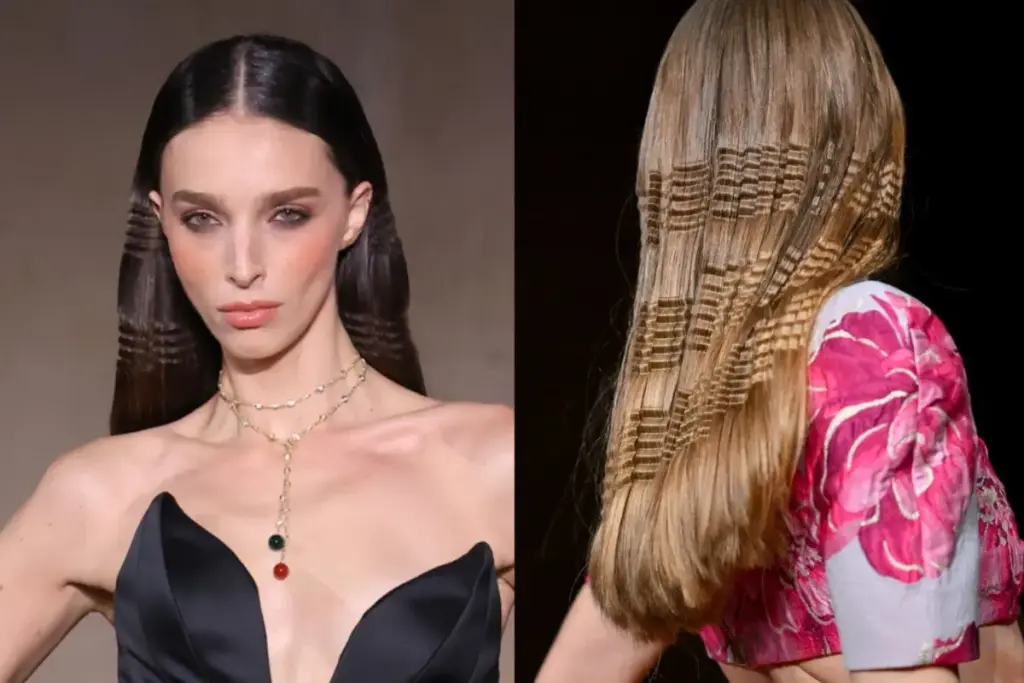
Rather than executing the all-over, fluffy, and voluminous crimping styles of decades past, Redway’s technique relies on restraint, precision, and a dual-texture philosophy. By laying down precise, horizontal bands of corrugated texture across otherwise pin-straight, ultra-glossy sheets of hair, the look acts less like a full-head commitment and more like an architectural accessory. Paired with Siriano’s ethereal, romantic garments, the enchanted crimp has instantly revitalized a dormant hair tool, setting a new benchmark for runway texture and signaling a calculated shift in how modern beauty trends interpret historical motifs.
Detailed Chronology: Backstage at Christian Siriano
The creation of the enchanted crimp was a masterclass in backstage precision, requiring a meticulous multi-step process that fused old-school hardware with modern styling formulations. To understand how a tool from forty years ago achieved such a sophisticated, runway-ready outcome, one must trace the chronological steps of the styling room prior to the models stepping onto the catwalk.
Phase One: Foundation and Prep
The transformation began well before the hot tools made contact with the hair. Redway and her styling team prioritized structural integrity and high-shine finishes from the ground up. Models’ hair was first prepped using a strategic combination of the Tresemmé A-List Collection All-In-One Style Primer and Extra Hold Mousse. This dual-product foundation provided the necessary hold to anchor the intricate texture while protecting the strands from thermal damage.
Once saturated with the foundational products, the hair was systematically blow-dried smooth. Stylists utilized a combination of flat brushes and round brushes to eradicate any natural frizz, kinks, or erratic wave patterns, ensuring that the canvas was as flat and reflective as a sheet of glass. A clean, sharp middle part was then established, anchoring the symmetrical layout of the final look.

Phase Two: Strategic Architecture
Unlike historical styling methods that called for the entire head of hair to be clamped from root to tip, Redway’s approach was defined by selective placement.
"Once the hair is flat-ironed, we use a crimper to create these ridges along the hair," Redway explained to Allure backstage. "And depending on how long your hair is, you might have different sections, but they’re all going horizontally across the hair."
Before bringing the heated plates down, stylists misted targeted sections with hairspray to lock in the integrity of the bend. The crimper was then applied in clean, distinct horizontal bands. These sections appeared almost like corrugated ridges laid deliberately across otherwise perfectly straight sheets of hair. The hair was then tucked cleanly and purposefully behind the ears, emphasizing the severe, geometric symmetry of the face frame while keeping the focus squarely on the textural contrast.
Phase Three: The High-Gloss Finish
The final phase of the look addressed light reflection and movement. To ensure the crimped sections did not appear dry or frizzy—a common pitfall of traditional crimping—Redway applied a generous amount of Bonding Oil through the lengths and ends.
This final touch imparted a liquid-glass shine that caught the runway lights with every stride the models took. The contrast between the sleek, high-shine straight hair and the matte, corrugated bands created a dynamic visual rhythm. Rather than dominating the silhouette, the textured bands acted as flashes of dimension, revealing themselves only as the hair shifted and moved in tandem with Siriano’s ethereal gowns.
Supporting Context & Metrics: The Evolution of Texture
To fully appreciate the cultural and aesthetic weight of the enchanted crimp, one must examine the broader trajectory of hair texture trends over the past four decades, alongside the technical evolution of the tools that create them.

The Rise, Fall, and Redemption of the Crimper
The hair crimper achieved peak cultural ubiquity in the mid-1980s, largely popularized by pop icons, music television, and suburban youth culture. Characterized by its zig-zag ceramic or metal plates, the device was designed to force hair into sharp, angular waves, creating immense volume and a distinctly wild, untamed aesthetic. By the 1990s, the look had filtered down into everyday mainstream styling, eventually burning out as beauty standards pivoted toward the sleek, effortless blowout era of the late ’90s and early aughts.
For decades, the crimper was viewed by professional hairstylists as a stylistic faux pas—an unsophisticated tool incapable of delivering the nuanced texture demanded by high fashion. However, beauty culture’s current obsession with Y2K and ’80s revivalism has systematically chipped away at these rigid stylistic boundaries.
Modern Hair Technology Meets Retro Hardware
The success of Redway’s look at Siriano underscores a broader evolution in hair care technology. In the 1980s, crimping tools operated at unregulated, blistering temperatures that frequently fried the hair cuticle, resulting in the dry, straw-like texture that gave the tool a bad reputation.
The revival of the technique relies heavily on modern chemistry—specifically lightweight priming sprays, strong-hold mousses with memory-retention polymers, and reparative bonding oils. By sandwiching a retro physical technique between advanced heat protectants and nourishing post-styling treatments, modern stylists can manipulate the hair’s physical structure without sacrificing its health or luminous shine.
| Era | Primary Tool Focus | Dominant Aesthetic | Finishing Product of Choice |
|---|---|---|---|
| 1980s / 1990s | All-over thermal crimper | High volume, maximum frizz, wild texture | Heavy aerosol hairspray, styling gels |
| Early 2000s | Ceramic flat irons | Bone-straight, flat, sleek layers | Silicone-based anti-frizz serums |
| Spring/Summer 2027 | Hybrid flat iron + localized crimper | Dual-texture, minimalist, high-shine | Bonding oils, lightweight style primers |
Official Statements and Industry Perspectives
Lacy Redway’s conceptualization of the enchanted crimp has generated considerable buzz among beauty editors, backstage insiders, and trend forecasters. Speaking on the philosophy behind the look, Redway emphasized that the goal was never to execute a literal historical reenactment.
"The two-texture effect and deliberate lack of volume are what separate the enchanted crimp from the fluffy, fully crimped looks that come to mind when you think of how crimpers were used in the ’80s," Redway noted. By treating the texture almost like an accessory rather than the foundation of the entire hairstyle, the look retains a refined elegance that complements, rather than competes with, high-fashion garments.

Christian Siriano’s collections are consistently celebrated for their theatricality, dramatic silhouettes, and romantic femininity. The pairing of architectural, high-shine hair with Siriano’s ethereal ensembles was a deliberate design choice. The clean lines of the middle part and the tucked-back sides anchored the romantic drama of the clothing, while the hidden bursts of corrugated texture provided an unexpected edge.
Industry analysts have noted that the look exemplifies a growing appetite for "disruptive minimalism" in beauty—styles that appear clean and restrained at first glance, only to reveal complex, unexpected details upon closer inspection.
Future Outlook: Translating the Runway to Reality
As fashion week dust settles and beauty enthusiasts look toward translating runway concepts into everyday wear, the question remains: Can the enchanted crimp survive outside the controlled environment of a New York Fashion Week show?
Redway herself is realistic about the everyday applications of the full runway look, acknowledging that few individuals will replicate the exact multi-band styling routine for a casual day out. However, she remains confident that the underlying concept will successfully trickle down into consumer beauty habits.
Practical Consumer Adaptation
"I think we might see girls doing it like how you’d put a barrette in your hair, like just doing a crimp on each side of their head," Redway predicts.
This simplified adaptation makes the trend remarkably accessible. By isolating the technique to a single, deliberate panel of hair—perhaps just behind the ear or framing the temple—individuals can experiment with the geometric texture of a crimper without committing to an intensive styling session. This micro-application aligns with current hair-accessory trends, where texture and hardware are used sparingly to elevate an otherwise simple ponytail, bun, or loose wave.

The Broader Aesthetic Impact
Ultimately, the enchanted crimp serves as a case study in trend recycling done right. By identifying the core visual asset of a dated tool—its unique geometric imprint—and stripping away its historically clunky execution (excessive volume, matte dryness, and full-head coverage), editorial stylists have successfully rehabilitated the crimper for a new generation.
As beauty consumers continue to seek out novel ways to express individuality through hair texture, innovations like the enchanted crimp prove that no tool is truly obsolete. With the right combination of modern hair care science, minimalist restraint, and creative vision, even the most polarizing relics of the past can find a luminous, high-fashion future.