Executive Overview
The global fine jewelry market is undergoing a profound aesthetic renaissance. In an era where consumers increasingly demand both deep heritage and radical novelty, legacy houses and avant-garde designers alike are rewriting the rules of high jewelry craftsmanship. The latest wave of collections from storied institutions—including Van Cleef & Arpels, Gucci, and Boucheron—alongside visionary independents like Melanie Georgacopoulos and Robinson Pelham, demonstrates a fascinating dual focus: honoring historical archives while pushing the boundaries of material science, form, and retail experience.
For decades, heritage jewelry was defined by strict adherence to classic motifs, predictable gemstone selections, and conservative designs. Today, however, innovation is the ultimate luxury. Maisons are investing years into R&D to develop breakthrough enameling processes, reimagining foundational equestrian and botanical house codes through ultra-modern lenses, and turning retail spaces into immersive experiential hubs.
This comprehensive report explores the intersection of heritage and high-tech craftsmanship, analyzing five major developments shaping the fine jewelry landscape. From microscopic gold particles creating vibrant hues to centuries-old plant motifs rendered in diamond pavé, this is the story of how contemporary high jewelry is honoring its past while boldly designing its future.
Detailed Chronology & Collection Breakdown
1. Van Cleef & Arpels: The Science of Pink Enamel (Vintage & Magic Alhambra)
First conceptualized in 1968 and modeled after the auspicious four-leaf clover, the Alhambra motif stands as one of the most successful and enduring icons in the history of luxury jewelry. Over the past half-century, the house has reinterpreted the design in mother-of-pearl, onyx, malachite, turquoise, and guilloché gold.
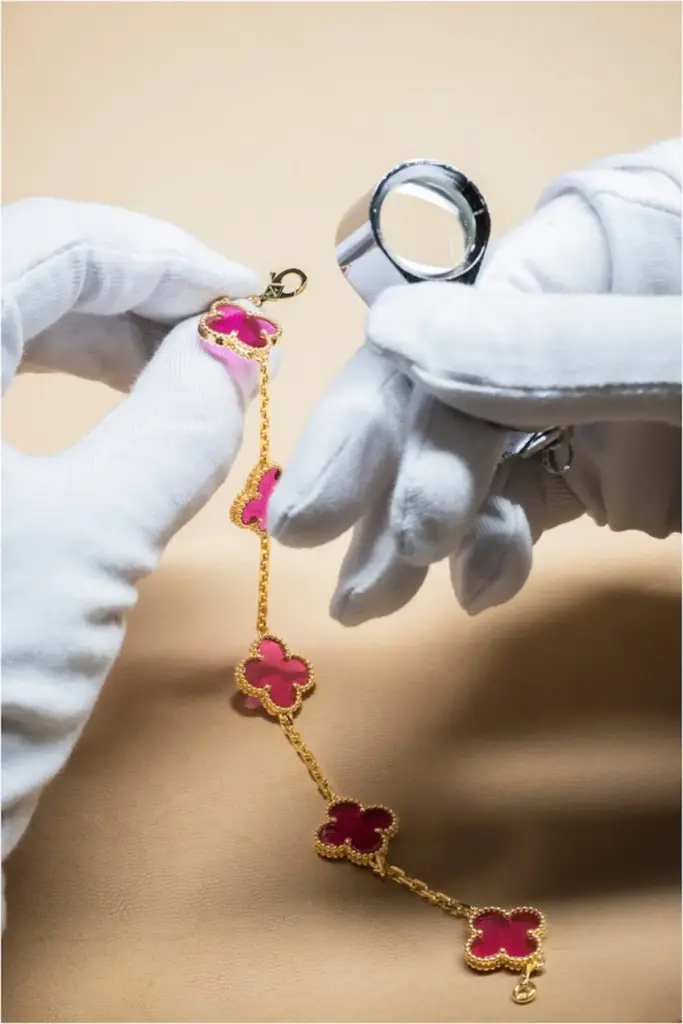
The latest chapter, however, represents a technical milestone. Van Cleef & Arpels has introduced five new Vintage Alhambra and Magic Alhambra pieces—comprising a long necklace, a standard necklace, a pendant, a bracelet, and earrings—rendered entirely in translucent pink enamel.

Developing this specific shade required years of exhaustive research within the maison’s specialized workshops. Drawing inspiration from the 17th-century "gold-ruby" manufacturing process, the vivid pink hue is engineered not through standard chemical pigments, but through the suspension of fine gold particles within the enamel matrix. To achieve visual complexity, artisans introduced microscopic bubbles into the material, imparting exceptional depth. Paired with subtly curved surfaces designed to capture and refract ambient light, these pieces bridge the gap between traditional glassmaking artistry and ultra-modern luxury jewelry design.
2. Gucci: Evolving the Equestrian Horsebit
Few design idioms are as inextricably tied to an Italian fashion house as Gucci’s Horsebit. Sketched initially in the late 1940s by an artisan striving to capture the lifestyle of the equestrian elite, the double-ring-and-bar motif rapidly graduated from leather loafers and handbags into the realm of fine jewelry and horology.
In its latest iteration, Gucci is breathing fresh life into this 75-year-old signature. The updated fine jewelry and watch capsule collection spans diamond-accented necklaces, multi-chain pendants, interlocking rings, flexible chain bracelets, and sculptural yellow and white gold bangles.
The crown jewel of the launch is a newly engineered Horsebit timepiece. Featuring a stainless-steel chain bracelet juxtaposed against a minimalist silver dial, the watch encapsulates the tension between Gucci’s deep historical roots and a sleek, contemporary, metropolitan aesthetic. It is a masterclass in how a house code can be continuously refreshed without losing its original industrial DNA.
3. Boucheron: Lierre de Paris and the Untamed Ivy
For the historic Place Vendôme jeweler Boucheron, nature has always been more than a source of fleeting inspiration—it is an obsession. In its newest nine-piece high jewelry offering, Lierre de Paris, the maison revisits the favorite botanical subject of its founder, Frédéric Boucheron: ivy.

First cataloged in the house’s expansive archives in 1870, ivy has periodically surfaced as a symbol of fidelity, attachment, and the wild, untamed beauty of the natural world. Creative Director Claire Choisne has resurrected the motif for the modern collector, utilizing diamond pavé settings that appear to organically climb, wrap, and wind across the human body.
The collection includes intricate rings, a central pendant, a remarkably flexible claspless necklace that drapes like fabric, asymmetrical earrings, and multi-wear brooches. To achieve this illusion of living plant life, every leaf is open-worked and precision-engineered with softly rounded edges, allowing diamonds to capture light from every conceivable angle while mimicking the natural undulations of a real vine.
4. Melanie Georgacopoulos: The "Eclipse" Collection
While legacy houses delve into archives, independent designers are redefining jewelry through conceptual storytelling. Melanie Georgacopoulos, renowned globally for her pioneering work with pearls, has unveiled "Eclipse," a collection centered on the transient, dramatic alignment of light and shadow.
Marking a critical evolution in her career, Georgacopoulos has ventured beyond her signature organic medium to incorporate hard stones, creating high-contrast compositions of black and white. Utilizing freshwater pearls, deep-black onyx, brilliant-cut diamonds, yellow and white gold, and black ruthenium-plated silver, the designer constructs structural necklaces, geometric rings, and sculptural earrings.
Standout pieces include fluid strands of pearls interwoven seamlessly through custom-cut onyx links, alongside geometric earrings that juxtapose stark onyx cubes against spherical white pearls. The collection’s centerpiece, the Eclipse Necklace, alternates dark and light sectors across a four-strand pearl foundation. The result is a graphic, architectural exploration of balance, tension, and material opposition.

5. Robinson Pelham: Celebrating 30 Years in New York
Rounding out this current wave of high-end jewelry movements is British fine jewelry brand Robinson Pelham, which is commemorating its landmark 30th anniversary. Known for its fearless use of vibrant color palettes and whimsical gemstone combinations, the brand is bringing its commemorative Bold Since ’96 campaign stateside with a month-long residency at Trove in New York’s West Village, kicking off September 1.
The immersive boutique takeover will display the maison’s latest capsule collections alongside signature bestsellers, one-of-a-kind bespoke commissions, and rare archival pieces dating back to the 1990s. The residency is designed not merely as a pop-up retail space, but as an experiential retrospective of three decades of unapologetic British design. In addition to a high-profile New York Fashion Week cocktail celebration, the residency will feature private, personal styling sessions hosted by Creative Director Vanessa Chilton, reinforcing the brand’s commitment to high-touch client relationships.
Supporting Context & Metrics
The timing of these high-profile launches is no coincidence. According to recent luxury retail analytics from firms such as Bain & Company and McKinsey & Company, the global personal luxury goods market has shown remarkable resilience, with hard luxury (specifically fine jewelry and watches) outpacing many apparel and footwear sectors.
| Brand | Collection / Initiative | Primary Motifs / Materials | Strategic Focus |
|---|---|---|---|
| Van Cleef & Arpels | Vintage & Magic Alhambra | Translucent Pink Enamel, Gold Particles, Yellow Gold | Technical innovation via 17th-century glassmaking processes. |
| Gucci | Horsebit Fine Jewelry & Watches | Diamond Accents, Yellow/White Gold, Steel | Celebrating 75+ years of an iconic equestrian code. |
| Boucheron | Lierre de Paris | Diamond Pavé, Open-worked Gold, Botanical Motifs | Archival revival emphasizing organic, flexible movement. |
| Melanie Georgacopoulos | "Eclipse" Collection | Freshwater Pearls, Onyx, Ruthenium Silver, Diamonds | Conceptual exploration of light, shadow, and material contrast. |
| Robinson Pelham | Bold Since ’96 Residency | Bespoke Gemstones, Archival 90s Designs | Experiential retail and 30-year brand milestone celebration. |
The Shift Toward Experiential and Technical Luxury
Industry data indicates a 14% year-on-year increase in consumer demand for narrative-driven jewelry—pieces that come equipped with a verifiable historical pedigree or an explicit technological breakthrough.
- The R&D Factor: As seen in Van Cleef & Arpels’ pink enamel development, clients are increasingly willing to pay a premium for proprietary material science. The revival of historical techniques, such as the "gold-ruby" glass process, validates a brand’s commitment to uncompromising craftsmanship.
- The Experiential Retail Model: Pop-up residencies, such as Robinson Pelham’s takeover at Trove, reflect a broader industry pivot away from traditional, sterile boutique environments toward intimate, community-building retail concepts. Clients are no longer just buying accessories; they are purchasing access to the creative directors and artisans behind the work.
Official Statements
The intersection of historical reverence and forward-thinking innovation has drawn commentary from leading creative minds across the luxury sector.

Reflecting on the milestone anniversary and the upcoming New York retail activation, Vanessa Chilton, Creative Director of Robinson Pelham, emphasized the importance of direct consumer engagement in foreign markets:
"We look forward to connecting with our New York clients and keeping the 30th anniversary festivities going in one of the biggest fashion capitals in the world. Our journey over the past three decades has been defined by bold color and unapologetic design, and bringing this narrative to the West Village allows us to share our heritage in an intimate, dynamic setting."
While archival directors and independent designers alike remain tight-lipped about upcoming production volumes, industry insiders note that the scarcity of these specialized collections—particularly those requiring intricate hand-enameling or custom stone-cutting—will naturally drive strong demand among collectors and high-net-worth investors.
Future Outlook
As the fine jewelry sector looks ahead to the remainder of the decade, several key trajectories are crystallizing:
- Hyper-Customization and Multi-Wear Functionality: Houses like Boucheron and Robinson Pelham are proving that modern clients demand versatility. Jewelry that can be worn in multiple ways—such as brooches that transition into pendants or claspless necklaces that shift contours—will dominate high jewelry sales.
- Material Experimentation: The success of Melanie Georgacopoulos’s "Eclipse" collection and Van Cleef & Arpels’ pink enamel highlights a growing appetite for non-traditional material pairings. Expect to see further hybridization of precious metals with industrial polymers, treated ceramics, and advanced composite stones.
- Immersive Retail Narratives: Static display cases are rapidly becoming obsolete. As demonstrated by Robinson Pelham’s month-long Trove residency, the future of luxury retail lies in temporary, highly curated, storytelling-driven environments that offer direct access to brand leadership.
In summary, the contemporary fine jewelry landscape is thriving not by resting on its laurels, but by aggressively challenging its own boundaries. Whether through the microscopic engineering of gold particles in French workshops or the intimate celebration of three decades of British color in New York, the message from the world’s premier jewelers is clear: heritage is merely the starting point.