Executive Overview
The landscape of online video metrics is undergoing a subtle yet profound structural shift. According to the latest data provided by GospelStats for the Tubefilter Global Top 50 charts, entertainment giant T-Series has successfully maintained its ironclad grip on the #1 position worldwide. Pulling in a staggering 930.4 million weekly views—a robust 19% increase week-over-week—the all-time viewership titan inches ever closer to breaking the coveted ten-digit weekly threshold once again.
Yet, beneath this headline-grabbing figure lies a curious industry-wide paradox.
Last month, YouTube implemented a sweeping policy change regarding how public view counts are registered, pivoting to a metric that logs views from the first frame of playback. Engineered to inflate nominal numbers and theoretically assist independent creators in negotiating lucrative brand deals, this alteration has thrown traditional digital media analysis into disarray. While early data from analytics firms like Agentio suggests that these inflated view counts overstate actual user engagement by a staggering 40% for mid-tier creators, the Global Top 50 charts tell a surprisingly stagnant story.
Rather than triggering a runaway stampede toward the billion-view mark across the board, the new algorithm has exposed the complex friction between platform-engineered metrics, real audience saturation, and aggressive content formatting—particularly across the dominant South Asian digital ecosystems. As the industry grapples with these shifting goalposts, analysts are left questioning whether YouTube’s newest metric represents genuine expansion or merely a mirage.
Detailed Chronology
To understand the current plateau at the top of the YouTube ecosystem, one must trace the timeline of metric updates and regulatory shifts that have defined the platform over the past several years:
- March 2025: The Shorts Watch-Time Relaxation: YouTube drastically reduced the amount of watch-time required for a public YouTube Shorts view to register. This first major lowering of counting standards led to an immediate flood of historic viewership data, propelling multiple channels past the historic multi-billion weekly view threshold within the Global Top 50.
- January 2026: The AI "Slop" Crackdown: Amid growing concerns regarding automated content generation, YouTube rolled out aggressive algorithmic audits and bans targeting low-effort, mass-produced channels. This sweeping audit forced many top-tier and mid-tier channels to adjust their production models, resulting in volatile, roller-coaster viewership graphs across the platform.
- August 18, 2026: The "First Frame" Policy Rollout: YouTube officially launched its new public-facing metric, mandating that public views be counted immediately from the first frame of a video. Executives defended the move as a tool to help creators bridge the gap in sponsor negotiations by aligning public-facing numbers closer to modern ad-impression standards.
- Early September 2026: The Engagement Reality Check: Digital advertising intelligence firm Agentio published findings revealing that the newly adopted first-frame policy artificially inflates reported engagement by roughly 40%, highlighting a massive disconnect between raw views and genuine human interaction.
- Current Week (Late September 2026): Stagnation at the Summit: Despite the new view-counting mechanism designed to pump up volume across the board, Tubefilter’s latest charts reveal a surprising plateau. Three of the top ten channels actually experienced week-over-week traffic declines, proving that the top tier of creators may have already reached the absolute ceiling of community saturation.
Supporting Context & Metrics
The intersection of platform policy and creator execution reveals a fascinating geographic and tactical concentration within the Global Top 50.
The South Asian Dominance
An examination of the top-performing channels highlights a persistent geographical trend: South Asia remains the undisputed engine room of global YouTube volume. In the latest rankings, an astounding 27 channels in the Global Top 50 are based in India, with an additional 3 channels operating out of Pakistan. Combined, these two nations account for a massive 60% of the entire global chart.
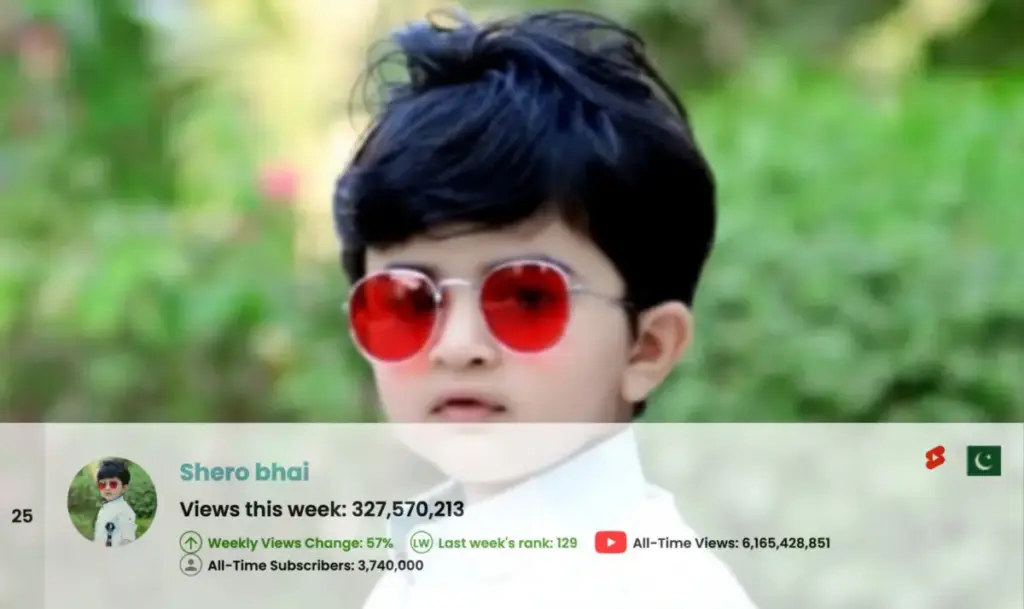
Channels operating within these hubs have mastered the mechanics of hyper-engagement. For instance, Pakistan-based creator Shero Bhai (@shaheerjuttvlog) utilizes rapid-fire visual editing, deploying heavy quick-cuts designed to hook scrollers immediately and trap them past the threshold of that critical first frame.
Volatility and Algorithmic Audits
However, life at the top is rarely smooth. Shero Bhai’s viewership trajectory over the past year reads like a seismograph. As YouTube alternates between liberalizing its definition of a public view and strictly auditing channels for unnatural traffic patterns, creators who rely heavily on algorithmic short-form loops experience violent peaks and troughs.
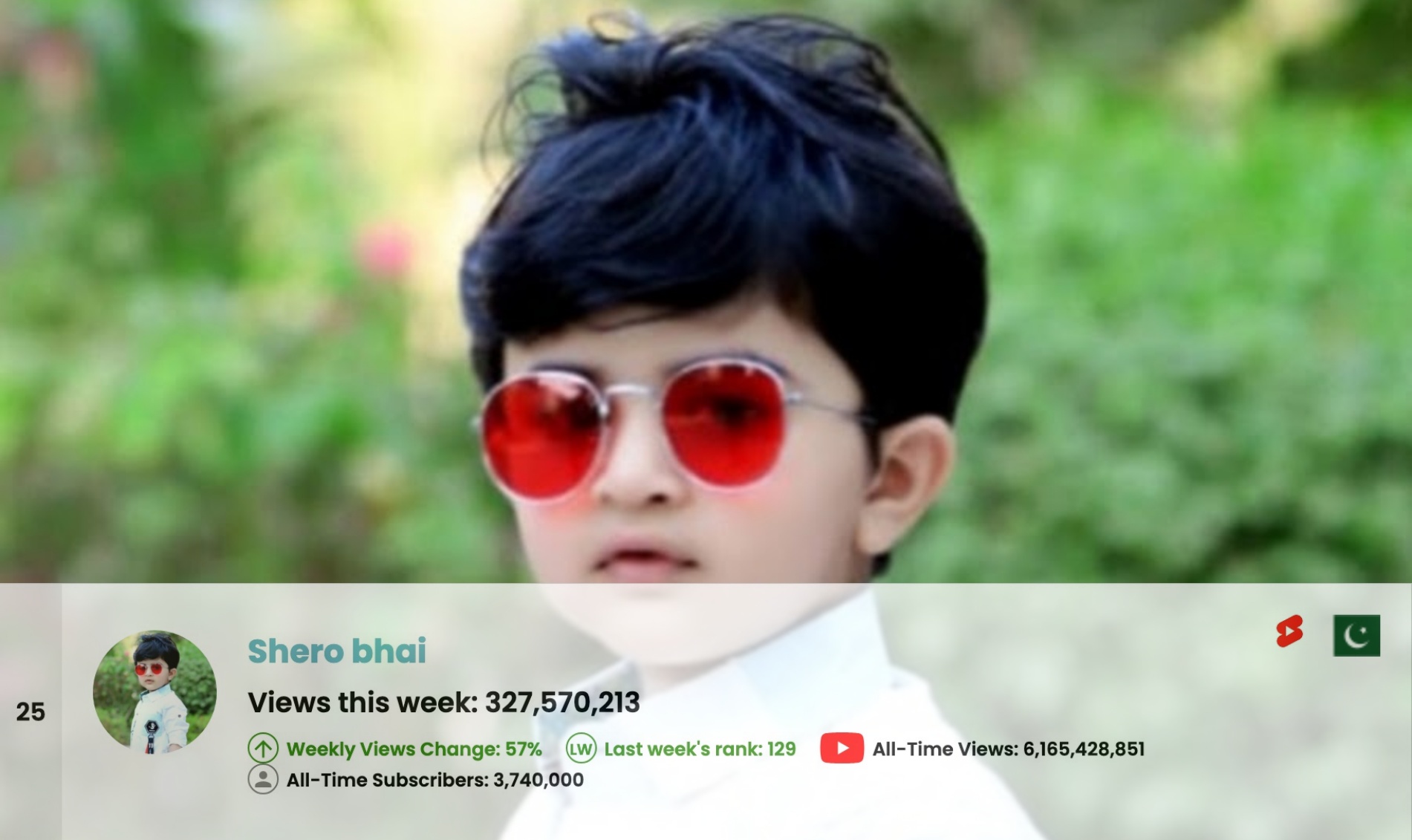
Despite these algorithmic crosswinds, the first-frame policy is undeniably leaving a footprint: Shero Bhai has managed to clear the 300 million weekly view mark for only the second time this calendar year, illustrating that optimized short-form strategies can still harvest immense numerical rewards under the right conditions.
The Shorts Monopoly
The format breakdown of the current Top 50 underscores the continued supremacy of vertical video. Out of the fifty most-viewed channels globally this week, a dominant 37 channels are primarily active on YouTube Shorts. Traditional long-form content creators, while holding immense cultural and monetary value, increasingly struggle to compete with the sheer velocity of algorithmic short-form distribution.
Industry Perspectives & Expert Analysis
The widening gap between raw platform metrics and genuine user engagement has sparked intense debate among digital marketing executives, analysts, and creator advocates.
Proponents of YouTube’s first-frame policy argue that modern digital advertising has long relied on impression-based metrics rather than sustained, active attention spans. By moving public view counts closer to standard ad-server logic, YouTube is attempting to modernize the creator economy. Major brand-side advocates point out that creators have historically been disadvantaged when trying to prove their top-of-funnel reach to legacy media buyers who are accustomed to broadcast and social media metrics that count every brief impression.
Conversely, independent data scientists and platforms like Agentio have raised red flags regarding brand safety and valuation integrity. When a metric overstates actual consumer engagement by 40%, the risk of misallocated marketing dollars skyrockets. Industry analysts note that brands purchasing sponsorships based purely on raw view counts may soon demand deeper, first-party retention data, potentially rendering the "first-frame" metric more of a vanity tool than a functional currency.
Furthermore, platform economists suggest a secondary hypothesis for the current top-tier stagnation: market saturation. Channels like T-Series and the top Indian and Pakistani short-form hubs have already achieved near-total demographic penetration within their target languages and regions. Even with an algorithmic boost that counts views from the microsecond a video loads, there are simply no new human eyeballs left to capture in those specific saturated niches.
Future Outlook
As the dust settles on YouTube’s latest architectural overhaul, the big question facing the creator economy is whether the platform will return to the era of multiple billion-view-per-week powerhouses.
In previous years, it was not uncommon to see several channels simultaneously cruising past the ten-figure weekly mark. Today, even with a policy explicitly engineered to inflate view totals, only T-Series is knocking loudly on that door.
Over the coming months, industry watchers will closely monitor the Global Top 50 to see if mid-tier creators adapt their editing styles to game the first-frame rule, or if the market will experience a corrective backlash from brands demanding truer engagement metrics. One thing remains certain: as YouTube continues to tweak the invisible gears of its recommendation engine, creators will continue to innovate, adapt, and hustle to capture whatever fractions of attention remain in an increasingly crowded digital universe.