Executive Overview
As the gaming industry prepares its collective gaze toward Cologne, Germany, for the annual Gamescom convention, the rumor mill has shifted into hyperdrive. Geoff Keighley’s heavily anticipated Opening Night Live showcase, slated for Tuesday, August 25, is traditionally a fertile ground for industry-shaking announcements. However, this year’s discourse has been unusually dominated by a shroud of secrecy surrounding a singular, highly whispered-about project: a clandestine Xbox revival.
According to prominent industry insider NateTheHate—whose track record includes accurately breaking news regarding Nintendo’s remakes of Star Fox and The Legend of Zelda: Ocarina of Time—Microsoft is poised to unveil a sequel to a dormant, well-loved Xbox property. Intriguingly, this unannounced title is reportedly being developed by an external third-party studio and could see a commercial release before the conclusion of the calendar year.
While NateTheHate has deliberately kept his cards close to his chest, offering only cryptographic breadcrumbs for the community to parse, his hints have sparked intense speculation across platforms like Reddit and ResetEra. Enthusiasts and industry sleuths are currently locked in a fierce debate, attempting to filter out eliminated franchises and pinpoint whether the mystery game is a continuation of the beloved metroidvania platformer Ori, the cult-classic chaotic shooter Sunset Overdrive, or perhaps another unexpected vault-dweller from Xbox’s historical catalog.
Against the backdrop of recent, widespread corporate restructuring and studio closures within Microsoft’s gaming division, this potential announcement carries immense weight. It not only signals Xbox’s ongoing reliance on external partnerships to bolster its ecosystem but also raises critical questions about brand identity, studio stewardship, and the strategic prioritization of established intellectual properties in an increasingly volatile market.
Detailed Chronology: The Anatomy of a Leak
The trail leading up to the anticipated Gamescom reveal began taking shape in mid-August, when industry insiders began hinting at major surprises slated for Keighley’s Opening Night Live broadcast. While confirmed appearances—such as CD Projekt’s upcoming DLC expansion for The Witcher 3: Wild Hunt and Director Naoki Hamaguchi presenting a fresh trailer for Final Fantasy 7 Revelation—were expected to anchor the headlines, the undercurrent of unconfirmed rumors proved far more magnetic.
NateTheHate took to social media and community forums to tease what he described as a "neat Xbox announcement" capable of generating genuine excitement and curiosity. Rather than dropping a direct title, the insider elected to frame the reveal through a series of structural parameters:
- The Platform: It is an established, Microsoft-owned intellectual property.
- The Developer: The sequel is being engineered by an external third-party studio, one that historically has not handled this specific franchise.
- The Timeline: The game is far along enough in its development cycle to target a release window before the end of the current year.
- The Scope: It is a continuation of a "recent" property, a term that most analysts interpret as stemming from the Xbox One era or later.
As the gaming community mobilized to cross-reference these clues, NateTheHate systematically narrowed the field by ruling out several high-profile contenders. He explicitly shot down theories tying the announcement to Fallout, Wolfenstein, Starcraft, or the beloved platforming relic Banjo-Kazooie.
With the eliminative process underway, enthusiasts were left staring at a starkly limited pool of candidates. The specificity of a third-party developer taking the reins of an existing IP—combined with a rapid turnaround to a late-year release—has turned what is normally standard convention chatter into a high-stakes guessing game. As the clock ticks down to the August 25 showcase, the industry remains poised to see whether this leak will culminate in a triumphant revival or a bittersweet reminder of franchises left behind.

Supporting Context & Metrics: Decoding the Candidates
To understand the weight of this impending announcement, one must dissect the primary contenders surviving the insider’s elimination rounds. Each potential candidate carries a unique set of structural hurdles, historical baggage, and strategic implications for Microsoft’s gaming portfolio.
1. The Ori Franchise: A Masterpiece Without Its Creators?
One of the most widely discussed and emotionally resonant theories is the possibility of a third entry in the Ori series. Following the monumental critical and commercial success of 2015’s Ori and the Blind Forest and its 2020 sequel, Ori and the Will of the Wisps, the metroidvania genre found its modern gold standard in Moon Studios’ evocative artistry.
However, the corporate dynamics surrounding Ori complicate this theory. While Microsoft holds the publishing rights to the IP, Moon Studios remained strictly independent and experienced a well-publicized falling out with Xbox leadership over workplace culture and creative differences. Moon Studios is currently pouring its efforts into its next dark fantasy action role-playing game, No Rest for the Wicked.
If NateTheHate’s revelation points to a third-party studio handling an IP it has never touched before, handing Ori over to a brand-new developer would be a massive gamble. Fans adore the franchise precisely for Moon Studios’ distinct, hand-crafted visual and mechanical identity. Replicating that lightning in a bottle with a fresh team—while pushing for a release before the year’s end—presents a logistical hurdle that tests even the most optimistic projections.
2. Sunset Overdrive: The Unlikely Relic of Insomniac Past
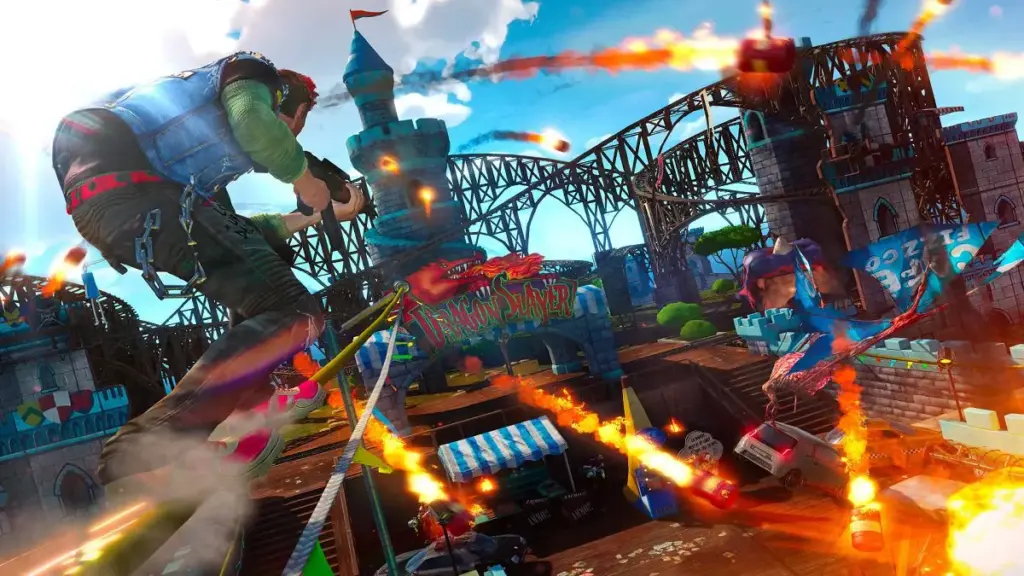
Another frequent entry in community speculation is 2014’s vibrant, punk-rock open-world shooter, Sunset Overdrive. Praised for its hyper-kinetic traversal and distinct comedic tone, the game carved out a passionate niche during the early, turbulent years of the Xbox One.
Yet, structural roadblocks make a Sunset Overdrive revival a legal and corporate labyrinth. Although Microsoft funded and published the original title, the intellectual property rights belong exclusively to developer Insomniac Games. Following Sony’s acquisition of Insomniac in 2019, the studio became an integral pillar of PlayStation’s first-party lineup, currently knee-deep in blockbuster Marvel adaptations like Spider-Man and Wolverine.
While Sony registered a trademark for Sunset Overdrive in 2021—reigniting faint embers of sequel hope—the likelihood of Sony licensing or selling the IP back to Microsoft, or allowing Insomniac to develop a multiplatform or Xbox-exclusive sequel, borders on the impossible. Furthermore, Microsoft’s recent corporate strategy has leaned heavily into stabilizing and amplifying proven, multi-platform blockbusters like The Elder Scrolls and Doom, rather than pouring capital into reviving minor cult hits from a decade prior.
3. ReCore and Crackdown: The Dark Horses
If we broaden the lens to other historical Xbox One properties, titles like ReCore (2016) and the Crackdown franchise emerge as theoretical possibilities. ReCore, a joint venture between the now-defunct Armature Studio and Comcept, offered a neat sci-fi action-platforming premise, but its muted commercial reception and soft cultural footprint make a sudden sequel unlikely.

Crackdown, meanwhile, has a storied history of being passed between external studios. With the original 2007 classic standing as an Xbox 360 icon, subsequent entries struggled to capture that original magic. Handing Crackdown 4 to yet another external developer aligns with NateTheHate’s hint about a third-party studio taking over an unfamiliar franchise, but consumer demand for the sandbox shooter has cooled significantly in recent years.
Official Statements and Industry Climate
The timing of this rumored Gamescom announcement intersects awkwardly with a turbulent period of internal restructuring at Microsoft. The shadow of major workforce reductions hangs heavy over the brand. Last month, Xbox implemented widespread layoffs, cutting over 3,200 staff members and shuttering or downsizing several prominent internal studios, including a sobering review of operations at Arkane. Reports of abrupt, impersonal layoffs communicated via brief corporate calls have further soured public perception among consumers and developers alike.
Consequently, Xbox’s physical and digital presence at Gamescom Opening Night Live carries heightened scrutiny. While fans historically clamor for new game announcements, the prevailing sentiment within online communities is one of cautious skepticism. Critics and players alike are questioning how Microsoft can justify investing in external revivals or new studio partnerships while simultaneously shedding thousands of internal development jobs.
Neither Microsoft nor Geoff Keighley has officially confirmed the nature of the secret Xbox project, adhering to standard industry practice regarding pre-show leaks. However, the weight of NateTheHate’s assertions, combined with the desperate need for positive narrative momentum, suggests that Xbox views Gamescom as a crucial staging ground to steer the public conversation back toward software and innovation.
Future Outlook: What to Expect on August 25
As the gaming world counts down the hours to Tuesday, August 25, at 7:00 PM BST, all eyes will be locked on the Gamescom Opening Night Live broadcast. Whether the mystery project turns out to be a triumphant return for the Ori universe under a new banner, a shock continuation of a forgotten Xbox One exclusive, or an entirely left-field intellectual property, the announcement will serve as a bellwether for Xbox’s current strategic trajectory.
If the leak proves accurate and a polished, late-year release is indeed unveiled, it will validate the reliability of modern insider reporting while demonstrating Microsoft’s continued willingness to leverage third-party alliances. However, hardware and software executives must navigate this reveal carefully. In an ecosystem still reeling from profound structural contractions and workforce trauma, the success of any newly revived franchise will be measured not just by its critical reception or commercial sales, but by the industry’s broader capacity to foster sustainable, respectful creative environments.
For now, the mystery remains intact—leaving fans, journalists, and developers alike to dissect every remaining clue until the curtain rises in Cologne.