Executive Overview
As the television industry prepares for yet another milestone Emmy Awards ceremony broadcast by NBC, it is worth looking back two decades to an inflection point that fundamentally altered the landscape of prestige television. On August 27, 2006, the 58th Primetime Emmy Awards took place at the Shrine Auditorium in downtown Los Angeles. At the time, television executives, critics, and viewers viewed the evening as a standard celebration of the television calendar. In hindsight, however, the 2006 ceremony served as a historic watershed moment—the absolute final time that the traditional broadcast networks claimed the television industry’s two most prestigious prizes: Outstanding Comedy Series and Outstanding Drama Series.
That evening, NBC’s breakout workplace mockumentary The Office secured the comedy crown, while Fox’s high-octane real-time thriller 24 captured the drama series Emmy. No broadcast network has won either of those premier categories since.
The 2006 ceremony captures a fascinating crossroads in entertainment history. It stood at the twilight of the traditional network era, right on the precipice of the Golden Age of cable dominance and the subsequent tsunami of the streaming revolution. This retrospective examines the structural, creative, and procedural shifts that occurred at the 2006 Emmys, exploring how a night dominated by ABC, CBS, NBC, and Fox became a poignant swan song for the medium’s foundational architects.
Detailed Chronology: The Night the Broadcast Networks Held the Crown
To fully understand the magnitude of the 2006 Primetime Emmy Awards, one must examine the operational and broadcast realities of the era. NBC held the broadcasting rights for the ceremony that year. Because of network commitments to the powerhouse sports franchise Sunday Night Football, the Emmys were scheduled unusually early—way back in late August—to avoid head-to-head competition with the gridiron juggernaut. (By fortunate contrast, modern scheduling has allowed NBC to shift the telecast to a Monday evening later in September, preserving summer vacation plans while maintaining a traditional post-season slot).
On that warm August evening in Los Angeles, the broadcast networks seemed to be standing on solid ground, even as rumblings of prestige cable disruption echoed from premium networks like HBO.
The Drama Battleground
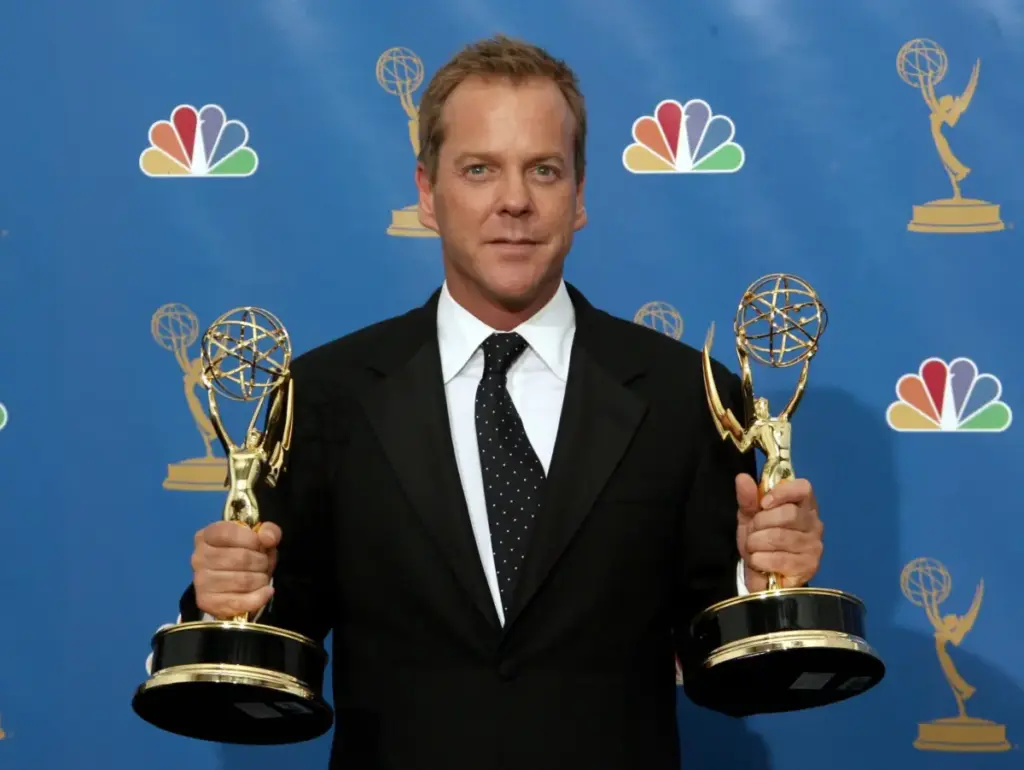
Fox’s 24, heading into its fifth season, was a certified pop-culture juggernaut. Its win for Outstanding Drama Series marked Fox’s first and, as history would prove, its last victory in the category. The win was part of a major night for the counter-terrorism thriller, which also saw lead star Kiefer Sutherland take home his first Emmy Award for his iconic portrayal of CTU agent Jack Bauer, alongside a win for outstanding directing.
The drama category that year was overwhelmingly populated by network titans. 24 squared off against a slate featuring ABC’s medical phenomenon Grey’s Anatomy, Fox’s medical mystery House, and NBC’s political prestige heavyweight The West Wing. HBO’s seminal mob drama The Sopranos was the sole representative from the cable landscape.
While The Sopranos would bounce back to win the drama series Emmy the following year in 2007, the writing was already on the wall. 2006 marked the final time that broadcast networks commanded the majority of nominations in the drama series category. In the years that followed, cable television seized total creative and critical control, launching a golden era defined by landmark series such as Mad Men, Breaking Bad, Homeland, and Game of Thrones. The decline was so absolute that NBC’s heartfelt family drama This Is Us stood as the final broadcast network series to even earn a nomination in the category, a feat it managed in 2021—nearly fifteen years after the broadcast blackout began.
The Comedy Stronghold
While broadcast dramas fell swiftly to the rising tide of cable, the comedy categories offered the traditional networks a slightly longer lease on life. Following The Office’s watershed victory in 2006, NBC maintained a firm grip on the category with Tina Fey’s critical darling 30 Rock, which won three consecutive Outstanding Comedy Series trophies from 2007 to 2009. Shortly after, ABC’s mockumentary-style family sitcom Modern Family embarked on an unprecedented five-year winning streak from 2010 to 2014.
However, even the comedy fortress eventually crumbled. By the mid-2010s, subscription video-on-demand (SVOD) platforms and premium cable networks dismantled the broadcast monopoly on funny business, leaving network comedies fighting for scraps in an increasingly fragmented viewing ecosystem.
Supporting Context & Metrics: The Procedural Earthquake of 2006
Beyond the shift in winners, the 2006 Emmy Awards are notable for an internal administrative experiment that reshaped the entire nomination process. In an effort to counter accusations of voter fatigue and break up predictable voting patterns, the Television Academy instituted a radical change: the implementation of "blue ribbon panels" designed to decide the nominees for Outstanding Comedy Series, Outstanding Drama Series, and several key acting categories.

The Mechanics of the Blue Ribbon Panels
Under this short-lived system, the voting mechanics operated in two distinct phases:
- The Initial Slate: General TV Academy members cast ballots to generate an initial pool of potential nominees.
- The Panel Deciders: Once the fields were narrowed down to 10 contenders (or 15 for individual performance categories), a specialized panel consisting of roughly 500 hand-picked Academy members gathered at the organization’s North Hollywood headquarters. These panelists were required to screen specific submitted episodes and vote directly on the final nominees.
The immediate fallout of this procedural overhaul sent shockwaves through Hollywood. The first year of the blue ribbon panel experiment generated widespread industry anxiety and public hand-wringing. Most notably, ABC’s supernatural mystery phenomenon Lost—which had captured the Outstanding Drama Series Emmy just the previous year—was entirely shut out of the drama series race, a snub that stunned television insiders.
Accelerating the Cable Takeover
While mainstream hits suffered under the scrutiny of the panels, cable contenders quietly benefited. The blue-ribbon framework required voters to actively sit down, watch submitted episodes, and evaluate them in a closed-room environment. This structural shift favored serialized, high-concept, boundary-pushing cable dramas that demanded intense engagement, thereby accelerating the decline of broadcast network procedural formulas at the Emmys.
Recognizing that the panels were concentrating power and leading to insular voting loops, the Television Academy ultimately eliminated the blue-ribbon system in 2015. The organization returned to a more democratic, popular-vote model across the entire membership base, but the damage—or rather, the evolution—to the broadcast networks’ standing was already irreversible.
Official Statements and Industry Reflections
Industry analysts and academy insiders have long pointed to the mid-2000s as the definitive fault line between old and new television business models.
Reflecting on the era, veteran entertainment commentators note that the transition was driven as much by shifting audience expectations as it was by executive risk appetite. When streaming platforms like Hulu shattered the glass ceiling a little over a decade later—with The Handmaid’s Tale becoming the first streaming series to win Outstanding Drama Series in 2017—it was the direct descendant of the path carved out by cable networks a decade prior.
Furthermore, the 2006 ceremony serves up remarkable moments of serendipity when tracking individual careers. Among the winners that night was Mariska Hargitay, who captured the Emmy for Outstanding Lead Actress in a Drama Series for her iconic work on NBC’s long-running procedural Law & Order: Special Victims Unit. That victory stands as the last time NBC won in that specific acting category.
Decades later, Hargitay’s enduring legacy underscores the paradox of modern television: while corporate structures, distribution pipelines, and award ceremonies have undergone seismic transformations, exceptional talent remains timeless. Hargitay’s return to the Emmy stage—not only as a master of ceremonies and host, but also as a contender for her deeply personal documentary work in My Mom Jayne—bridges the gap between the broadcast era of 2006 and the multi-platform landscape of today.
Future Outlook: The Next Frontier of Television Recognition
As the television industry looks ahead toward future Emmy ceremonies, the lessons of the 2006 broadcast swan song remain acutely relevant. The boundary lines that once strictly separated broadcast, cable, and streaming have dissolved entirely. Today, major broadcast networks operate parallel streaming services, and legacy linear models are continuously forced to adapt to rapid cord-cutting trends and non-linear viewing habits.
The streaming revolution, which began with platform pioneers capturing top-tier trophies in the late 2010s, has matured into a complex ecosystem defined by FAST channels, ad-supported tiers, and global co-productions. Yet, as the Television Academy continues to reform its voting procedures to accommodate short-form content, international streaming hits, and creator-driven digital platforms, the fundamental currency of the Emmy Awards remains artistic excellence.
The 2006 Primetime Emmy Awards will always occupy a bittersweet space in television history. They represent the final golden sunset for an era when families gathered around living room television sets at predetermined times to watch broadcast network flagships. Though the industry has evolved into a boundless, on-demand digital universe, examining that night two decades ago reminds us of the relentless innovation that continues to drive the medium forward.