Executive Overview
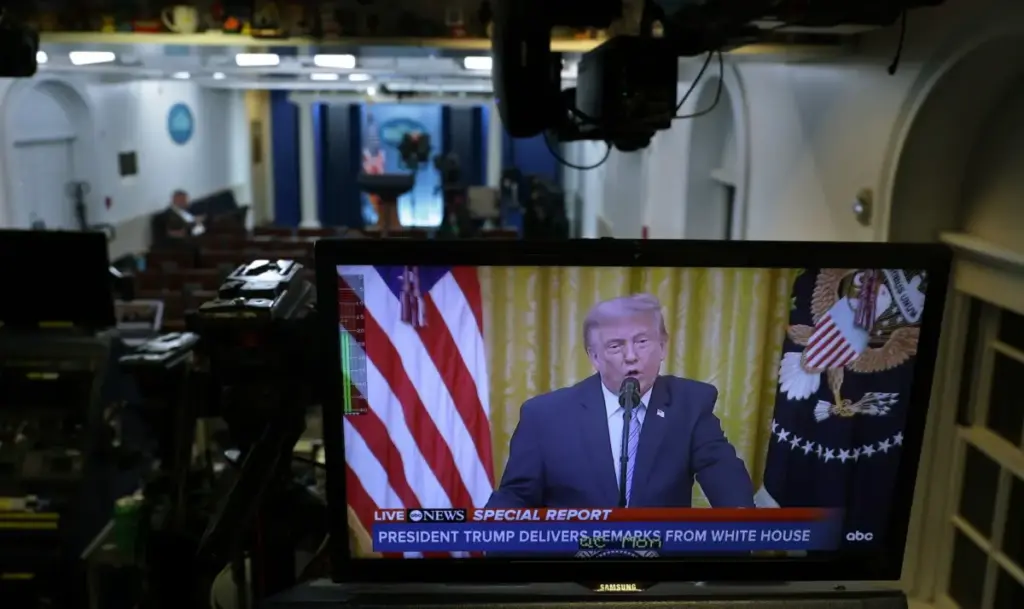
In an era defined by fractured media ecosystems and deepening political polarization, the fault lines between the executive branch and the traditional American press have ruptured completely. Faced with an unprecedented media blockade orchestrated by five of the nation’s largest news conglomerates, the Trump administration has pivoted decisively toward direct-to-consumer digital infrastructure, launching a 24/7 streaming initiative dubbed “Trump TV” on the official White House YouTube channel.
This dramatic escalation follows the administration’s controversial decision to ban prominent outlets—including Politico, MS NOW, and CNN—from the physical confines of the White House press room. In swift retaliation, Fox News, ABC News, CBS News, NBC News, and CNN formed a united front, enacting a sweeping blackout of the president’s live briefings and statements.
Rather than conceding to traditional journalistic pressure, the White House has bypassed the legacy gatekeepers entirely. By weaponizing mainstream hosting platforms like YouTube, the administration is attempting to construct an unfiltered, state-backed broadcasting apparatus that delivers its messaging straight to the electorate. Yet, this high-stakes standoff raises profound constitutional, ethical, and technological questions. Critics immediately drew parallels to state-run media operations in authoritarian regimes, while digital rights advocates and industry watchers turned their gaze toward Silicon Valley.
As traditional journalism fights to preserve the public’s right to independent oversight, tech giants like YouTube find themselves caught in the crossfire. By hosting the feed, platforms are implicitly choosing to play ball with the executive branch, leaving the ultimate future of press freedom—and digital censorship—hanging in a precarious balance.
Detailed Chronology: From Press Room Bans to the YouTube Pivot
The sequence of events leading to the birth of Trump TV represents a historic milestone in the deterioration of relations between the American presidency and the fourth estate. The friction began escalating immediately following the inauguration of Donald Trump’s second term, characterized by an administration determined to redefine access on its own terms.
The White House Press Room Blacklist
The crisis reached a boiling point when the White House communications team abruptly revoked the press credentials of several premier news organizations. Reporters from Politico, MS NOW, and CNN were barred from entering the press briefing room, effectively shutting them out of daily operational updates and direct questioning of executive spokespersons.
The administration defended the move as a necessary correction against what it termed systemic bias and slanted reporting. However, the decision was widely interpreted by media unions, press freedom advocates, and executive correspondents as a blatant authoritarian tactic designed to punish critical reporting and muzzle independent scrutiny.
The Unified Media Boycott
In an unprecedented display of solidarity, five major television and digital news networks—Fox News, ABC News, CBS News, NBC News, and CNN—colluded on a joint response. Releasing a formal statement condemning the administration’s actions, the coalition declared:
"The public has a vital interest in receiving accurate, independent information about its government. A free press is the bedrock of American democracy, and we will not normalize the arbitrary exclusion of independent journalists from the people’s house."
Following this declaration, the networks drastically curtailed or completely halted their live broadcasts of standard White House press briefings, effectively instituting an on-air embargo against the executive branch’s primary communicative outlet.
The Debut of Trump TV
Recognizing the immediate threat of a communications blackout, White House digital strategists moved with lightning speed. Hours after the five-network embargo went into effect, a brand-new 24/7 continuous stream went live on the official White House YouTube channel.
Dubbed "Trump TV" by media observers, the stream began broadcasting a looped reel of the president’s past speeches, campaign rally highlights, and signature policy achievements. Rather than submitting to the demands of legacy media corporations, the administration decided to double down on digital-first sovereign broadcasting, betting that the American public’s consumption habits have permanently shifted away from cable television and toward streaming platforms.
Supporting Context & Metrics: The Creator Economy and Viewership Realities
While the ambitions behind Trump TV are grand, the reality of its early deployment reveals a complex landscape of shifting media consumption, creator partnerships, and underwhelming initial engagement metrics.
Analyzing the Metrics: Who is Watching?
Despite the immense cultural footprint of Donald Trump and the sheer novelty of a 24/7 presidential streaming channel, the initial public appetite for Trump TV has proven surprisingly muted. According to data tracked across the platform during its rollout, concurrent viewership for the stream has largely stagnated, staying consistently below 10,000 concurrent viewers.
Critics and digital media analysts have been quick to point out that much of the content featured on the loop consists of recycled material, including speeches that are months old. Whether the platform can scale its audience or whether it will remain a niche digital outpost for the most dedicated loyalists remains one of the central operational questions facing the White House digital team.
The Creator Economy Alliance
Realizing that traditional news networks can no longer serve as reliable megaphones, the administration has systematically courted the alternative media and creator economy. From the very opening days of his second term, the president’s inner circle opened the doors of the White House to right-wing influencers, independent podcasters, and YouTube creators, granting them coveted press credentials typically reserved for wire services and major networks.
This strategy was dramatically underscored just four days prior to the launch of Trump TV, when the administration solidified an alliance with internet megastars Logan and Jake Paul. In a move that sent shockwaves through both traditional political circles and the digital creator community, the Paul brothers were invited to the Pentagon to speak directly to active-duty U.S. troops.
By integrating creators into official government functions, the White House is signaling a paradigm shift: political access is no longer mediated exclusively by journalistic credentials, but by digital reach, algorithmic influence, and parasocial viewer loyalty. Trump TV represents a natural extension of this philosophy, serving as a potential incubator where the administration can host creator collaborations, guest interviews with prominent digital influencers, and unedited town halls that bypass legacy gatekeepers entirely.
Official Statements and Industry Reactions
The emergence of state-level streaming infrastructure under the guise of Trump TV has drawn sharp rebukes from legal scholars, international observers, and media watchdogs, while drawing robust defenses from executive leadership.
The White House Defense
Defending the launch of the YouTube channel, White House Head of Digital Strategy Kaelan Dorr took to social media platform X (formerly Twitter) to frame the initiative as a corrective measure against journalistic malpractice.
"The press, in some cases, reported inaccurately or not at all on the Administration’s many record-breaking accomplishments on behalf of all Americans," Dorr explained on X.
Dorr explicitly pitched Trump TV as "the Administration’s greatest hits, unfiltered." The strategy relies on cutting out editorial middle-men, allowing the executive branch to communicate policy, triumphs, and grievances directly to the citizenry without contextual framing, fact-checking, or hostile questioning from mainstream journalists.
Global Comparisons and the State-Run Media Debate
Media critics and international press freedom organizations have been unsparing in their analysis. The launch of the stream has drawn immediate, unfavorable comparisons to state-run media apparatuses found in authoritarian regimes worldwide—such as North Korea’s Korean Central Television (KCV) or Russia’s Channel One—where government-controlled channels serve as the sole arbiters of truth and narrative.
The Guardian and other international publications noted that while Western democracies have historically prided themselves on independent, adversarial media ecosystems, the deployment of a 24/7 presidential propaganda loop on a private tech platform represents an unprecedented degradation of institutional norms.
Silicon Valley’s Dilemma: The YouTube Response
Perhaps the most critical variable in the Trump TV equation is the posture of Big Tech. While mainstream journalists are staging a unified boycott against the White House, major social media platforms—most notably YouTube—have continued to play ball with the administration.
Historically, YouTube has faced intense scrutiny regarding its content moderation policies, election outcome messaging, and how it handles political misinformation. Yet, despite mounting pressure from civil rights organizations and traditional media conglomerates, YouTube has not moved to restrict or remove the White House channel’s continuous broadcast.
This passive complicity—or platform neutrality, depending on one’s regulatory viewpoint—poses an existential question for the tech sector: Is there a tipping point at which YouTube will feel compelled to intervene in the name of democratic integrity, or will corporate policies continue to protect official government accounts regardless of how they are utilized? By allowing the administration to broadcast unchecked material directly from the official White House handle, YouTube is effectively acting as the primary infrastructure provider for state-run media in the United States.
Future Outlook: The New Frontier of Information Warfare
As the dust settles on the initial weeks of the White House press boycott and the launch of Trump TV, the long-term implications for American media and governance are profound and unsettling.
1. The Death of the Unified National Narrative
We are entering a permanent balkanization of American reality. With the executive branch broadcasting its own curated reality via YouTube streams and creator collaborations, and legacy networks refusing to broadcast unverified executive statements, the American public no longer shares a common set of facts or a unified civic stage. Citizens are increasingly retreating into hyper-targeted media silos that reinforce their pre-existing ideological worldviews.
2. The Rise of Creator-State Politics
The integration of internet creators like the Paul brothers into official military and governmental spaces marks a permanent evolution in political communication. Future administrations will likely find it increasingly unnecessary to court the New York Times or CNN, opting instead to book appearances on high-traffic podcasts, live-streaming channels, and creator-led networks where engagement is high, oversight is low, and interviewers are generally more pliable.
3. The Regulatory and Legal Battlegrounds
As Trump TV matures, legal scholars will inevitably scrutinize the use of official, taxpayer-funded government resources—such as the White House YouTube channel—for what amounts to partisan image-making and continuous political campaigning. Furthermore, pressure will mount on Alphabet (Google/YouTube) to clarify its Terms of Service regarding state-sponsored media, especially if the channel begins amplifying disputed electoral claims or policy disinformation.
Conclusion
Trump TV may currently attract fewer than 10,000 concurrent viewers on its daily loops, but dismissing it as a failed digital experiment would be a grave analytical error. The channel is not merely a broadcasting feed; it is a declaration of independence by the executive branch from the traditional mechanisms of accountability. As the wall between state messaging and platform capitalism grows thicker, the American experiment in free press and open governance faces its most arduous digital trial yet. The war for the information ecosystem has entered a new phase, and the outcomes will reverberate for generations.