Executive Overview
Netflix’s true crime catalog has long relied on headline-grabbing narratives, but few cases match the sheer, labyrinthine audacity of Thomas Randolph. Chronicled in the 91-minute documentary The Widower: ’Til Death Do Us Part, Randolph’s terrifying saga involves a man who walked down the aisle six times and buried four of his wives—three under deeply suspicious, violent circumstances.
While the chilling details of Randolph’s crimes may ring a bell for devoted true-crime followers—having previously been explored in NBC producer Dan Slepian’s five-hour 2021 docuseries Dateline: The Widower and Investigation Discovery’s The Black Widower: The Six Wives of Thomas Randolph—Netflix’s feature puts a fresh spin on the material. Director and producers pivot the lens away from a standard outsider’s retrospective. Instead, veteran Dateline producer Dan Slepian steps directly in front of the camera, evolving into a primary narrator who details his extraordinary, decade-long firsthand access to Randolph and the tortuous legal proceedings that spanned nearly twenty years.
The documentary not only re-examines Randolph’s horrific misdeeds and serves as a meta-analysis of the true-crime investigative process, but it also brings the saga completely up to date with recent legal milestones. For nearly two decades, Randolph danced along the edge of the justice system, evading accountability through legal churn, manipulation, and the sheer force of a textbook narcissistic personality. This extensive investigative piece unpacks the chronology of Randolph’s crimes, the extraordinary reporting behind the documentary, the structural vulnerabilities of the American judicial system exposed by the case, and where the notorious "Widower" stands today.
Detailed Chronology: The Wives, The Murders, and the 20-Year Legal War
To understand the scope of Thomas Randolph’s crimes is to witness a masterclass in calculated manipulation. Randolph operated with a chillingly consistent pattern: he courted women, married them, accumulated hundreds of thousands of dollars in life insurance policies naming himself as the sole beneficiary, and then engineered their tragic demises or orchestrated scenarios to cast himself as the heroic survivor.
The Early Marriages and Suspicious Deaths
Randolph’s marital history reads like a roadmap of tragedy. Out of his six unions, his first and fourth wives remain alive. However, the fates of the others are shrouded in suspicion:
- The Second Wife: Shot to death in a manner meticulously staged to look like suicide. This incident triggered a high-stakes trial that ultimately resulted in Randolph’s acquittal, successfully dodging a potential death sentence.
- The Third Wife: Died of cancer.
- The Fifth Wife: Passed away in a hospital following routine heart surgery. Despite her death appearing natural on paper, suspicions swirled around Randolph—suspicions he later leveraged by suing the hospital for medical malpractice, walking away with a substantial financial settlement.
- The Sixth Wife (Sharon Causse): The fatal turning point of Randolph’s criminal enterprise.
The Murder of Sharon Causse and the 2008 Investigation
In 2008, Las Vegas police were summoned to the home of Randolph and his sixth wife, Sharon Causse. Upon arrival, officers found Causse shot and dead in her home. Randolph greeted investigators with a prepared narrative: he claimed that a handyman he had recently hired, Mike Miller, had shot Causse, forcing Randolph to bravely step in, shoot, and kill Miller in self-defense.
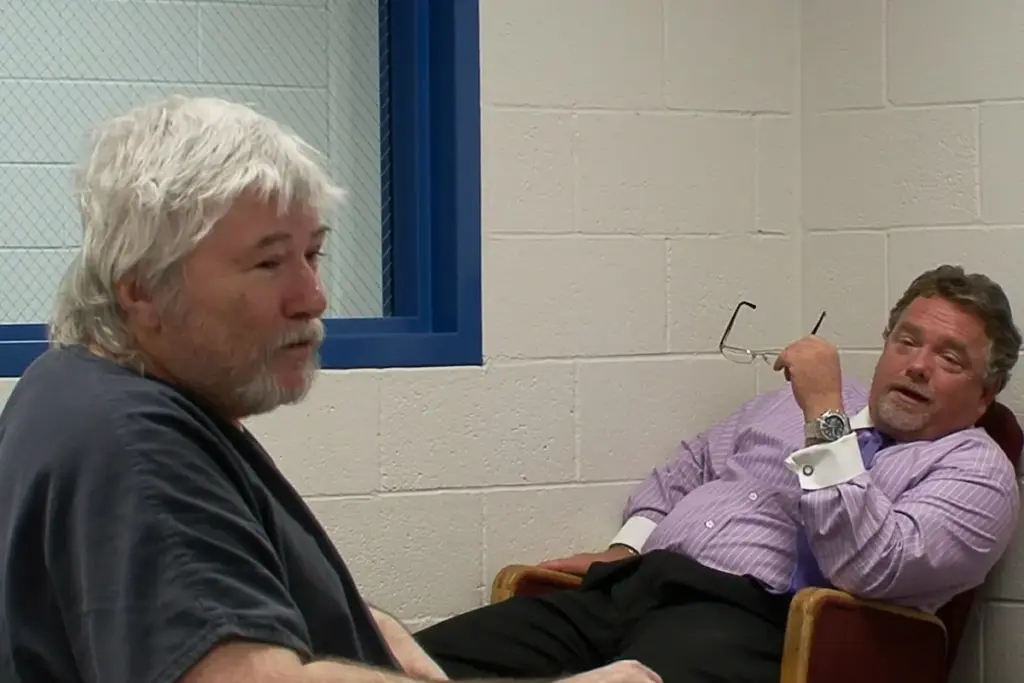
Enter Las Vegas Police Department Detective Dean O’Kelley and journalist Dan Slepian. In an unprecedented move, detectives tipped off Slepian early in the investigation, granting him nearly unfettered access to the crime scene, meetings with district attorneys, and the bizarre spectacle of police having Randolph reenact the night of the murder—with Slepian’s camera rolling the entire time.
As investigators dug deeper, the financial motive materialized. Randolph had taken out heavy life insurance policies on Causse and designated himself as the sole beneficiary. However, sensing her husband’s escalating aggression and fearing for her life, Causse had quietly altered her will to name her daughter, Colleen Beyer, as her beneficiary. Beyer would subsequently emerge as the emotional heart of The Widower: ’Til Death Do Us Part, carrying the heavy trauma of her mother’s murder through decades of legal limbo.
The Arrest and Legal Stall Tactics
Months after the bloodshed, in 2009, law enforcement finally closed in. Slepian’s cameras captured the tense moment police knocked on the door of Randolph’s mother’s home, deploying a taser when he refused to comply with arrest orders. Slepian even interviewed a dazed Randolph in the back of the transport vehicle as he shook off the effects of the stun gun.
What followed was a masterclass in judicial obstruction. While incarcerated, Randolph repeatedly hired and fired defense attorneys just days before trial dates, deliberately resetting the legal clock and causing agonizing delays for grieving families like Colleen Beyer’s.
Conviction, Reversal, and Retrial
Finally, in 2017—nearly a decade after Causse’s murder—a jury convicted Randolph, handing down the death penalty. Slepian, who covered the trial extensively, believed justice had finally been served.
That relief was short-lived. In 2020, leveraging his sophisticated manipulation of the courts, Randolph successfully appealed to the Nevada Supreme Court. The conviction was overturned on the grounds that jurors had been improperly exposed to details regarding Randolph’s prior, decades-old murder trial in Utah, which rendered the jury pool biased.
Forced to start over, prosecutors mounted a second trial with strict limitations on past evidence. Yet, the mountain of evidence collected by O’Kelley, Slepian, and the state was too substantial to overcome. Randolph was convicted a second time, bringing an overwhelming sense of validation to Colleen Beyer and Detective O’Kelley.
Supporting Context & Metrics: The Journalism Behind the Docuseries
The credibility of The Widower: ’Til Death Do Us Part rests heavily on the journalistic integrity and persistence of Dan Slepian. A veteran producer for NBC’s Dateline, Slepian is widely respected for his exhaustive investigative reporting and long-form advocacy journalism.
Slepian’s Investigative Footprint
Slepian’s dedication to the justice system extends far beyond the Randolph case. In 2024, his groundbreaking podcast series The Sing Sing Chronicles—which meticulously exposed the injustices faced by six wrongfully convicted inmates—earned him a prestigious Pulitzer Prize nomination. His ability to build a rapport with subjects across the ethical spectrum allowed him to maintain a ten-year correspondence with Randolph, conducting hours-long phone interviews that unlocked the psychological profile of a textbook narcissist.
Key Case Metrics & Timelines
- Total Marriages: 6
- Wives Who Died Under Suspicious Circumstances: 3 (Wives #2, #5, and #6)
- Span of Legal Proceedings: Nearly 20 years (from the 2008 murder of Sharon Causse to the final appellate dismissal in September 2026).
- Current Age of Thomas Randolph: 71 years old.
- Current Sentence: 60-year prison sentence.
Official Statements and Legal Posture
Throughout the documentary and the subsequent legal maneuvers, the contrast between the unrepentant perpetrator and the exhausted agents of justice highlights deep systemic frustrations.
Dan Slepian openly reflects on the absurdity of the case in the documentary, noting that while true crime often leans into sensationalism, the Randolph case defied normal human comprehension:
"He played the system like a fiddle," Slepian laments, pointing out the gross systemic disparity where genuinely innocent people struggle for decades to get the legal system to listen to them, while a blatantly manipulative, serial predator weaponized legal technicalities for years to stall accountability.
For Colleen Beyer, the legal battle was not merely about a conviction, but about reclaiming peace after losing her mother to an act of calculated greed:
"I thought, ‘This is finally over,’" Slepian recalls feeling at the 2017 verdict, echoing the collective relief of a family held hostage by endless legal delays.
Despite losing his appeals—including the Nevada Supreme Court’s definitive rejection of his request for a third trial in September 2026—Thomas Randolph maintains an air of defiant confidence. Even behind bars, his narcissistic resolve remains unbroken, refusing to offer confessions or remorse to journalists, investigators, or the families he shattered.
Future Outlook: The Final Chapter for "The Black Widower"
With the Nevada Supreme Court definitively closing the door on any future trials in September 2026, the legal saga of Thomas Randolph has effectively reached its terminal phase.
At 71 years old, Randolph is staring down the reality of a 60-year prison sentence, ensuring that he will likely spend the remainder of his natural life behind bars. Netflix’s The Widower: ’Til Death Do Us Part serves not only as a satisfying true-crime conclusion to a complex multi-decade investigation, but also as a sobering cautionary tale about the vulnerabilities inherent in the American criminal justice system.
For Colleen Beyer and the loved ones of Randolph’s victims, the documentary provides a permanent public record of a manipulative predator’s downfall—cementing the truth that even the most cunning architects of deception cannot outrun the persistent march of investigative journalism and dedicated law enforcement.