In the high-stakes, hyper-visible arena of modern Grand Slam tennis, athletes are no longer merely competitors; they are global lifestyle brands, cultural curators, and high-fashion muses. Few athletes embody this paradigm shift quite as completely as Coco Gauff. As the tennis world descended upon Flushing Meadows for the opening rounds of the 2026 US Open, Gauff made an understated yet definitive statement that bridged the worlds of elite athletic performance and luxury jewelry design.
Ahead of her opening-night match, the tennis superstar debuted a bespoke, highly personal talisman: a custom necklace featuring a single, striking sapphire-blue “C” pendant. Unveiled following a collaborative design process with celebrity jeweler Jennifer Fisher and financial titan Chase Sapphire Reserve, the piece is more than mere ornamentation. It is an intentional intersection of personal identity, athletic utility, and high-end curation.
For Gauff, who has steadily evolved from a teenage prodigy into one of the most recognizable and marketable faces in global sports, the necklace symbolizes a coming-of-age. It is a physical manifestation of her growing authority in the fashion space, designed to withstand the rigorous physical demands of Grand Slam tennis while retaining the effortless cool synonymous with New York City street style. This comprehensive report explores the origins of this unique collaboration, the engineering and design challenges of creating jewelry for elite athletic competition, and the broader implications of Gauff’s rising influence at the crossroads of sports and style.
Detailed Chronology: From London Ateliers to the Flushing Meadows Stage
The genesis of this partnership traces back to the early summer months of 2026 across the Atlantic Ocean in London. Amidst the historic grass courts of the All England Club—where Gauff carved out the deepest Wimbledon run of her career by reaching a grueling and inspiring semifinal—the foundational ideas for the necklace were drawn.
While managing the immense pressure of a Grand Slam tournament, Gauff quietly engaged in design sessions with Jennifer Fisher, a jeweler renowned among the global fashion elite for her ubiquitous, statement-making letter charms and bold metals. For Fisher, whose client roster reads as a who’s who of Hollywood and international culture, this project marked a distinct professional milestone.
“I’ve worked with many celebrities in the past, but never a female athlete,” Fisher remarked, reflecting on the collaboration. “I have so much respect for her, in the prime of her career.”
The cross-continental partnership transitioned from conceptual sketches to physical reality in late August. On August 26, just days before the main draw of the US Open commenced, Gauff and Fisher celebrated the upcoming launch at an intimate Chase Sapphire Reserve dinner hosted at Casa Tua. Surrounded by tennis racquets and industry insiders, the duo officially revealed the piece to select cultural tastemakers.
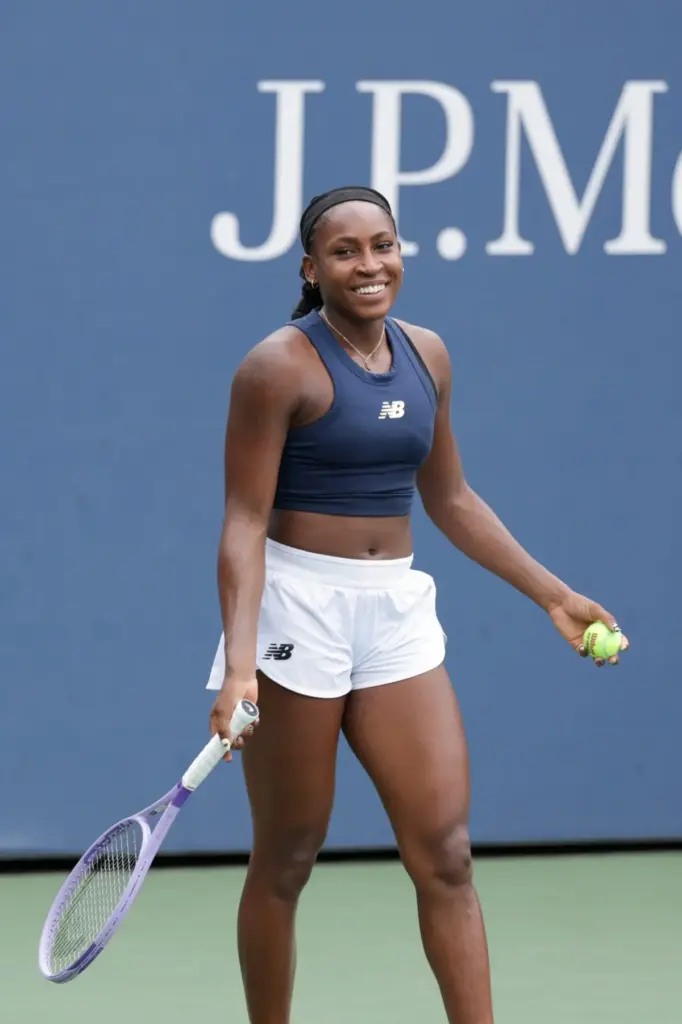
By August 28—Media Day at the USTA Billie Jean King National Tennis Center—Gauff was already sporting the necklace during her press engagements. Over the subsequent 48 hours, as she took to the practice courts in her vibrant New Balance kits on August 29 and August 30, the sapphire-blue “C” remained a fixture around her neck, enduring sweat, high-velocity serves, and intense lateral movements without missing a beat.
Supporting Context & Metrics: The Fusion of High Fashion and Grand Slam Tennis
The convergence of tennis and high fashion is hardly a novel concept—from the legendary court couture of Suzanne Lenglen and the rebellion of Serena Williams to the modern partnerships dominating Flushing Meadows. However, the integration of bespoke, fine jewelry into active Grand Slam competition represents a distinct evolution in athletic styling.
The Mechanics of On-Court Jewelry
Historically, jewelry in professional tennis was kept to a minimum—small stud earrings or delicate chains tucked safely beneath moisture-wicking apparel—largely due to safety regulations and the risk of distraction during high-speed rallies. Gauff and Fisher’s creation redefines this boundary.
Weight and Ergonomics: The pendant was engineered to maintain a featherlight profile, ensuring that rotational forces during a 115-mph serve or a sliding baseline defense do not cause the chain to whip uncomfortably against the collarbone.
Durability: Built for everyday wear, the materials selected had to resist corrosion from sweat, friction from technical fabrics, and the physical impacts of a grueling three-set match.
Chromatic Synergy: The centerpiece of the design is its distinctive sapphire-blue enamel finish. The shade serves a dual purpose: it pays direct homage to Chase Sapphire Reserve, the corporate partner facilitating the project, while aligning seamlessly with Gauff’s personal aesthetic preferences.
Gauff’s Evolution as a Fashion Icon
Gauff’s relationship with the fashion industry has matured alongside her tennis ranking. Recalling her first major editorial shoot at age 15—where she was first introduced to Jennifer Fisher’s signature pieces—Gauff noted how her appreciation for design has deepened.
"I wore Jennifer Fisher during one of my first major editorial shoots when I was 15, so to now be working with her and Chase Sapphire Reserve on something that I helped create feels really special."
This full-circle moment highlights a broader trend: Gen Z and Millennial athletes are refusing to be boxed into traditional athletic silos. They demand creative agency, leveraging their personal brands to co-design products that resonate with younger, style-conscious consumers.
Official Statements and Insights
In an exclusive discussion regarding the collaboration, Gauff and Fisher offered deep insight into their creative processes, the demands of performance-driven design, and the psychological weight of competing in New York City.
On the Collaborative Process and Personalization
When asked about her level of involvement in the design phase, Gauff emphasized that while she trusted Fisher’s artistic vision, her input was vital to ensuring the piece remained grounded in her everyday reality.
"I took Jennifer’s lead, but I wanted the necklace to feel personal and wearable," Gauff explained. "We talked a lot about the details and how it would actually feel to wear every day. The shade of blue was especially important to me. I love that we landed on this beautiful sapphire blue that connects it back to Chase while still feeling like something I would naturally wear."
On Balancing Performance and Aesthetics
Designing jewelry intended for a professional tennis player requires a delicate balance between visual impact and uncompromising functionality. Gauff noted that performance considerations dictated the weight, length, and clasp security of the piece.
"For me, it was important that the necklace felt light but still looked stylish," she said. "I’m constantly moving between tennis, travel, events, and everyday life, so I wanted something that could move with me and didn’t feel too precious or restrictive. We really thought about how it would sit and feel when I was wearing it, while still making a statement."
On On-Court vs. Off-Court Styling
The distinction between athletic uniforms and street style is a frequent topic of conversation among modern tennis professionals. Gauff approaches her wardrobe with a clear strategic divide, though common threads of authenticity remain.
"On court, I think about performance first, but I still want my outfits to feel like me," Gauff observed. "There’s definitely more intention around the details because you’re wearing the same look for hours and moving constantly. Off court, I have more freedom to experiment."
When comparing fashion to jewelry specifically, she added: "I think both are about expressing yourself, but jewelry can feel a little more personal because it’s often something you choose for yourself rather than just for an outfit. With both, I want things to feel authentic and comfortable. I’m always thinking about whether I can actually see myself wearing something in my real life."
The New York State of Mind
No Grand Slam tournament carries the distinct cultural electricity of the US Open. For Gauff, an American superstar playing in her home major, New York City represents both intense pressure and an unmatched creative canvas.
"There’s definitely a lot of emotion," Gauff confessed when asked about walking onto the Flushing Meadows courts. "The US Open is such a special tournament for me, and New York has been the backdrop for some really big moments in my career. When I walk onto those courts, I try to stay present and remember why I love competing there in the first place. There’s obviously pressure, but there’s also a lot of excitement and gratitude."
Addressing the city’s unique sartorial expectations, she concluded: "I think New York naturally brings out a little more personality. It’s such a fashion-forward city, and the US Open has always had this connection to fashion and culture, so it’s fun to be part of that. But at the end of the day, I still want my look to feel like me and, most importantly, make me feel confident when I step on court."
Future Outlook: The Intersection of Sports and Luxury Branding
As the 2026 US Open progresses, the narrative surrounding Coco Gauff extends far beyond her forehand mechanics or baseline tactics. Her collaboration with Jennifer Fisher and Chase Sapphire Reserve serves as a predictive case study for the future of sports marketing and athlete-driven product design.
We are entering an era where premier athletes will increasingly bypass traditional endorsement models in favor of deep, co-creative partnerships. These ventures allow athletes to monetize their distinct tastes while offering luxury heritage and contemporary brands authentic access to younger, highly engaged demographic cohorts.
For Jennifer Fisher, the partnership successfully opens a new demographic frontier—proving that high-end letter charms and custom pendants can seamlessly transition from red carpets and editorial spreads to the sweat-soaked trenches of elite sport. For Chase Sapphire Reserve, the activation underscores the growing value of experiential and lifestyle-oriented sponsorships that extend well beyond traditional financial services.
And for Coco Gauff? The sapphire-blue “C” is more than just a pre-tournament accessory or a clever nod to her initials. It is a suit of armor forged in collaboration with her idols-turned-peers, a personal talisman worn under the blinding lights of Arthur Ashe Stadium. As she continues her march through the tournament draws of 2026 and beyond, Gauff proves that true icons don’t just play the game—they define its style.