Executive Overview
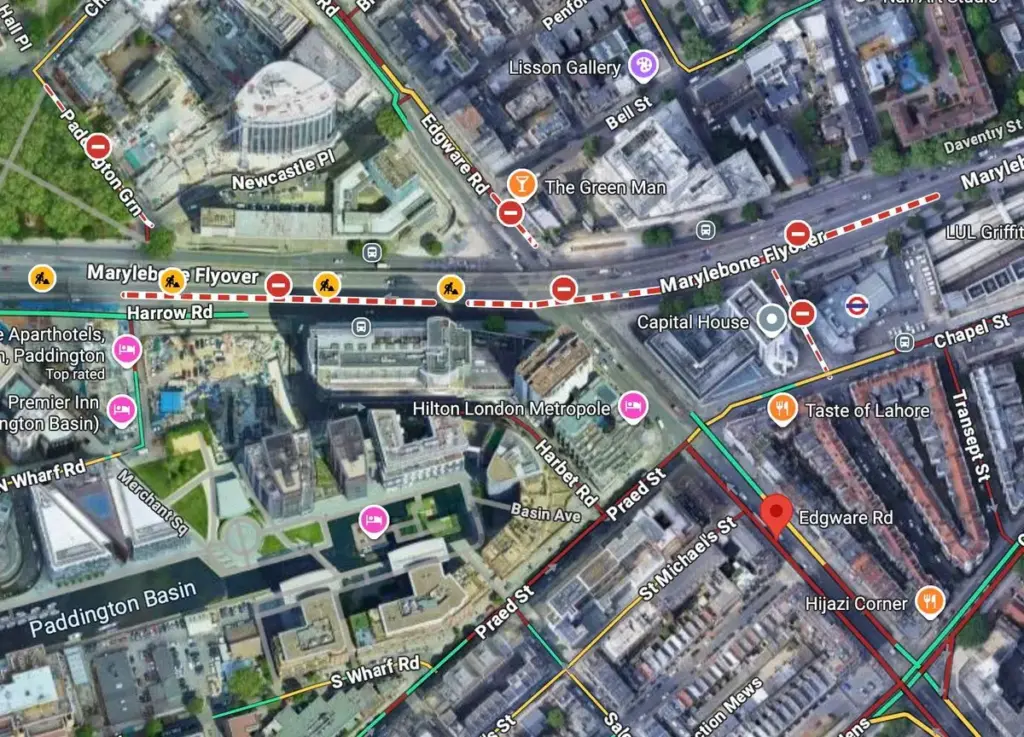
Central London’s transport network experienced severe evening disruption on Friday, August 21, 2026, after emergency services rushed to an ongoing security incident in the city’s bustling West End. Transport for London (TfL) confirmed that Edgware Road Underground station was closed indefinitely late Friday night, while metropolitan authorities implemented sweeping road closures across major thoroughfares, including the Marylebone Flyover and sections of Marylebone Road and Edgware Road itself.
The closure—prompted by an emergency police response—has created significant bottlenecks across the capital’s transit arteries. Live traffic tracking and municipal updates indicate that congestion is spilling over into adjacent residential and commercial corridors, causing long delays for motorists, bus passengers, and pedestrians alike. TfL has strongly urged commuters and evening travellers to re-plan their journeys, seek alternative routes, and anticipate prolonged delays throughout the surrounding district as investigative and emergency operations remain underway.
With tickets currently being accepted on parallel London Bus services to mitigate the shortfall in rail capacity, city officials are racing to contain the logistical fallout of the shutdown. This report provides a comprehensive examination of the developing situation, detailing the precise timeline of events, the geographical scope of the disruptions, official directives from transport and law enforcement bodies, and the broader context of managing emergency responses in London’s high-density transit zones.
Detailed Chronology of the Incident
The sequence of events unfolded rapidly during the late evening rush and transition into the night, catching thousands of commuters off guard.
21:28 BST: Initial Station Closure and Police Deployment
The disruption first came to light at approximately 21:28 BST when Transport for London updated its official status boards and website. TfL issued a flash alert stating that Edgware Road Tube station had been completely shut down. The initial advisory was concise, noting that the station was closed "while police respond to an incident."
Recognising the immediate strain this would place on displaced passengers attempting to complete their journeys, the service update included a contingency measure: valid Underground tickets were immediately accepted on local London Bus services to provide alternative transit options around the affected area.
21:35 BST: Expanding Road Closures and Gridlock
Within minutes of the station closure, the operational footprint of the emergency response widened significantly to accommodate public safety protocols and emergency vehicles. According to real-time traffic data derived from mapping platforms like Google Maps, authorities extended closures well beyond the immediate station curtilage.
Key arterial routes affected included:
- The Marylebone Flyover: A critical east-west corridor carrying heavy volumes of traffic across central London.
- Marylebone Road: A major segment of the inner ring road system, experiencing complete blockages in both directions near the affected junction.
- Edgware Road: Vital sections closed off to vehicular and pedestrian traffic, severing a primary north-south route into the West End.
Traffic monitoring networks immediately registered severe congestion. Surrounding side streets and alternate feeder roads quickly filled with trapped motorists, creating stationary queues and heavy gridlock that persisted long past midnight.
21:44 BST: TfL Issues Urgent Travel Advisory
By 21:44 BST, as the extent of the cordon and the severity of the traffic delays became apparent, TfL escalated its public communications. A formal advisory was broadcast across digital channels, urging all passengers affected by the closure of Edgware Road Tube station to completely re-plan their journeys rather than attempting to wait out the disruption.
Commuters were advised to check live travel feeds, avoid the West End and Marylebone districts if possible, and utilise more distant interchange stations to bypass the affected zone entirely. Emergency services, meanwhile, maintained a heavy presence on the ground, securing the perimeter and conducting initial forensic and safety assessments.
Supporting Context & Metrics: London’s Vulnerable Transit Arteries
The sudden paralysis of Edgware Road and its surrounding infrastructure underscores the delicate balance required to maintain fluid movement through one of the world’s most densely populated urban centers.

The Strategic Importance of Edgware Road Station
Edgware Road is a major multi-line subterranean and sub-surface interchange station served by the Bakerloo, Circle, District, and Hammersmith & City lines. Handling tens of thousands of passenger movements daily, the station acts as a crucial link connecting north-west London suburbs directly to the West End, the City financial district, and major mainline rail termini such as Paddington and Marylebone.
When a station of this magnitude is abruptly taken offline during peak evening hours, the ripple effects are felt across the entire Underground network. Interchanging passengers are forced onto street-level buses or compelled to take circuitous rail detours via Paddington, Baker Street, or Paddington Green, overwhelming station platforms and concourses elsewhere.
The Road Network: Marylebone and the Inner Ring
The inclusion of the Marylebone Flyover and Marylebone Road in the emergency closures highlights the sheer scale of the police cordon. The Marylebone Flyover is a vital elevated section of the A40, channelling traffic from the Westway directly toward central London. Closing it forces heavy freight, commercial vehicles, and private cars onto local surface streets that are entirely unequipped to handle such volumes, leading to immediate gridlock.
Urban transport analysts point out that incidents requiring the simultaneous closure of major underground stations and elevated multi-lane flyovers demand extraordinary coordination between TfL’s Network Management Control Centre (NMCC) and the Metropolitan Police.
Official Statements and Institutional Response
As the situation evolved late into the night, transport authorities and emergency services coordinated their messaging to ensure public safety and minimise confusion.
Transport for London (TfL)
TfL’s operational response focused heavily on passenger redirection and alternative routing. In statements released via their digital network status updates, TfL reiterated:
"Edgware Road station is closed while police respond to an incident. Tickets are being accepted on London Buses. Passengers affected by the closure are advised to re-plan their journeys."
Behind the scenes, TfL’s traffic control operators worked alongside municipal authorities to adjust traffic light signal timings on peripheral routes, attempting to flush out trapped vehicles and prevent total gridlock across the West End. However, with major arteries sealed off, the efficacy of signal re-timing remained severely constrained.
Emergency Services and Law Enforcement
While specific details regarding the exact nature of the "incident" remained tightly controlled by late Friday evening, the Metropolitan Police deployed specialized units to secure the area, manage crowds, and conduct thorough safety sweeps. Local policing teams urged the public to stay clear of the cordoned zones to allow emergency vehicles unimpeded access.
Future Outlook and Ongoing Advice for Commuters
As of late Friday night, August 21, 2026, there is no official timeline for when Edgware Road Tube station or the surrounding roads will reopen. Emergency investigations, safety clearances, and structural or forensic checks often require several hours, particularly when major transport hubs are involved.
What Commuters and Motorists Should Do:
- Check Before You Travel: Anyone planning to travel through central London, Marylebone, or via the Bakerloo, Circle, District, or Hammersmith & City lines early Saturday morning should check TfL’s live status updates before setting out.
- Allow Extra Time: If travel through the West End is unavoidable, commuters must factor in significant delays, particularly if relying on replacement bus services or detoured surface routes.
- Avoid the Area: Motorists are strongly advised to bypass Marylebone Road, Edgware Road, and the Marylebone Flyover entirely, utilizing outer ring roads or alternative transport corridors well clear of the emergency zone.
Further updates will be provided as soon as Transport for London and the Metropolitan Police release official information regarding the resolution of the incident and the resumption of normal transit services.