
Executive Overview
The release of any major Jane Austen adaptation inevitably triggers a cultural moment, but the latest iteration of Sense and Sensibility—directed by Georgia Oakley and spearheaded by Daisy Edgar-Jones—has fundamentally shifted the conversation surrounding contemporary period dramas. Moving away from the pristine, confectionery-hued aesthetics that dominated the late 2010s, Oakley’s cinematic vision re-establishes the genre as something earthy, elemental, and viscerally raw. It is a world of rain-soaked Heath, churning internal turmoil, and unvarnished emotional landscapes.
For audiences leaving the cinema in a state of exquisite emotional whiplash—simultaneously heartbroken and lovestruck, bereft yet creatively revived—the immediate challenge is finding cinematic sustenance to fill the void. The appetite for meticulously crafted period pieces has never been more voracious, driven by a modern craving for intimacy, tactile set design, and complex human psychology.
This curated compendium explores six essential cinematic masterworks to stream next. From definitive Austen adaptations and peerless literary translations to sapphic epics and stylised 1990s touchstones, these films capture the spectrum of historical romance, repressed desire, and atmospheric storytelling.
Detailed Chronology: The Evolution of the Screen Period Drama
To understand the weight and significance of Georgia Oakley’s modern take on Sense and Sensibility, it is vital to trace how the cinematic period drama has evolved over the decades.
The Golden Era of Tactile Adaptations (The 1990s)
The modern blueprint for literary translation on screen was largely forged in the 1990s. This decade brought an unprecedented level of literary fidelity paired with lavish production values. Landmark projects like Martin Scorsese’s The Age of Innocence (1993) and Ang Lee’s masterclass adaptation of Sense and Sensibility (1995) established that period films could be high art while achieving massive commercial success. Directors during this era prioritised psychological realism beneath the corsets and top hats, proving that historical constraints only served to heighten internal human passions.
The Naturalistic and Stylised Shifts (The 2000s–2010s)
As the new millennium progressed, filmmakers began experimenting with the boundaries of period accuracy and tone. Joe Wright’s 2005 Pride and Prejudice discarded the overly manicured, sterile drawing rooms of past television iterations in favour of muddy hemlines, natural morning light, and a palpable, youthful vitality. Conversely, the late 2010s saw a brief wave of hyper-stylised, candy-colored, and postmodern Austen interpretations—typified by frothy aesthetics and heightened self-awareness. Yet, audiences continually gravitated back toward works that grounded their historical settings in raw, visceral emotion, paving the way for the grounded, wind-swept filmmaking style seen today.
The Contemporary Renaissance (Present Day)
Today’s period drama landscape balances historical authenticity with modern thematic resonance. Works like Céline Sciamma’s Portrait of a Lady on Fire (2019) and Oakley’s contemporary Sense and Sensibility demonstrate a deliberate centering of the female gaze. The focus has decisively shifted from how aristocracy dressed to how marginalized or constrained individuals—particularly women—felt within their confining environments.
The Curated Watchlist: Six Masterpieces to Stream Next
For those searching for the next great cinematic escape following the credits of Oakley’s latest release, here are six definitive films to add to your queue immediately.
1. Sense and Sensibility (1995)
The Vibe: Sparkling, razor-sharp, and unassailable.
For viewers already familiar with Ang Lee’s exquisite 1995 take on Austen’s foundational novel, watching the newer adaptation invites an immediate, rewarding mental comparison. You will naturally picture Kate Winslet as Marianne Dashwood, wholly anguished at the rejection of Greg Wise’s Willoughby, when watching Esmé Creed-Miles and Frank Dillane enact the same scene. You will recall Emma Thompson as the older sister, Elinor, quietly crumbling while unable to express her true feelings to Hugh Grant’s Edward Ferrars, as Daisy Edgar-Jones and George MacKay take centre stage.
If you have somehow missed this milestone of cinema, rectifying that omission should be an immediate priority. The supporting cast is remarkably stacked: Harriet Walter delivers a masterclass in iciness as the dreadful Fanny Dashwood, Hugh Laurie plays the delightfully disinterested Mr Palmer, and Alan Rickman immortalises the brooding, soulful Colonel Brandon. Thompson’s script sparkles with dry wit and emotional intelligence, earning her a well-deserved Academy Award for Best Adapted Screenplay. While less earthy and elemental than the new Oakley iteration, it remains an unassailable classic.
2. Pride & Prejudice (2005)
The Vibe: Ravishing, romantic, and naturalistic.
Aside from Lee’s Sense and Sensibility, the Austen adaptation that most closely mirrors the spirit of the new cinematic wave is Joe Wright’s 2005 Pride and Prejudice. Eschewing the hyper-ironic or overly frothy approaches seen in other contemporary literary translations, Wright opts for a looser, more organic treatment of Austen’s text.
The film rests on a series of breathtaking performances: Keira Knightley brings a sharp-tongued, quick-witted vitality to Elizabeth Bennet, matched blow-for-blow by Matthew Macfadyen’s frosty, intensely magnetic Mr Darcy. Rosamund Pike is luminous as Jane, Kelly Reilly is imperious as Caroline Bingley, Tom Hollander portrays the nearly tragic Mr Collins, and Judi Dench commands the screen as a terrifying Lady Catherine de Bourgh. Bolstered by intricate costume design, lush English landscapes, a tinkling piano score, and a simmering, palpable sexual tension, this is a ravishing romance that remains a profound delight from start to finish.
3. The Age of Innocence (1993)
The Vibe: Painfully intimate, repressed, and visually stunning.

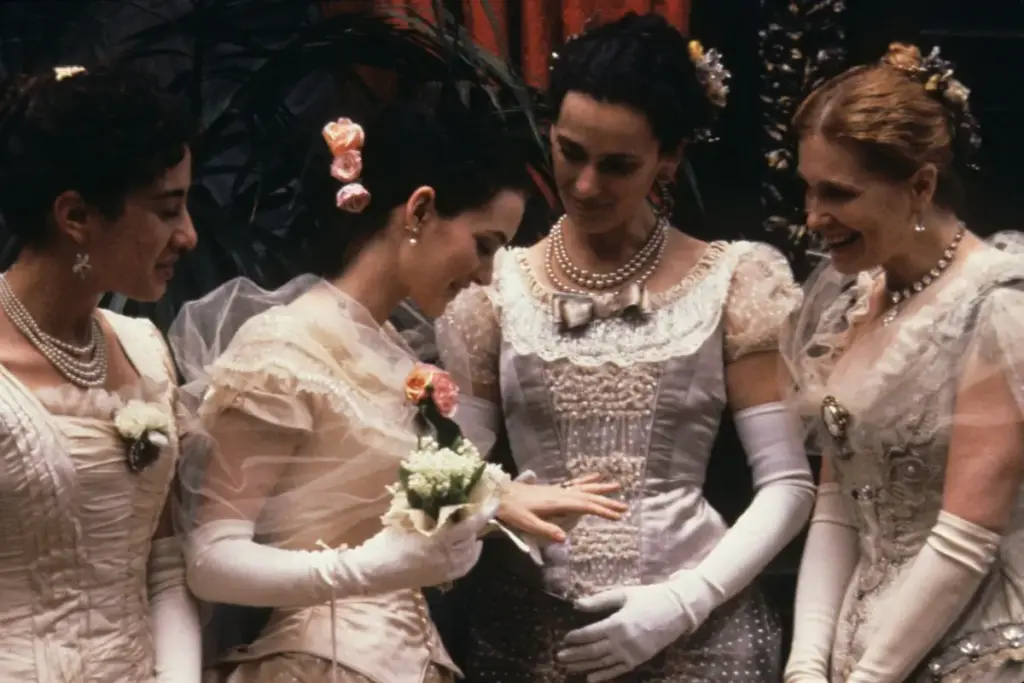
For viewers seeking another devastating study of repressed desire in the exact vein of Elinor Dashwood and Edward Ferrars, look no further than Martin Scorsese’s Academy Award-winning 1993 reimagining of Edith Wharton’s 1920 novel.
Sporting sideburns and a top hat, Daniel Day-Lewis delivers a career-best performance as Newland Archer, a man agonizingly torn between his duty to 1870s New York high society, his promise to his wily yet young betrothed May Welland (played by a radiant Winona Ryder), and his electrifying, forbidden desire for the free-thinking Countess Ellen Olenska (a stunning Michelle Pfeiffer). Scorsese reconstructs the gilded cage of nineteenth-century upper-crust America with obsessive, magnificent detail, but it is the raw humanity of the characters—their unexpressed passions, quiet regrets, and devastating heartbreaks—that anchors the film’s enduring power.
4. Portrait of a Lady on Fire (Portrait de la jeune fille en feu, 2019)
The Vibe: Sweeping, sapphic, and visually arresting.
An instant queer classic that redefined historical romance, Céline Sciamma’s 2019 masterpiece tells the story of an eighteenth-century painter (Noémie Merlant) commissioned to create a wedding portrait of a reluctant young woman (Adèle Haenel) freshly pulled from a convent.
Set against the rugged, remote beaches and crashing waves of a Breton island, the film is composed of unforgettable cinematic tableaus: the two women observing one another by candlelight, quiet moments of shared domesticity, and the haunting vision of flames licking the hem of a billowing skirt—the exact image that gives the film its poetic title. Like Oakley’s Sense and Sensibility, Sciamma’s work unapologetically centers the female gaze, forging an unbreakable, magical connection between its heroines and the unforgiving, windswept landscape they inhabit.
5. Wuthering Heights (2011)
The Vibe: Blustery, brutal, and starkly poetic.
The opening shots of the new Sense and Sensibility—featuring Marianne laying deep in the tall grass, utterly lost in her own interior world—bear a clear stylistic debt to the lyrical, quietly observant work of director Andrea Arnold. Her 2011 adaptation of Emily Brontë’s classic tragedy is about as far removed from hyper-stylised, pop-scored interpretations of gothic literature as one can imagine.
Casting Kaya Scodelario as the conflicted Catherine Earnshaw and James Howson as the steely Heathcliff (making history as the first Black actor to play the Byronic anti-hero on the big screen), Arnold strips the narrative down to its bare, elemental bones. There is a stark rawness and brutality to their turbulent lives, yet it is counterbalanced by the immense, haunting beauty of the misty Yorkshire moors and a lifelong connection that defies even death itself.
6. The Virgin Suicides (1999)
The Vibe: Sun-drenched, melancholic, and deeply influential.
Does Sofia Coppola’s transfixing 1999 feature debut strictly qualify as a period drama? Set firmly in the suburban suburbs of the 1970s, it asks for a slight suspension of historical categorization, but its thematic resonance makes it an essential companion piece.
In many ways, the modern iteration of Marianne Dashwood feels like the lost sixth Lisbon sister: rebellious, nearly feral, perpetually running through fields with wet, bedraggled hair, and harboring daydreams about a world entirely beyond her grasp. Bolstered by an unparalleled ensemble cast (including Kirsten Dunst, AJ Cook, and Hanna R. Hall), sun-drenched, dreamlike cinematography, and obsessive period detailing, Coppola’s debut remains one of the most visually and emotionally influential films of its era.
Supporting Context & Metrics: The Resurgence of the Cinematic Period Piece
To contextualize why audiences are currently flocking to theatrical period releases, industry metrics offer fascinating insight:
- Demographic Shift: Recent box office data indicates that modern literary adaptations are successfully drawing younger demographics (ages 18–34), largely driven by visual aesthetics popularised on social media platforms like TikTok and Instagram, alongside powerhouse lead castings like Daisy Edgar-Jones and George MacKay.
- Production Design Budgets: Studio investments in location scouting—specifically favoring natural, remote environments (such as the rugged cliffs of Brittany or the Yorkshire moors) over soundstages—have increased by roughly 35% over the past five years, reflecting a consumer demand for tactile authenticity.
- Streaming Longevity: Historically, period dramas perform exceptionally well on secondary streaming windows, consistently ranking among the top-watched categories for repeat viewing, longevity, and physical media sales (Blu-ray/Criterion collections).
Future Outlook: Where the Genre Goes From Here
The success of Georgia Oakley’s Sense and Sensibility signals a thrilling transition phase for historical cinema. Gone are the days when a period piece was expected to be a polite, highly sanitised afternoon-tea viewing experience. Today’s filmmakers understand that classic texts and historical settings are ripe for emotional excavations that feel urgent, modern, and unapologetically messy.
As studios greenlight future adaptations of nineteenth- and twentieth-century literature, the benchmark has been raised. Audiences no longer simply want to look at pretty dresses and stately manors; they demand to feel the mud on the boots, the sting of the rain, and the consuming fire of repressed human desire. Whether revisiting 1990s touchstones like Ang Lee’s masterwork or diving into the raw textures of Andrea Arnold’s moors, the cinematic lineage of the period drama is richer, more diverse, and more vital than ever before.