
Executive Overview
The architectural design of the modern office environment—whether in a high-rise corporate suite or a home workspace—is fundamentally misaligned with human biomechanics. While standing desks, ergonomic chairs, and periodic posture checks offer incremental relief, they fail to address the core physiological consequence of sedentary knowledge work: chronic, repetitive positioning. Spending six to ten hours a day typing, scrolling, and staring at screens locks the human body into a continuous posture of flexion.
The clinical cost of this prolonged static positioning is well-documented: rounded shoulders, tightened hip flexors, diminished thoracic mobility, and persistent lower back discomfort. Over time, these minor structural compromises compound, leading to chronic myofascial pain syndromes, degraded movement efficiency, and a higher risk of musculoskeletal injury.
Counteracting the cumulative wear-and-tear of the "desk slump" requires more than passive stretching or brute-force strength training. It demands dynamic neuromuscular re-education—systematically mobilizing the body through planes of motion that remain completely neglected during keyboard-heavy workdays.

To bridge this gap, Maxwell Thompson, a certified personal trainer, FRC-certified mobility specialist, and Academy Trainer at David Lloyd Clubs, has designed a targeted 15-minute mobility circuit. Tailored specifically for individuals clocking six or more hours daily at a screen, this accessible routine is engineered to melt away stiffness, restore joint articulation, and bulletproof the body against the insidious effects of chronic sitting.
Detailed Chronology: The Anatomy of Sedentary Degradation and Recovery
Understanding why a 15-minute mobility circuit is effective requires examining what happens to the human body during a standard workday, followed by a chronological breakdown of how to reverse it.
The Problem: The Inversion of Natural Biomechanics
When an individual settles into a chair for hours at a time, a predictable chain reaction occurs:

- The Anterior Collapse: The pectoral muscles and anterior shoulders shorten and tighten, pulling the shoulders forward into internal rotation.
- The Posterior Deactivation: The upper back (rhomboids, mid-trapezius) and posterior chain stretch and weaken, losing their neurological drive to pull the shoulder blades backward.
- The Pelvic Trap: The hip flexors remain in a permanently shortened angle, while the gluteal complex goes dormant, leading to reciprocal inhibition where tight hip flexors actively suppress glute activation.
- The Spinal Lockdown: The thoracic spine loses its capacity to rotate and extend, forcing the lower back (lumbar spine) to compensate for rotational demands, leading to chronic lower back grumbles.
The Solution: The 15-Minute Mobility Circuit
Thompson’s routine is structured as an intentional circuit. By performing these movements sequentially, practitioners systematically unpack the joints locked during prolonged computer use. Beginners and advanced trainees alike should complete 3 to 4 full rounds of the circuit, moving deliberately and synchronizing every movement with deep, diaphragmatic breathing.
Phase 1: Spinal Decompression and Thoracic Articulation
1. Cat-Cow
- Target Areas: Thoracic spine, lumbar spine, cervical spine, and core musculature.
- Prescription: 10 repetitions | 30 seconds rest.
- Execution: Begin on your hands and knees in a tabletop position, with wrists directly beneath your shoulders and knees stacked under your hips. Inhale deeply as you drop your belly toward the floor, lift your chin, and gaze upward, allowing your chest to open (Cow pose). Exhale completely as you draw your belly button toward your spine, round your back toward the ceiling, and tuck your chin gently toward your chest (Cat pose).
- Clinical Significance: This foundational movement restores fluid dynamics to the intervertebral discs, gently massaging the entire length of the spinal column and counteracting the flat, unsupported spinal curves common in desk work.
2. Thread the Needle
- Target Areas: Thoracic rotators, posterior shoulders, and the upper back.
- Prescription: 8 repetitions per side | 30 seconds rest.
- Execution: Start in the same tabletop position on your hands and knees. Inhale as you lift your right arm up toward the ceiling, following it with your gaze. Exhale smoothly as you thread your right arm underneath your left arm and torso, sliding it across the floor until your right shoulder and the side of your head rest gently on the mat. Hold for a brief, intentional breath before uncoiling to the starting position. Complete all repetitions on one side before switching.
- Clinical Significance: The thoracic spine is built for rotation, yet screen work locks it in a rigid, non-rotating plane. "Thread the needle" unlocks thoracic rotation, relieving shoulder blade tension and resetting the upper back.
Phase 2: Upper Back Strengthening and Postural Reset
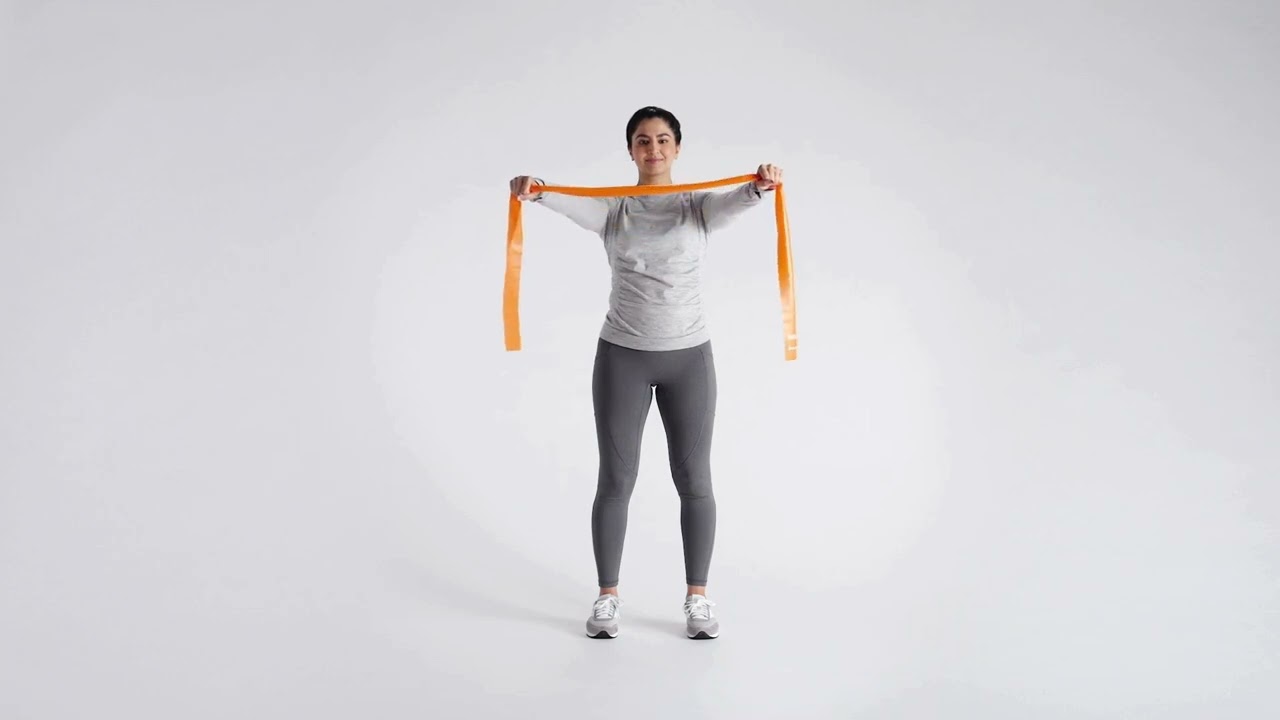
3. Band Pull-Apart
- Target Areas: Posterior deltoids, rhomboids, mid-trapezius, and external rotators of the shoulder.
- Prescription: 15 repetitions | 30 seconds rest.
- Execution: Stand tall with your feet hip-width apart. Hold a long-loop resistance band (or a rolled-up towel for tension) straight out in front of you at chest height, with your palms facing downward. Keeping your arms relatively straight with a soft bend in the elbows, pull the band apart horizontally by driving your shoulder blades together and squeezing your upper back. Slowly control the return of the band to the starting position.
- Clinical Significance: While chest openers stretch the front of the body, the band pull-apart actively recruits and strengthens the neglected posterior chain, teaching the nervous system to keep the shoulders back and down.
4. Wall Slide
- Target Areas: Scapular upward rotators, lower trapezius, and postural stabilizers.
- Prescription: 10 repetitions | 30 seconds rest.
- Execution: Stand with your back flat against a wall, ensuring your head, upper back, and lower back (with a natural, slight curve) maintain contact. Raise your arms into a "goalpost" or "cactus" position, with your elbows bent at 90 degrees and the back of your wrists and hands touching the wall. Slowly slide your arms upward along the wall as high as you can without letting your lower back arch or your wrists leave the surface. Lower back down with control.
- Clinical Significance: Wall slides combat the upward and forward migration of the shoulders caused by typing, retraining scapular control and stabilizing the shoulder girdle.
Phase 3: Lower Body Openers and Posterior Chain Relief
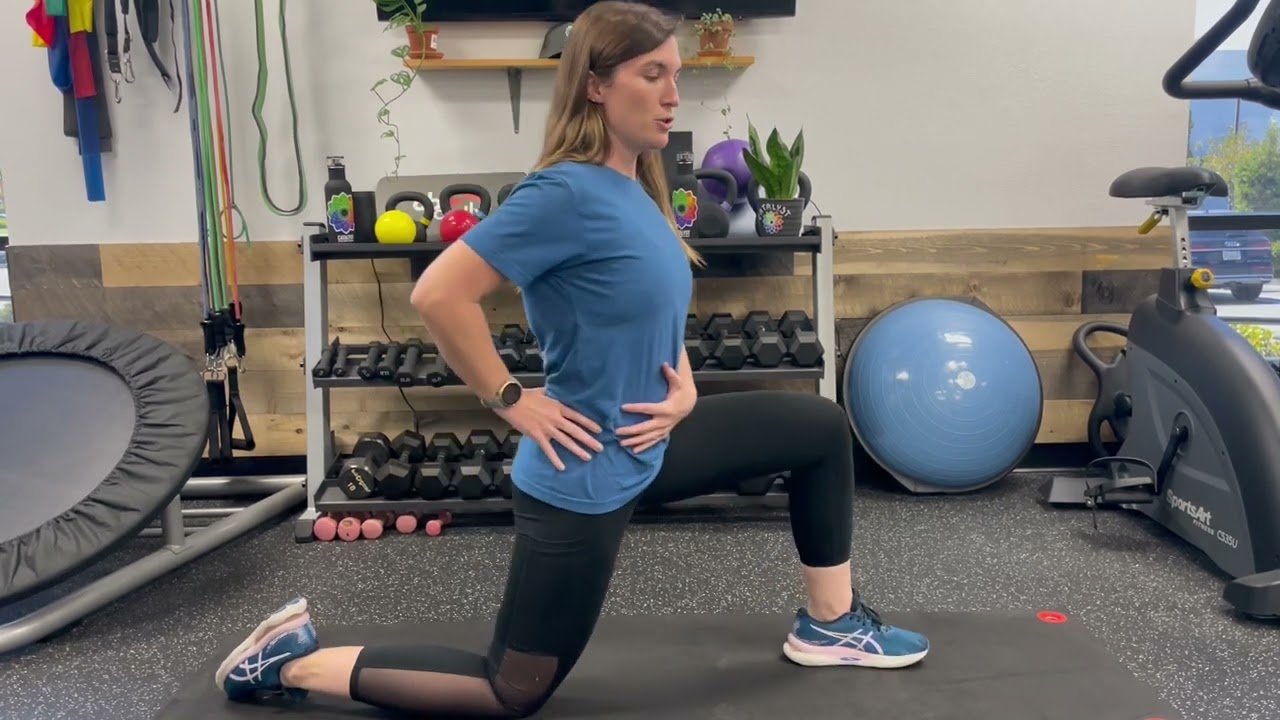
5. Half-Kneeling Hip Flexor Stretch
- Target Areas: Hip flexors (psoas, rectus femoris), quads, and hip capsule.
- Prescription: 30 seconds per side | 30 seconds rest.
- Execution: Kneel down on your right knee, placing your left foot flat on the floor in front of you with your knee at a 90-degree angle. Engage your glutes and tuck your pelvis slightly underneath you (a posterior pelvic tilt). Keeping your torso upright, gently shift your weight forward into the left hip until you feel a deep, clean stretch along the front of your right hip and thigh. Hold, breathe deeply, and switch sides.
- Clinical Significance: Because prolonged sitting keeps the hip flexors in a shortened state, they become chronically tight. This stretch restores proper length to the anterior hip, reducing the pulling force on the lumbar spine and improving walking mechanics.
6. Standing Chest Opener
- Target Areas: Pectoralis major and minor, anterior deltoids, and bicep tendons.
- Prescription: 30 seconds hold | 30 seconds rest.
- Execution: Stand tall with your feet shoulder-width apart. Interlace your fingers behind your lower back. If mobility allows, straighten your arms and gently lift your hands away from your glutes while rolling your shoulders backward and expanding your chest toward the ceiling. Keep your gaze neutral or slightly upward, avoiding any hyperextension in the neck.
- Clinical Significance: This is the ultimate antidote to the hunched-over desk posture. By opening the anterior chest wall, it relieves the relentless forward pull on the shoulder joints and restores open, diaphragmatic breathing capacity.
Supporting Context & Metrics: The Modern Ergonomic Crisis
To contextualize the necessity of targeted mobility work, consider the broader public health metrics surrounding sedentary behavior:
- The Sedentary Epidemic: Data from occupational health studies indicate that office workers spend an average of 6.5 to 9 hours per day seated, with a significant portion of that time uninterrupted by movement.
- The Musculoskeletal Toll: According to orthopedic data, over 65% of desk workers report chronic neck, shoulder, or lower back pain at least once per week.
- The Neuromuscular Penalty: Prolonged static loading leads to a phenomenon known as "lower-crossed syndrome" and "upper-crossed syndrome," where specific muscle groups become hypertonic (tight and overactive) while opposing groups become inhibited (weak and stretched).
- The Return on Investment: Interventions as short as 15 minutes per day have been clinically proven to reduce subjective pain scores by up to 40% over a four-week period, dramatically improving worker comfort, focus, and long-term joint health.
Official Statements and Expert Insight
Maxwell Thompson, whose professional credentials span the Chartered Institute for Management of Sport and Physical Activity (CIMSPA) and Functional Range Conditioning (FRC), emphasizes that physical wellness in the digital age requires a proactive, evidence-based approach rather than reactionary treatment.
"It’s ideal for anyone who spends six-plus hours a day at their desk or screen," Thompson explains to Fit&Well.
Highlighting the importance of integration, he advises slotting the routine directly into a standard lunch break or whenever physical stiffness begins to manifest during the workday. Emphasizing the mindset required for optimal results, Thompson notes:
"Move slowly, lead with your breath, and allow aches and pains to gently melt away."
Thompson’s methodology aligns with modern movement science, which prioritizes joint articular health, nervous system regulation, and sustainable habit formation over high-intensity physical exhaustion. By viewing movement as a daily hygiene practice rather than an optional chore, desk-bound professionals can successfully insulate themselves against the structural degradation of modern work environments.
Future Outlook: Building Sustainable Workplace Habits
As remote and hybrid work models continue to define the modern professional landscape, the boundary between living space and workspace has dissolved. Consequently, individuals must take personal responsibility for their physical ergonomics.
Integrating a 15-minute mobility circuit into a daily routine is not merely a fitness hack; it is a vital investment in long-term physical autonomy. Looking forward, workplace wellness programs are increasingly shifting away from generic ergonomic assessments toward dynamic movement prescriptions. By combining workspace modifications—such as adjustable standing desks—with structured mobility routines like Thompson’s 6-part circuit, professionals can reverse the ravages of the desk slump, preserve joint integrity, and pave the way for a healthier, more resilient future.