Executive Overview
Pop culture moves fast, but few cultural barometers are analyzed with the microscopic precision applied to Taylor Swift. From her lyrical easter eggs to her sartorial choices, every single iteration of the multi-Grammy-winning artist is cataloged, analyzed, and mythologized by a global fan base. However, over the weekend, public discourse shifted away from lyrics and chord progressions to focus on a far more visceral, universally relatable topic: hair.
Following the emergence of photographs capturing Swift at a high-profile wedding in England, digital comment sections erupted into a familiar frenzy. Swift had debuted a dramatic shift in her signature look—her hair was noticeably shorter by several inches, teetering near a sophisticated lob, and her iconic bangs were swept aside in a deep, sweeping part. To beauty experts and seasoned stylists, this styling choice was not merely a casual trim; it bore all the hallmark physical characteristics of the dreaded first phase of growing out bangs.
This potential transition marks a significant stylistic crossroads for the pop icon. Since 2012, Swift’s bangs have functioned as an enduring architectural constant amid an ever-shifting carousel of musical eras, dye jobs, and aesthetic reinventions. If she is indeed waving goodbye to her forehead fringe, she is embarking on a notoriously arduous beauty pilgrimage—one that transcends net worth, celebrity status, and access to elite glam squads. Growing out bangs remains one of the few great equalizers in the modern grooming landscape, a humbling trial by fire characterized by awkward lengths, bobby pins, and endless patience.
Detailed Chronology: A History of Swift’s Iconic Hair Eras
To understand the weight of Swift’s current hair transformation, one must trace the historical lineage of her tresses. Swift’s relationship with bangs is nearly as storied as her discography, serving as a visual anchor that has bridged multiple distinct artistic eras over the past decade.
The Genesis: The Red and 1989 Years (2012–2015)
Swift’s romance with the fringe officially began in 2012 during a career-defining photo shoot for Vogue. Seeking a fresh aesthetic to match the thematic heartbreak and autumnal maturity of her fourth studio album, Red, she debuted thick, blunt, eyebrow-grazing bangs. This look quickly became her signature silhouette, transitioning seamlessly into the blockbuster pop hegemony of 2014’s 1989 era. During this period, the blunt fringe paired with side-swept elements became a defining archetype of early-2010s mainstream pop culture.
The Rebellion: “Bleachella” and the Reputation Edge (2016–2019)
As Swift’s musical styles shifted toward darker, more synthesized, and defiant soundscapes, her hair followed suit. The most radical structural shift in her modern hair history occurred at the 2016 Met Gala, where she discarded her traditional soft blonde curls in favor of an edgy, platinum-blonde, piece-y bob with dark roots—an era affectionately dubbed “Bleachella” by her fanbase.
While she experimented with textures and varying lengths during the rollout of 2019’s Lover, the foundational presence of the fringe remained remarkably resilient, albeit styled with softer, more feathered framing.

The Pandemic Naturalism and the Modern Era (2020–Present)
During the COVID-19 pandemic, as the world retreated inward and Swift surprised fans with the introspective, cottagecore-inspired sister albums Folklore and Evermore, her aesthetic shifted toward organic naturalism. She embraced her natural curl pattern, allowing a warmer, blond-brown hue to take center stage. Yet, even amidst the stripped-back, acoustic intimacy of these eras, the bangs persisted.
Subtle indicators that Swift might be growing weary of the high-maintenance fringe began to surface in late 2023. When attending the star-studded London premiere of Renaissance: A Film by Beyoncé, Swift notably tucked her bangs away, offering a rare glimpse of her forehead.
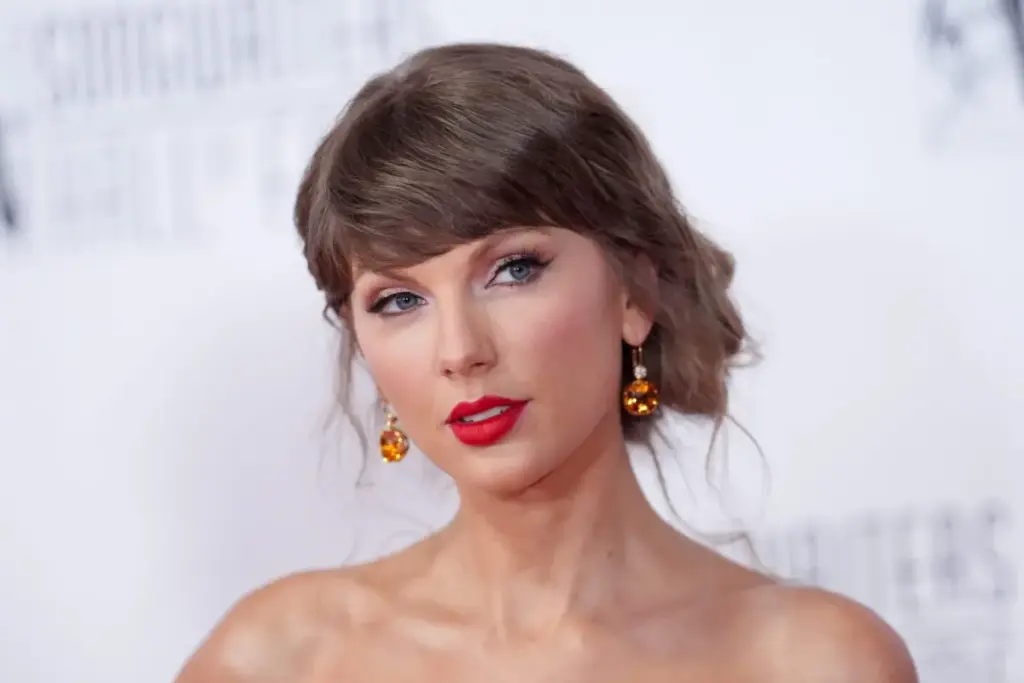
The strategy became more pronounced over time. By June 2026, at the prestigious Songwriters Hall of Fame Induction and Awards Gala, Swift styled her hair with a pronounced, deep side part across her forehead, signaling a deliberate departure from her traditional straight-across cut. The recent weekend wedding in England appears to be the logical culmination of this gradual process: a shorter, highly polished cut explicitly engineered to transition her past the awkward interim stages of hair growth.
Supporting Context & Metrics: The Anatomy of Growing Out Bangs
While Swift’s multi-billion-dollar empire affords her access to the world’s most elite hairstylists, top-tier extensions, and bespoke treatments, the biological reality of hair growth remains stubbornly democratic. Human hair grows at an average rate of approximately half an inch per month—roughly six inches per year. Consequently, executing a clean, seamless transition from a heavy, blunt fringe to a fully integrated layered cut is a project that demands roughly twelve to eighteen months of sustained follicular management.
The Stages of the Transition
Stylists broadly categorize the bang-growing journey into three distinct psychological and physical phases:
- The Eye-Line Invasion (Months 1–3): The initial phase where the fringe drops below the eyebrows, obstructing vision and forcing the wearer into constant, subconscious head-tossing maneuvers.
- The Awkward Sweep (Months 4–8): The critical juncture where the hair is too short to tuck behind the ears yet too long to sit flat on the forehead. This phase relies heavily on styling manipulation, deep side parts, and structural accessories.
- The Jawline Integration (Months 9–12+): The final stretch where the former bangs reach the chin or jawline, requiring strategic layering, texturizing, or temporary extensions to merge smoothly with the baseline haircut.
Styling Interventions and Industry Hacks
Navigating these awkward milestones requires structural ingenuity. Beauty experts frequently recommend several transitional interventions:
- The Accessory Route: Utilizing vintage-inspired barrettes, headbands, or pins (stylistically evoking characters like Margot Tenenbaum) to secure errant strands away from the face.
- Strategic Parting: Shifting from a center part to a dramatic, architecture-driven deep side part to distribute volume evenly and create the illusion of deliberate styling rather than accidental growth.
- Professional Texturizing: Introducing soft, face-framing layers during routine trims to prevent the hair from stacking heavily at the cheekbones.
Official Statements and Industry Insights
While Taylor Swift herself has not issued a formal press release regarding her follicular trajectory—preferring to let her style speak for itself—leading beauty authorities and celebrity stylists have weighed in on the cultural mechanics of the celebrity hair transition.

Industry analysts note that major hair transformations in the public eye rarely happen in a vacuum. They frequently correlate with significant life milestones, professional pivots, or the closing of major creative chapters.
"When an artist of Swift’s magnitude alters a signature feature that has defined their visual identity for over a decade, it is rarely a superficial accident," notes Los Angeles-based celebrity stylist Marcus Vance. "The fringe has been part of her brand armor since the Red era. Moving away from it signals a desire for structural lightness, maturity, and a literal opening up of the face. It’s a physical manifestation of turning the page."
Furthermore, consumer behavior metrics within the beauty sector frequently track alongside celebrity grooming choices. Whenever high-profile figures alter their signature looks, search engine queries for transitional hairstyles, side-part tutorials, and bang-growing hacks experience immediate statistical spikes, proving that the collective anxiety of managing an awkward fringe is a universal human bonding experience.
Future Outlook: What’s Next for the Icon’s Aesthetic?
As Swift settles into her post-wedding glow and prepares for her next creative endeavors, the beauty world will undoubtedly monitor every millimeter of her hair growth.
Whether this newly debuted lob and side-swept part represent a temporary experiment or the deliberate first act of a permanent structural evolution, one thing is certain: the journey will be closely watched. If Swift successfully navigates the perilous twelve-month gauntlet of growing out her bangs—emerging on the other side with a sleek, unencumbered, layered cut—she may well inspire a new wave of fans to embrace their own awkward hair transitions.
Until then, millions will watch, sympathize, and perhaps reach into their bathroom drawers for a bobby pin, comforted by the knowledge that even the biggest pop star on the planet is not immune to the universal trials of the awkward bang grow-out.