
In the sprawling landscape of contemporary cinema and British cultural lore, few figures occupy as distinct, sharply tailored, and effortlessly magnetic a space as Bill Nighy. At 76 years of age, an era when many contemporaries retreat quietly into the archives of past triumphs, Nighy is enjoying a rich, multifaceted late-career renaissance. This resurgence spans critically acclaimed film projects, a hit podcast, and a continued refusal to take himself—or the grand apparatus of celebrity—seriously.
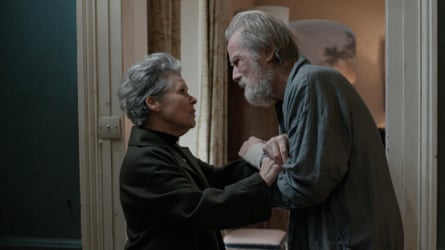
This deep dive into Nighy’s current trajectory is anchored by his latest cinematic outing in the genre-bending drama & Sons. In the film, Nighy plays AN Dyer, a reclusive, abrasive literary titan modeled in the aesthetic traditions of J.D. Salinger and Catweazle, who summons his estranged family for a disruptive, sci-fi-adjacent revelation. Playing opposite a stellar cast including Imelda Staunton, Johnny Flynn, and George MacKay, Nighy delivers a masterclass in controlled misanthropy—a performance that starkly contrasts with his own famously affable, albeit fiercely protective, off-screen persona.
Beyond the silver screen, Nighy remains a cultural omnipresence. From his unexpected dominance in the audio-first medium with his award-winning podcast Ill-Advised to his reflective musings on a life spent evading industry traps—such as working lunches, Zoom meetings, and anything requiring a toga—Nighy continues to redefine what it means to be a modern character actor. This article examines his trajectory through a rigorous journalistic lens, mapping his journey from a starstruck teenager in Surrey and a penniless hopeful in Paris to an Oscar-nominated institution who still views his own success as a happy accident.
Detailed Chronology: From Caterham to Cinematic Icon
The Formative Years: Books, Blushes, and Bentleys
Long before he was commanding the screen as a decaying rock star, a tentacled sea captain, or an emotionally stunted bureaucrat, a young Bill Nighy had his sights set not on the theater, but on the page. Born in Caterham, Surrey, Nighy’s early world was shaped by the literary idols of the mid-20th century—Hemingway and Fitzgerald—and a fateful encounter at his Catholic grammar school with an English teacher named Mr. Weir.
"He told me, ‘You might want to try your hand at the novel,’" Nighy recalls of a moment that occurred when he was just 14 years old. "I must have been 14. I’m not claiming this as an early sign of my neglected genius. But it was like a bomb going off in my head."
This literary fascination led him, at the tender age of 15, to secure employment at The Field, a traditional hunting and fishing magazine. Far from a glamorous apprenticeship, Nighy’s duties were famously grounding. "I changed the roller towel in the ladies’ room," he remembers. "All the girls from the typing pool used to come in. Not because of my animal magnetism, I hasten to add, but because they knew they could make me blush. Those roller towels are quite tricky. I’d bugger it up and they’d start laughing."
His wide-eyed provincialism also landed him in professional hot water. A self-described product of a small town, Nighy retained an intense fascination with luxury automobiles. "I used to become very excited if I saw a Roller or a Bentley in the street," he admits. His enthusiasm proved his undoing when he was hauled before the chief executive officer after being spotted jumping up and down and waving wildly at the CEO’s passing motorcar. "He said, ‘That’s not what I expect from an employee,’" Nighy notes with characteristic dry amusement.

Paris, Shakespeare & Company, and the Pivot to Acting
Fulfilling the quintessential mid-century bohemian cliché, Nighy eventually abandoned his clerical duties and ran away to Paris with the aspiration of becoming a celebrated author.
"I am a walking, talking cliché," he reflects. "I ran away to be a writer. Like a million others, I went straight to Shakespeare & Company and hung about thinking I’d write killer sentences and find a girlfriend. Neither of which happened. I ended up begging on the Trocadéro."
With his literary ambitions wilting under the harsh reality of penury, a fortuitous suggestion pointed him toward drama school. Though he reasoned that he would eventually return to writing, procrastination and the momentum of a burgeoning acting career took over. The pen was ultimately shelved for the script, though the linguistic precision, rhythmic cadence, and deep appreciation for narrative structure would permanently inform his approach to performance.
The Breakthroughs and Critical Acclaim
Nighy’s career trajectory is a study in delayed-fuse recognition. While he worked steadily on stage and screen through the 1970s and 1980s, it was the 1991 raunchy BBC television series The Men’s Room that first thrust him into the public consciousness as an unlikely sex symbol. His explicit, uninhibited portrayal of a libidinous academic earned the sharp censure of the Broadcasting Standards Council, while laying the groundwork for a reputation as a sophisticated screen presence.
Global household-name status arrived later, catalyzed by Richard Curtis’s 2003 romantic comedy Love Actually, in which Nighy played Billy Mack, an aging, delightfully cynical rocker. The role won him a BAFTA and cemented his status as a national treasure. Blockbuster franchises soon followed—most notably his motion-capture performance as the tentacled Davy Jones in the Pirates of the Caribbean series.
Yet, it is his work in intimate, character-driven dramas that defines his critical legacy. Whether playing a husband who pulls back from infidelity in Lawless Heart, a Scrabble enthusiast in Sometimes Always Never, or his Oscar-nominated turn as a terminally ill, buttoned-up civil servant in Oliver Hermanus’s 2022 masterpiece Living, Nighy has carved out a niche for portraying endearingly flawed, quietly resonant figures.
Supporting Context & Metrics: The Nighy Ecosystem
To understand Bill Nighy’s current cultural footprint, one must look at the quantitative metrics and structural boundaries he has meticulously erected around his personal and professional life.
+-----------------------------------------------------------------+
|                    THE BILL NIGHY PARADIGM                      |
+-----------------------------------------------------------------+
|  Professional Boundaries   |  Refusal of Zoom calls, working     |
|                            |  lunches, awards-show red carpets, |
|                            |  and film roles requiring togas.   |
+----------------------------+------------------------------------+
|  Podcast Dominance         |  *Ill-Advised*: Over 300,000 monthly |
|                            |  listeners; 2026 BPG Podcast of the|
|                            |  Year winner.                      |
+----------------------------+------------------------------------+
|  Critical Recognition      |  1 Academy Award Nomination (Living|
|                            |  BAFTA Award (Love Actually);      |
|                            |  Broadcasting Press Guild Accolade.|
+-----------------------------------------------------------------+
The Anatomy of Boundaries
Now 76, Nighy operates with an enviable clarity regarding how he spends his time. His aversion to modern corporate communication tools is absolute. "It got to the point where every time I had a Zoom call, it made me unhappy," he states. "I’m old enough to be able to say, ‘Can I retire from Zoom?’"
Equally taboo are professional social obligations. Lunches dedicated to discussing work are firmly struck from his calendar, and he retains a long-standing tradition of tossing high-society invitations straight into the wastebasket. When queried about his singular criterion for rejecting an acting project, his answer is instantaneous and unyielding: "Togas."
Ill-Advised: The Accidental Audio Empire
Perhaps the most surprising metric of Nighy’s late career is the runaway success of his podcast, Ill-Advised. Garnering over 300,000 monthly listeners, the podcast features Nighy acting as an improvised agony uncle, fielding meandering questions on everything from wardrobe management to social etiquette.
Despite being named Podcast of the Year by the Broadcasting Press Guild, Nighy maintains his trademark self-effacing skepticism. "I tried not to have a podcast," he insists. Recorded entirely off-the-cuff without prior sight of the questions, the show relies on his innate conversational rhythm and lifelong obsessions—such as his self-confessed fetish for lounge suits and bespoke shirt collars.
Official Statements & Industry Perspectives
Nighy’s philosophy on art, performance, and celebrity breaks sharply with contemporary self-promotion culture. In discussions surrounding his role in & Sons, where he portrays a father who uses his towering literary intellect to excuse emotional neglect and abrasive behavior, Nighy draws a firm line between artistic output and personal accountability.
"It’s like when footballers behave badly on the pitch and people say, ‘Temperament is part of his genius.’ Give me a break. That’s anathema to me. I don’t believe it in the least."
When discussing his own parenting style regarding his daughter, actor-director Mary Nighy (whom he shares with his former partner of 27 years, actor Diana Quick), he rejects grand manifestos. "Blimey… It’s a long time ago. You make it up as you go along. You make mistakes, then correct them, and hopefully you arrive at something that works. My parents were not oppressive or unkind, and I didn’t want to be either."

His acting idols reflect a preference for minimalism over histrionics. While he holds a deep reverence for Prince—"Anyone who can do the splits and come back up on the backbeat… well, I’ll follow them anywhere"—his ultimate cinematic North Star is Steve McQueen.
Reflecting on McQueen’s minimalist restraint in films like The Great Escape, Nighy notes with a sigh: "That I’ll never be Steve McQueen. You need a lot of confidence to do what he did. No fireworks, no reaching for prizes. It’s a kind of reckless restraint."
Industry peers have long recognized this very quality in Nighy himself. Cate Blanchett, reflecting on their time together in Notes on a Scandal, famously encapsulated his broad appeal: "What thinking western woman do you know who wouldn’t want to embrace him?"
Future Outlook: The Unending Performance
As & Sons prepares to make its mark on the international cinema circuit and Ill-Advised enters its third successful series, Bill Nighy shows no signs of adopting a conventional retirement plan. Yet, his approach remains entirely devoid of careerist calculation.
Whether he is walking through the bookshops of north-west London, curating his specific selection of emojis (favoring the purple dahlia, the leaping shark, and the mid-swing golfer while remaining entirely opposed to smiley faces), or inhabiting characters defined by their profound emotional complexities, Nighy continues to work on his own terms.
He may humorously lament that half his early work is outside living memory—remarking that "you get to the stage where everyone who watched it is dead"—but his current output ensures that his cultural footprint will endure for generations to come. In an industry obsessed with loud reinvention, Nighy’s ongoing success stands as a testament to the power of reckless restraint: no fireworks, no reaching for prizes, just an enduring masterclass in authenticity.