Executive Overview
It has been several years since the cultural phenomenon of the "glazed donut manicure"—popularized largely by trendsetters like Hailey Bieber—first flooded social media feeds, forever altering the landscape of modern nail art. What began as a singular, pearlescent obsession has matured into a sophisticated, highly versatile design category that dominates both high-fashion runways and everyday street style. Today, chrome nails are no longer defined solely by a single milky-white sheen over a neutral base. Instead, modern chrome encompasses an expansive spectrum of light-reflecting finishes, ranging from liquid metallics and color-shifting holographic powders to hyper-textured 3-D embellishments and avant-garde negative-space applications.
This comprehensive report explores the technological advancements in nail powders, the artistic innovations driving current salon trends, and the psychology behind our collective infatuation with high-shine aesthetics. By examining the intersection of chemistry, artistry, and digital-era beauty culture, we decode why chrome has transcended passing fad status to become a permanent pillar of modern personal style.
Detailed Chronology: From Runway Novelty to Digital Dominance
To understand the current state of chrome manicures, it is essential to trace how a technique once reserved for niche editorial photo shoots became a mainstream staple.
Phase One: The Industrial Origins and Early Runway Roots
Long before ultra-fine pigments were packaged for consumer gel kits, metallic finishes in the nail industry relied on heavy foils, metallic polishes, or chunky glitter suspensions. These early iterations were often plagued by premature chipping, uneven application, and a lack of refined luster. In the late 2010s, backstage manicurists working at fashion weeks—such as London Fashion Week—began experimenting with industrial-grade pigments, rubbing fine cosmetic-grade metal powders into tacky gel top coats to achieve an authentic, liquid-metal reflection that traditional polishes simply could not replicate.
Phase Two: The Glazed Donut Catalyst
The true inflection point occurred when the technique was democratized for digital audiences. By pairing a sheer, neutral pink or milky base coat with a translucent pearl chrome powder, tastemakers created a look that was simultaneously clean, luxurious, and understated. Social media algorithms favored the way light caught the reflective surface under ring lights and natural sunlight, turning short-form video platforms into virtual lookbooks. The "glazed donut" descriptor instantly communicated the desired texture to consumers and nail technicians alike, streamlining communication across global salons.
Phase Three: The Diversification of Chromatics
As consumer confidence grew, the trend rapidly expanded beyond soft pearl tones. Nail artists began experimenting with underlying base colors, discovering that layering chrome powders over moody dark bases, neon gels, or vibrant cobalt blues yielded entirely new color dimensions. This era marked the introduction of color-shifting iridescent powders, which displayed different hues depending on the viewing angle.
Phase Four: The Avant-Garde Renaissance (Present Day)
Today, chrome has entered its most experimental and technically demanding era. Rather than coating an entire nail uniformly, contemporary nail artists use precision techniques to isolate chrome finishes on specific zones—crafting micro-French tips, floating aura gradients, and 3-D sculptural details. The manicure is no longer just a color choice; it is a complex architectural and chemical composition.
Supporting Context & Metrics: The Science of Shine
The staying power of chrome manicures lies in the fascinating interplay between optical physics and polymer chemistry. Understanding how these manicures are constructed sheds light on why they offer unmatched durability and visual depth compared to standard lacquers.
The Chemical Anatomy of a Chrome Manicure
At its core, a professional chrome application relies on the interaction between a non-wipe gel top coat and ultra-micronized pigment particles.
- The Foundation: A structured gel manicure or hard gel overlay provides a smooth, flawless canvas. Any imperfections on the natural nail plate will be magnified by a reflective surface, making structural preparation critical.
- The Base Color: A cured gel polish color is applied. The choice of base fundamentally alters the final chrome output—a silver powder over black reads as molten steel, while the same powder over a sheer pink reads as a delicate pearl.
- The Catalyst Top Coat: A specific "no-wipe" UV/LED top coat is applied and cured for a precise duration. It must leave behind a microscopic layer of tackiness or possess a micro-smooth surface optimized for pigment adhesion.
- The Burnishing Process: Using a silicone tool, sponge applicator, or clean fingertip, technicians buff the loose pigment powder directly onto the cured surface. Friction causes the microscopic flakes to align flatly, creating a continuous, mirror-like plane that reflects light uniformly.
- The Seal: Encapsulation is the most critical step. A dedicated rubber base or double top-coat application seals the edges to prevent the metallic layer from lifting or dulling when exposed to daily wear, oils, and water.
Aesthetic Categories Dominating Salons
Market observations and salon data highlight several distinct design pathways currently driving consumer demand:
- Frosted Chrome: The direct descendant of the original glazed look, characterized by icy, translucent sheens that impart a clean, minimalist elegance.
- Aura Points (Gradient Chrome): Utilizing airbrush techniques or sponge-dabbed pigments to create a central aura of color that blooms outward, finished with a subtle chrome veil.
- Deluxe Velvet (Cat-Eye Chrome): A mesmerizing hybridization where magnetic metallic particles are manipulated into a plush, dimensional velvet effect before being sealed with a glossy chrome layer.
- Moody Hues & Jewel Tones: Deep espressos, rich burgundies, and midnight purples elevated by high-shine dark chrome top coats that radiate drama and sophistication.
- The Sea-Glass Special (Mermaid Nails): Translucent, jelly-tinted layers interspersed with iridescent chrome to mimic the refractive, watery depths of sea glass and aquatic scales.
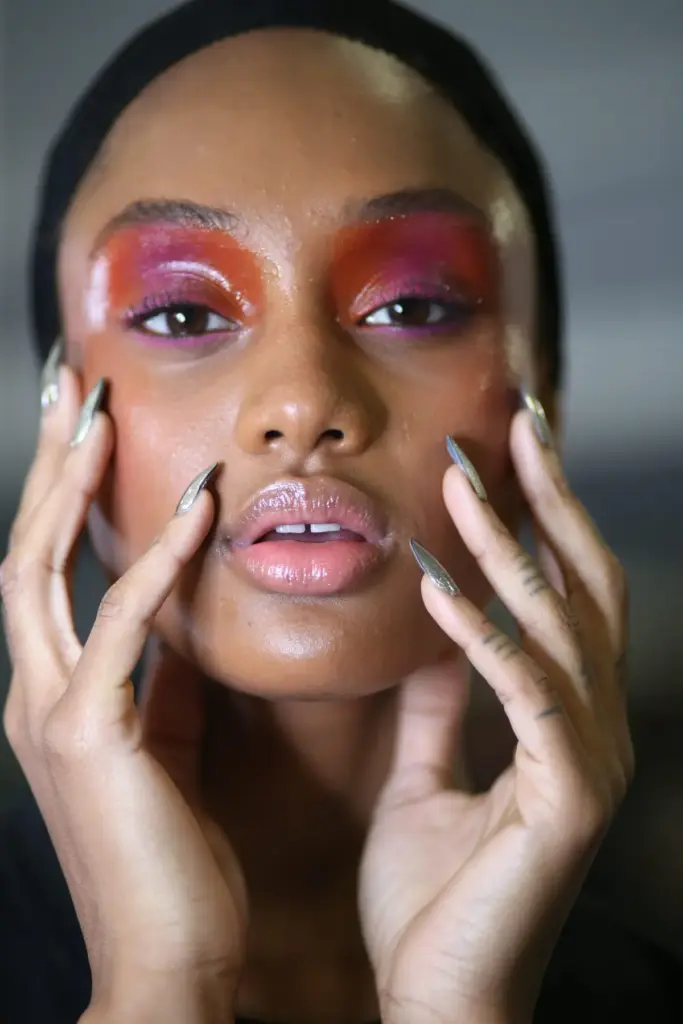
- Isolated Accents and Negative Space: Precision application of metallic powders restricted exclusively to micro-French tips, geometric lines, or abstract 3-D sculpted gel drops.
Official Perspectives: Insights from Industry Leaders
Leading editorial manicurists and salon founders agree that the evolution of chrome represents a broader shift in consumer beauty habits: nails are no longer an afterthought, but a primary vehicle for self-expression.
"When we first started buffing pigments onto runways, it was an insider secret used to catch the camera’s eye under harsh lights," shares a prominent backstage session manicurist. "What’s remarkable is how everyday clients have taken that high-fashion technique and made it their own. Chrome isn’t a trend anymore; it’s a finish category, much like matte or high-gloss."
Another leading nail chemist notes the manufacturing innovations that have propelled the medium forward: "Early powders were essentially crushed metallic minerals that tarnished or oxidized when exposed to certain top coats. Today’s cosmetic-grade silica and synthetic fluorphlogopite flakes are engineered at a molecular level to maintain color integrity, ensuring that a gold chrome stays brilliantly gold and a holographic shift remains razor-sharp for weeks."
Industry analysts also point to the tactile nature of modern manicures. In an increasingly digital world governed by flat screens, tactile textures—such as the plush dimensionality of velvet chrome or the sculptural weight of 3-D chrome accents—provide a sensory grounding that resonates deeply with millennial and Gen Z consumers.
Future Outlook: Where Are Chrome Nails Headed Next?
As we look toward upcoming seasons, the trajectory of chrome nail design points toward even greater technological integration and artistic boundary-pushing.
1. Smart Materials and Temperature-Sensitive Chromes
The next frontier in nail chemistry involves responsive pigments. Researchers are currently exploring thermochromic and photochromic compounds integrated into metallic powders, allowing manicures to shift colors or reflectivity based on ambient temperature or exposure to UV sunlight. Imagine a silver chrome that transitions into a deep obsidian metallic when stepping outdoors.
2. Sustainable Pigments and Eco-Friendly Production
As beauty consumers demand greater transparency and environmental responsibility, the nail industry is moving away from non-sustainable glitter and heavy-metal mining. Future chrome powders will increasingly rely on biodegradable cellulose-based optics and sustainably synthesized mica alternatives that deliver identical high-shine performance without ecological compromise.
3. Hyper-Personalized Digital Printing
The convergence of AI-driven design tools and salon robotics will soon allow clients to map complex, custom holographic gradients and localized chrome placement digitally before a single brush touches the hand. This will bridge the gap between avant-garde runway concepts and accessible, everyday salon execution.
Conclusion
The modern chrome manicure has proven that it is far more than a fleeting social media flash-in-the-pan. Through continuous chemical refinement, boundless artistic reinvention, and an innate alignment with digital-age aesthetics, chrome has cemented its status as an enduring canvas for personal style. Whether one opts for the understated grace of a frosted pearl or the brazen, mirror-like intensity of liquid silver, chrome offers an infinite spectrum of possibilities—ensuring that our fingertips will continue to catch the light for years to come.