Executive Overview
Just when mainstream cultural commentators and music industry insiders alike assumed the seasonal festival circuit had wound down for the year, Olivia Rodrigo effectively flipped the script. With the sweeping debut of her curated, all-female music festival, Daisy Chain Fields, the multi-platinum singer-songwriter has permanently altered the landscape of modern live-entertainment curation. Held at the expansive Great Park in Irvine, California, the inaugural one-day event brought together an eclectic, powerhouse roster of female and non-binary artists, cementing Rodrigo’s status not only as a defining pop icon of her generation, but also as a formidable tastemaker and cultural producer.
From the moment Rodrigo stepped up to the podium at the pre-festival press conference—flaunting a distinctly vintage-inspired aesthetic that immediately sent fashion blogs into a frenzy—it was clear that Daisy Chain Fields was going to be as much about high-concept sartorial self-expression as it was about sonic exploration. Preceded by an exclusive, highly sought-after Etsy merchandise drop that leaned heavily into nostalgic, DIY craftsmanship, the festival delivered on every front.

As the gates opened at Great Park, festival-goers were treated to a masterclass in modern concert style. The all-female lineup stepped onto the grounds dressed to the absolute nines, offering an inspiring blueprint for upcoming concert-goers, festival enthusiasts, and back-to-school fashion hounds alike. Despite last-minute lineup adjustments—most notably, global powerhouse group KATSEYE having to withdraw from their scheduled performance due to an injury—the spirit of community, resilience, and high-octane performance remained entirely unbroken. Daisy Chain Fields did not merely close out the summer festival season; it raised the operational and aesthetic bar for every curated event to follow.
Detailed Chronology of the Event
The journey toward Daisy Chain Fields was marked by strategic announcements, unexpected hurdles, and a relentless build-up of anticipation that culminated in a historic day of music and fashion in Irvine.

The Lead-Up and Sartorial Teasers
Anticipation for the festival began months prior, but reached a fever pitch in the week leading up to August 29, 2026. Olivia Rodrigo’s press conference appearance served as the primary catalyst, offering the first real glimpse into the visual ethos of the festival. Emphasizing indie-sleaze undertones mixed with romantic, ethereal textures, Rodrigo set a high sartorial standard. This was swiftly followed by the rollout of the festival’s official merchandise line on Etsy, a creative collaboration that highlighted independent creators and sustainable, small-batch fashion pieces rather than mass-produced tour merch.
The KATSEYE Schedule Adjustment
Just days before the festival gates were set to open, a wave of disappointment rippled through the fan base when it was announced that global girl group KATSEYE would have to pull out of their highly anticipated set. Member Megan had suffered an unfortunate ankle sprain, making high-energy choreography and stage performance impossible.

However, the group refused to let their fans down completely. In a display of true solidarity and dedication, Megan—sporting a chic Coach Tabby bag alongside her medical boot—alongside bandmates Yoonchae and Lara, made the physical trek to Great Park. Rather than retreating backstage, the trio actively engaged with festival-goers, walking the grounds, and taking to the Dandelion Stage to introduce Kelly Sawyer Patricof and Norah Weinstein, the co-CEOs of the prominent nonprofit organization Baby2Baby.
Stepping in to fill the vacant performance slot was rising indie-pop artist Devon Again, whose electrifying, gritty set seamlessly integrated into the day’s lineup and earned rave reviews from early attendees.

Performances and Stage Highlights
As the afternoon sun beat down on Great Park, a diverse roster of emerging and established acts took turns commanding the multiple stages.
- Quiet Light kicked off the afternoon with atmospheric, shimmering indie soundscapes that matched the breezy California afternoon.
- Eli took over the Dandelion Stage, delivering a visceral, emotionally raw performance that anchored the early evening crowd.
- Rachel Chinouriri mesmerized the audience with her soul-drenched vocals and a sartorial presentation that blended romantic silhouettes with modern edge.
- Devon Again, pulling double duty as the emergency addition to the bill, brought an unbridled, garage-rock energy that galvanized the festival grounds.
- Headlining or anchoring key performance slots were the gritty, punk-infused members of Die Spitz, whose ferocious stage presence and leather-heavy, DIY styling brought a blistering rock-and-roll edge to the otherwise pop-leaning festival landscape.
Supporting Context & Metrics: Fashioning the Festival
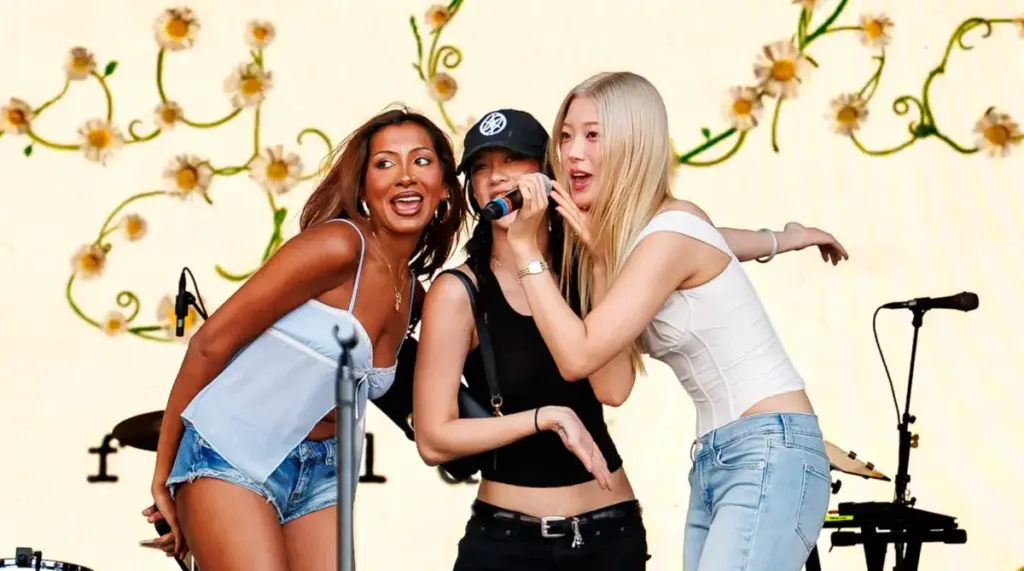
While the music drew thousands to Irvine, the stylistic curation of Daisy Chain Fields became an immediate focal point for fashion critics and digital publications. The event functioned as a living runway, showcasing the distinct stylistic identities of the performing artists.

Key Fashion Moments and Visual Breakdowns
- Lara, Megan, and Yoonchae (KATSEYE): Even without taking the stage to perform, the trio dominated street-style coverage. Megan’s styling—cleverly incorporating her ankle injury into an intentional accessory statement by pairing her boot with high-fashion streetwear and a coveted Coach Tabby handbag—proved that mobility aids need not compromise aesthetic integrity. Lara and Yoonchae complemented her with coordinated, Y2K-meets-grunge ensembles that highlighted individual flair while maintaining a cohesive group identity.
- Eli: Opting for a stage aesthetic that merged performance practicality with avant-garde detailing, Eli’s performance wear utilized layered sheer fabrics and structured harnesses, capturing the theatricality of indie-pop performance art.
- Rachel Chinouriri: Chinouriri leaned into ethereal, textural romanticism. Her on-stage styling featured cascading ruffles contrasted sharply with heavy footwear, perfectly mirroring the delicate yet biting emotional resonance of her songwriting.
- Devon Again: Embodying effortless cool, Devon Again favored a palette of muted tones, distressed textiles, and vintage hardware. Her look served as a masterclass in modern grunge revival, appealing directly to the Gen-Z demographic in attendance.
- Die Spitz (Ellie Livingston, Chloe De St. Aubin, Ava Schrobilgen, and Kate Halter): The four-piece punk outfit brought absolute sartorial chaos in the best possible way. Decked out in a combination of hardware-heavy leather, shredded lace, and high-energy performance sweat, the band members proved that punk rock style is entirely alive and well. Their visual presentation was raw, unapologetic, and thoroughly documented by the battery of photographers stationed in the pit.
Economic and Cultural Impact Metrics
- Location: Great Park, Irvine, California.
- Date: August 29, 2026.
- Charitable Integration: Direct platform amplification for Baby2Baby, highlighting maternal and child welfare support systems.
- Retail Innovation: Pioneering a direct-to-consumer artisanal merchandise partnership via Etsy, supporting independent creators over traditional mass-manufacturing supply chains.
Official Statements and Industry Reception
The industry response to Daisy Chain Fields has been overwhelmingly positive, positioning the event not merely as a vanity project for a pop star, but as a legitimate institutional shift in how boutique festivals can be structured.
In a joint statement regarding their presence at the festival, Baby2Baby CEOs Kelly Sawyer Patricof and Norah Weinstein expressed their profound gratitude:

"Having artists like Olivia Rodrigo and the members of KATSEYE actively use their platform to center philanthropic outreach shifts the entire paradigm of modern music events. Daisy Chain Fields isn’t just a concert; it is a community-driven ecosystem."
Music critics have similarly lauded Rodrigo’s curatorial vision. Unlike traditional mega-festivals that lean heavily on legacy male headliners or demographic algorithms, Rodrigo utilized her considerable cultural capital to curate an entirely all-female bill that celebrated multi-genre artistry—spanning indie rock, punk, pop, and soul.

Industry analysts note that the festival’s success points to a growing consumer demand for hyper-curated, values-driven live music experiences. By integrating sustainable artisan merchandising and direct non-profit partnerships, Daisy Chain Fields has established a new benchmark for corporate social responsibility within the live-entertainment sector.
Future Outlook: The Legacy of Daisy Chain Fields
As the dust settles on the grounds of Great Park, attention naturally turns to the future. Will Daisy Chain Fields become an annual staple of the Southern California music calendar? Given the immediate commercial and critical success of its inaugural run, industry insiders view an expanded multi-date or annual recurrence as an absolute certainty.

Furthermore, the festival’s structural success provides a blueprint for other top-tier artists interested in stepping behind the scenes as curators and producers. By prioritizing an all-female lineup, Rodrigo has directly challenged festival promoters who historically under-index female talent on main stages, proving that curated lineups centered around women can command massive audiences, drive critical fashion discourse, and generate substantial economic returns.
For concert-goers, festival enthusiasts, and the broader cultural zeitgeist, Daisy Chain Fields has left an indelible mark. It proved that the end of summer does not signify the end of live music innovation, but rather an opportunity to reinvent it. As fans unpack their Etsy memorabilia, heal their festival-worn boots, and look ahead to the remaining concerts of the year, one thing remains abundantly clear: Olivia Rodrigo has only just begun to shape the future of live performance and style.