Executive Overview
The modern digital media landscape is caught in a profound identity crisis. For over a decade, the recipe for independent digital success appeared standardized: gather two internet personalities in a studio, position a couple of Shure SM7B microphones in front of them, turn on a multi-camera video setup, and record an hour of unscripted banter about current events, pop culture, or personal grievances. Today, that once-lucrative formula is rapidly losing its luster. Audiences are experiencing fatigue, platforms are endlessly mutating, and the looming, existential shadow of generative artificial intelligence threatens to flood feeds with algorithmic “slop.”
Enter Noel Miller. The Viner-turned-comedian, podcaster, and media entrepreneur launched TMG Studios in 2021 with a clear-eyed vision of independence. Five years later, TMG Studios has evolved into a robust network boasting 11 distinct shows spanning various niches and featuring an eclectic roster of creators. Now, as the industry grapples with shrinking attention spans, the blurring lines between video and audio, and a race to the bottom driven by automated content creation, Miller is charting a radically different course.
With the launch of its newest production, Superior Exotics II, TMG Studios is diving headfirst into an underserved frontier: semi-scripted, improvised fictional podcasts. For Miller, this isn’t just a creative expansion; it is a declaration of war against the commoditization of human attention. In an era where legacy media institutions are stumbling over rigid categorizations and independent creators are leaning into AI-assisted shortcuts, Miller is doubling down on raw, unfiltered, 100% human-led storytelling. If TMG Studios’ strategy succeeds, it could fundamentally alter how we define podcasts, YouTube series, and television for the next decade.
Detailed Chronology: The Evolution of TMG Studios and the Birth of Superior Exotics II
2021: Laying the Foundation
When Noel Miller established TMG Studios in 2021, the digital media ecosystem looked markedly different. Coming from the fast-paced, micro-video world of Vine before successfully transitioning into long-form audio alongside co-host Cody Ko with That’s Cringe and the Tiny Meat Gang podcast, Miller understood the shifting architecture of online fame. He recognized that creators needed more than just ad-hoc distribution deals—they needed vertically integrated networks capable of owning their intellectual property, managing direct-to-consumer relationships, and scaling production quality.
2021–2025: Scaling the Network
Over the next four years, TMG Studios methodically built out a diverse roster. Rather than blindly signing every viral personality, the network curated a stable of 11 distinct shows. These properties catered to varied niches, balancing comedy, lifestyle, commentary, and cultural critique. However, as the digital landscape matured, Miller noticed a troubling trend: the sheer volume of "two people talking into microphones" content had reached saturation point. The format that had fueled the podcast boom of the late 2010s was becoming white noise.
2025–2026: The Pivot to Fiction and Improv
Recognizing that standard talk-show podcasts were losing their cultural currency, Miller began engineering the network’s next evolution. The goal was to dismantle the traditional boundaries separating audio programs from visual media. This philosophical shift culminated in the greenlighting and release of Superior Exotics II.
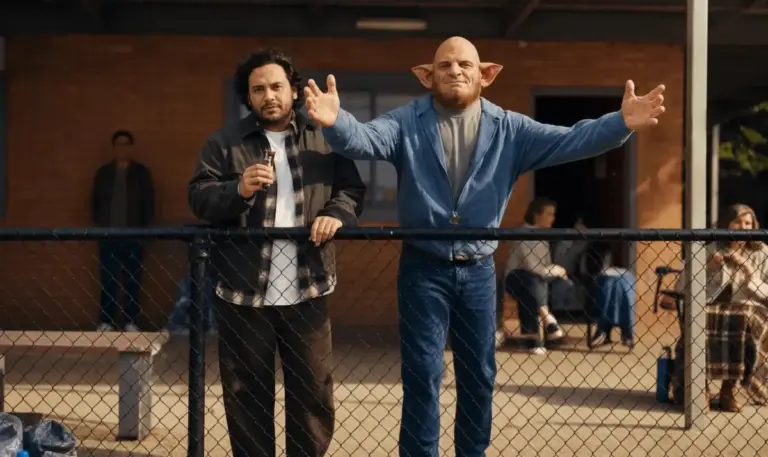
Starring comedians Milo Tucker-Meyer and Kyle Chase, the show drops viewers into a struggling, down-on-its-luck convenience store located in Orange County, California. The premise is deceptively simple: Tucker-Meyer and Chase play convenience store employees recording a podcast live during their shifts. Each 40-minute episode chronicles the mundane struggles of retail work, punctuated by unscripted interactions with a rotating cast of guest "customers."
While the macro-narrative, physical setting, and scheduled guest appearances are structured by design, the vast majority of the runtime relies entirely on raw comedic improvisation. By marrying the intimacy of long-form audio with the performance-driven world of sketch and improv comedy, Superior Exotics II has opened up a new playbook for TMG Studios—one that treats the podcast feed not as a diary, but as a stage.
Supporting Context & Metrics: The Death of Boundaries and the Rise of AI "Slop"
The Erosion of Media Categories
To understand why TMG Studios is investing in semi-scripted formats, one must examine the death of traditional media silos. For decades, the media consumption pipeline was governed by gatekeepers who enforced strict boundaries: films played in theaters, television shows aired on networks or cable, radio broadcasts ruled the audio waves, and print dominated text.
The internet democratized distribution, but for a long time, digital creators still tried to squeeze themselves into legacy definitions. A YouTuber made "vlogs," a podcaster made "audio shows," and a streamer played "video games." Today, those walls have completely collapsed. When a show like Superior Exotics II streams on a dedicated YouTube channel, lives on an audio podcast feed, and features cinematic production values, asking whether it is a "podcast," a "YouTube series," or a "TV show" becomes an exercise in obsolescence.
Miller points out that this democratization is a double-edged sword. On one hand, it grants creators unprecedented freedom to bypass Hollywood executives and studio gatekeepers. On the other hand, it has flooded the market with uniform clickbait, engineered rage-bait, and an overabundance of low-effort content designed solely to game algorithmic metrics. In a media ecosystem where audiences can no longer easily distinguish between what is authentic and what is manufactured, the value of conventional talk-show banter plummets.
The Generative AI Threat
Compounding this crisis of authenticity is the relentless march of generative artificial intelligence. Major tech platforms—from YouTube and Meta to TikTok—are actively embedding generative AI tools into their dashboards, encouraging creators and brands to automate scripts, synthetic voices, automated video generation, and algorithmic thumbnail optimization.
While many production companies and digital agencies have embraced these tools to slash overhead and maximize output velocity, Noel Miller has drawn a hard ethical and creative line in the sand. TMG Studios has explicitly rejected generative AI across its workflows.
For Miller, choosing to remain entirely human-led is not merely a nostalgic rejection of technology; it is a calculated business and artistic differentiator. In an era where consumers are increasingly bombarded by synthetic "slop factories" churning out automated content at scale, genuine human struggle, vulnerability, and spontaneous wit become scarce, premium commodities. Fighting for viewer attention in the algorithmic trenches is difficult—it is a daily "dogfight"—but the friction of the creative process is precisely what gives the resulting work its value.
Official Statements & Industry Insights
The philosophy driving TMG Studios’ transformation is rooted in a fundamental reassessment of what media can and should be. In exclusive commentary, Noel Miller unpacks the motivations behind the network’s aggressive pivot away from conventional formats:
“If we’re the last human-led media channel and everything else is prompted and generated in a data center, well then so be it.”
Addressing the commoditization of casual conversation in the digital space, Miller notes:
“I think two people talking about their lives has little value these days. It’s just not that compelling in terms of media. So I think [exploring fictional podcasts] comes from a place of: What is a podcast? What is a YouTube channel? There’s no hard lines anymore, it’s all this weird amorphous thing. So to step into semi-scripted, it’s something I’ve wanted to do for a long time.”
Miller is deeply critical of legacy media institutions, which he believes are ill-equipped to survive the modern creator economy due to their addiction to rigid hierarchies and manicured career paths:
“I just think there are no more defining lines. They are continuously eroded. That’s why I believe old media institutions are struggling, because they’re accustomed to rigid structure. They control distribution, so you distribute like this. That person is an actor, and here’s the manicured path to acting. But the internet democratized this process. It completely destroyed it.”
Furthermore, Miller emphasizes that partnering with raw, unfiltered talent requires looking beyond the conservative filters of traditional Hollywood casting offices:
“When we’ve partnered with talent, we’ve gotten a lot of great partnerships, and they’re very hand-selected for a reason. A lot of them have very strong on-camera presence that a major studio might not give a chance because they want it to go through so many filters.”
Finally, on the battle against automated content production and the psychological toll of maintaining artistic integrity, Miller remains unyielding:
“I think human creative independence is very important these days. I never want to romanticize the work we do because when you’re trying to do creative that’s not a slop farm, it’s a fight. You’ve got to dogfight in the algorithm to get people to stick around. But because we’re committed to it, I think it’s that much more rewarding for us.”
Future Outlook: The "Avengers" of the Internet and the Next Frontier for TMG Studios
As TMG Studios looks toward the horizon, the success of Superior Exotics II serves as a proof-of-concept for a broader strategic expansion. The network is no longer content to act merely as a backend producer for standard interview shows and commentary podcasts. Instead, it is positioning itself as an incubator for alternative, narrative-driven digital performance.
Building the Roster of Tomorrow
The roadmap for TMG Studios’ future hinges on talent acquisition and world-building. Miller and his executive team are actively searching for creators who possess a rare combination of quick wit, deep-seated camera presence, and the theatrical versatility required to anchor a semi-scripted universe.
Rather than casting traditional actors through standard agency channels, TMG plans to source performers directly from the digital ecosystem—individuals who have cut their teeth building organic audiences online but possess the dramatic and comedic chops to slip seamlessly into character work.
The "Avengers" Moment for Digital Creators
One of the most ambitious concepts floated by Miller for future TMG productions is the creation of crossover events that bridge disparate corners of the internet. By establishing foundational lore and building robust fictional worlds, the network aims to orchestrate what Miller analogizes to the Avengers franchise: taking internet personalities from vastly different niches, subcultures, and aesthetic backgrounds, and dropping them into shared, performative fictional environments.
This approach solves one of the primary limitations of traditional influencer collaborations, which often rely on awkward guest appearances or forced interview segments. By placing internet stars inside a structured narrative framework, the interactions become driven by character dynamics rather than mutual promotion.
The Ultimate Test of Human-Led Media
As generative AI continues to mature and platforms lean further into automated content distribution, TMG Studios is embarking on a high-stakes gamble. By rejecting AI shortcuts and moving away from commoditized talk shows, the company is betting that audiences will ultimately reward authentic craftsmanship, narrative risk-taking, and uncompromising human creativity.
Superior Exotics II is currently airing episodes via the official TMG Studios platform and its dedicated YouTube channel. Whether this ambitious experiment sparks a wider industry movement away from algorithmic "slop" and back toward character-driven digital theater remains to be seen. However, one thing is certain: under Noel Miller’s leadership, TMG Studios is refusing to let the machines write the script of its future.