Executive Overview
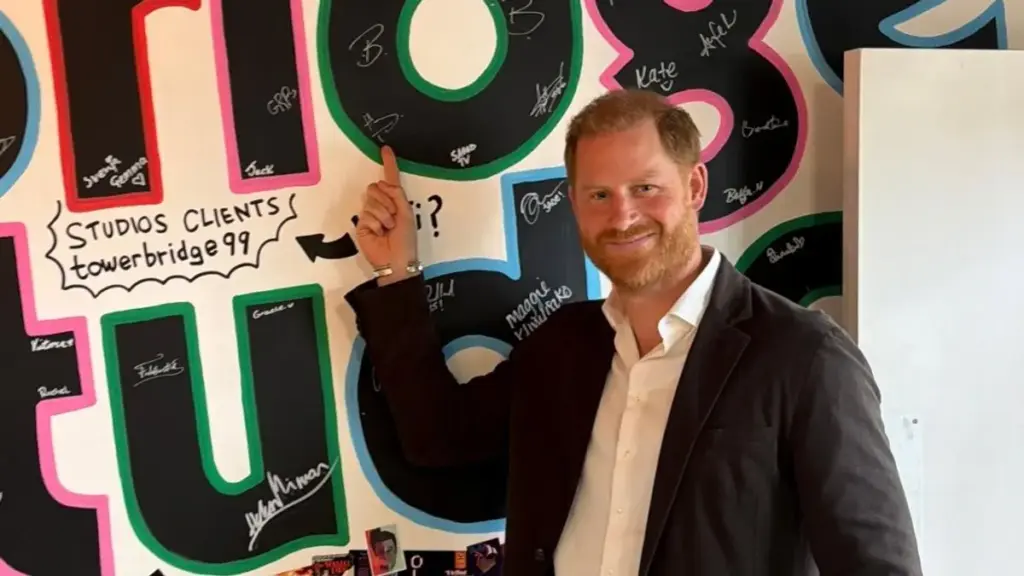
Prince Harry has made his first public appearance in the United Kingdom since arriving back in the country at the end of August, accompanied by Meghan Markle for an extended stay. The Duke of Sussex was photographed visiting Tower Bridge Studios in central London on Friday, where he was seen signing a studio wall and posing cheerfully next to his signature.
This low-key public sighting coincides with a significant and unprecedented intervention from Buckingham Palace. Prompted by numerous inquiries from government departments, the military, and Lord Lieutenants regarding the couple’s status following their return, King Charles III instructed his senior officials to issue official guidance. Distributed under the direction of the Lord Chamberlain and signed by royal aide Lord Benyon, the formal directive makes it abundantly clear that the Duke and Duchess of Sussex are private citizens and remain strictly non-working members of the Royal Family.
The juxtaposition of Prince Harry’s casual studio visit and the Palace’s firm administrative clarification underscores the complex reality of the Sussexes’ ongoing relationship with the institution. While King Charles remains open to personal family ties, the boundary between private life and royal representation has been drawn with absolute rigidity. As the couple settles into their temporary UK base, questions abound regarding their itinerary, potential charity work, and the broader implications of their high-profile return.
Detailed Chronology: The Return and First Public Sighting
The Arrival and Anticipation
The Duke and Duchess of Sussex returned to the United Kingdom on August 26, landing quietly ahead of an anticipated extended stay. The return immediately sparked intense media speculation regarding the exact purpose of their visit. While rumors circulated concerning potential business ventures, media projects, and personal engagements, royal watchers closely monitored how the couple would navigate their return to British soil after years of living primarily in California.
In the lead-up to their arrival, sources close to the family indicated that King Charles was pleased at the prospect of spending quality time with his family. However, palace insiders were quick to reiterate that the King remained entirely firm on a critical boundary: there would be no "half-in, half-out" arrangement. The terms under which the Sussexes stepped down in January 2020 remained immutable.
Friday at Tower Bridge Studios
The weeks of speculation were partially broken on Friday when new photographs emerged of Prince Harry visiting Tower Bridge Studios in central London. The facility is a premier hub for high-profile video and audio content production, frequently hosting major digital productions, including Steven Bartlett’s popular Diary of a CEO podcast and comedian Jimmy Carr’s The Big Pitch.
During the visit, Prince Harry partook in a studio tradition by signing a wall and posing proudly beside his signature. The studio later shared two photographs of the Duke on their official Instagram account, accompanied by a public message of gratitude:
"Thank you Prince Harry for choosing Tower Bridge Studios! It was an absolute pleasure to have you in our studios and signing our wall. We look forward to welcoming you back again."
Despite the friendly reception and the public nature of the studio’s social media post, the exact purpose of Prince Harry’s visit remains undisclosed. Whether the meeting pertained to forthcoming media ventures, philanthropic outreach, or private networking is currently a matter of speculation, but the appearance marked a confident and relaxed return to the London public sphere.
Supporting Context & Metrics: The Mechanics of the Palace Directive
While Prince Harry was leaving his mark on a central London recording studio wall, high-level administrative machinery was operating within Buckingham Palace to establish absolute clarity regarding the couple’s official standing.
The Lord Chamberlain’s Directive
The guidance was issued on Friday under the direct instructions of King Charles III. It was drafted and distributed by the office of Lord Benyon—the royal aide responsible for organizing the sovereign’s ceremonial and public-facing events—following a surge of formal requests for guidance from various government bodies, military branches, and Lord Lieutenants nationwide.
The directive serves as an authoritative administrative manual for official bodies interacting with the Duke and Duchess during their time in the UK. Key elements of the guidance include:
- Non-Working Status: Explicit confirmation that Harry and Meghan stepped down from representative duties on behalf of the Sovereign in January 2020 and do not act as working members of the Royal Family.
- HRH Styles: Clarification that the couple does not use their "His/Her Royal Highness" styles in professional or public capacities.
- Security and Operational Protocol: Direct instruction that any operational security issues or administrative inquiries concerning the couple should be directed to the relevant civil and police authorities rather than internal royal households, reflecting their status as private citizens.
The 2020 Megxit Framework
To fully understand the weight of this newly issued guidance, one must examine the baseline established during the 2020 Sandringham Summit, often colloquially referred to as "Megxit." When the Duke and Duchess first chose to step back from their senior royal roles, the primary driver was a desire for financial independence and personal privacy.

The Palace’s recent communication reinforces the core tenet of that original agreement: the separation of state duties from private autonomy. By explicitly outlining that the Sussexes enjoy the "personal latitude… in respect of financial independence and protection of their privacy," the institution is formally acknowledging their right to operate outside the royal goldfish bowl, while simultaneously insulating the Crown from any institutional accountability for their private commercial or public activities.
Official Statements and Institutional Stance
The wording of the official letter sent out by the Lord Chamberlain’s office provides a fascinating window into the current state of royal affairs. It balances administrative firmness with a respectful acknowledgment of the couple’s personal choices.
An excerpt from the widely distributed administrative note reads:
“Following the decision by the Duke and Duchess of Sussex to relocate to the UK, we have received a number of requests for guidance. To help avoid doubt or confusion, The King has directed that the following information be shared.
“It is well known that in January 2020 the Duke and Duchess stepped down from undertaking representative duties on behalf of The Sovereign, and are no longer working Members of The Royal Family.
“This position, distinct from the State and Royal duties undertaken by the working Royal Family, and with the personal latitude it brings the couple in respect of financial independence and protection of their privacy as they would wish, will continue to be fully respected.”
This carefully crafted language achieves two distinct goals. First, it reassures government and military officials that state resources and royal protocol will not be misapplied to private citizens. Second, it publicly honors the boundaries set by the Duke and Duchess, ensuring that their private commercial endeavors—such as potential media production partnerships or independent charitable projects—are understood to be entirely separate from the work of the Crown.
Future Outlook: What Lies Ahead for the Sussexes in the UK
As Prince Harry and Meghan Markle settle into their extended UK stay, attention naturally turns toward their upcoming schedule and long-term intentions.
Imminent Engagements and Charitable Pursuits
Prince Harry is widely expected to maintain his long-standing commitment to the WellChild Awards, an annual event celebrating the inspirational qualities of seriously ill children and their caregivers, which typically takes place in mid-September. The Duke has remained a deeply dedicated patron of WellChild for many years, and his presence at the ceremony is anticipated to be a focal point of his time in the country.
Concurrently, reports suggest that Meghan Markle is aiming to rekindle and expand her professional and philanthropic work with several UK-based charities close to her heart. While her return to the UK is primarily focused on family and independent projects, her philanthropic footprint in Britain remains an area of significant public and media interest.
Navigating a Duality of Roles
The events of this past week encapsulate the delicate tightrope walk defining the current chapter of the Sussexes’ lives. On one hand, Prince Harry moves freely through London’s creative and entrepreneurial spaces, engaging with podcast studios and media ventures on his own terms. On the other hand, the apparatus of the British state maintains a strict, codified boundary around his family’s lack of official royal standing.
Ultimately, this latest development signals a maturing post-royal landscape. King Charles has demonstrated a willingness to embrace familial warmth and personal reconciliation, yet he remains entirely uncompromising on the constitutional architecture of the monarchy. For Prince Harry and Meghan Markle, the path forward in the UK is one defined by absolute personal autonomy—free from the burdens of the Crown, yet entirely separate from its institutional privileges.