Executive Overview
VENICE — In the storied halls of the Venice Film Festival, where cinematic masterworks are routinely put to the ultimate test by notoriously discerning audiences, veteran writer-director Paul Schrader once again commanded the international spotlight. On a brisk Friday evening, the Sala Grande fell silent as the credits rolled on Schrader’s latest provocative endeavor, The Basics of Philosophy. Visibly moved, the 80-year-old auteur stood as the theater erupted into a warm, respectful 4.5-minute ovation.
The film, screening out-of-competition, represents a searing addition to Schrader’s illustrious filmography—one that stretches back to the gritty, neon-drenched streets of 1970s New York with Taxi Driver. In The Basics of Philosophy, Schrader returns to his signature thematic territory: the "man in a room" paradigm, a crucible wherein tormented, morally compromised men grapple with existential dread, deep-seated guilt, and the elusive pursuit of redemption.
Starring Jack Huston as John Jorissen, a philosophy professor whose tightly controlled academic existence is upended when a victim of his past sexual abuse unexpectedly re-enters his life, the film tackles themes of accountability and reckoning with unflinching gravity. Huston was joined at the premiere by co-stars Sofia Boutella, Bill Pullman, and Daniel Zovatto. Together with the ensemble cast, they huddled warmly around Schrader, patting him on the back as the Italian audience chanted, “Bravi, Bravi!” from the stalls.
With executive producer Martin Scorsese lending his legendary imprimatur to the project and a powerhouse supporting cast that includes Dana Delany, Shiloh Fernandez, Karl Glusman, and Elizabeth Petruso, The Basics of Philosophy arrives as one of the most anticipated and critically scrutinized prestige dramas of the festival season. Schrader’s deep-rooted Calvinist upbringing continues to bleed onto the screen, proving that even after decades in the industry, the legendary filmmaker remains relentlessly preoccupied with the architecture of human sin and the heavy machinery of grace.
Detailed Chronology
The Road to the Lido: From Conception to Premiere
The journey of The Basics of Philosophy to the Venice Film Festival is the latest chapter in a long-standing, symbiotic relationship between Schrader and the world’s oldest film festival. The Lido has historically served as a hospitable harbor for Schrader’s late-career renaissance, having previously hosted the premieres of First Reformed (2017), The Card Counter (2021), and Master Gardener (2022). It was also in Venice that Schrader was deservedly awarded the Golden Lion for Lifetime Achievement in 2022, an honor that cemented his status as a living pillar of American independent cinema.
Months before its official world premiere, the project generated quiet industry murmurs, not least because of its harrowing subject matter. The narrative centers on John Jorissen (Jack Huston), an esteemed professor of philosophy whose intellectual detachment is shattered by the return of a ghost from his youth. As a young man, Jorissen committed an unforgivable transgression—an act of sexual abuse that he has spent decades burying beneath layers of academic jargon and intellectual rationalization. When the victim re-emerges, the psychological scaffolding holding Jorissen’s life together collapses, forcing him to navigate a harrowing confrontation with his past.
As production wrapped under the guidance of producers Braxton Pope and David Wulf, the project caught the attention of Schrader’s longtime collaborator and cinematic soulmate, Martin Scorsese. Boarding the film as an executive producer ahead of its Venice launch, Scorsese’s involvement signaled an immediate stamp of approval from American cinema’s highest echelon, elevating the film’s profile from a standard indie drama to an international cinematic event.
Friday Night on the Lido: The Screening and Ovation
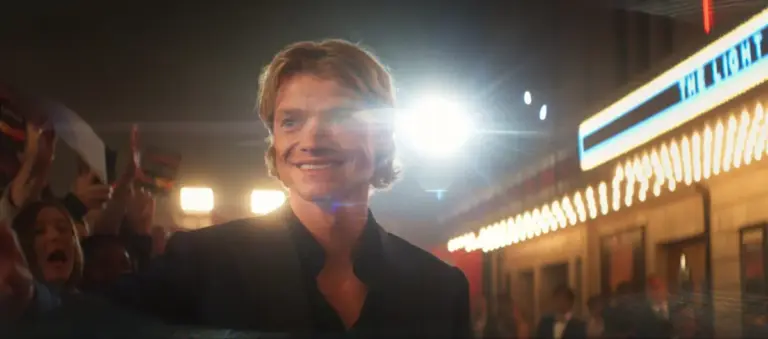
On Friday, September 5, the anticipation culminated on the red carpet. Schrader, accompanied by his cast—Jack Huston, Sofia Boutella, Bill Pullman, and Daniel Zovatto—arrived to a sea of flashbulbs. Despite health battles in recent years that have occasionally threatened to sideline the filmmaker, Schrader walked the red carpet with the resolute posture of a man who has spent half a century commanding film sets.
As the house lights dimmed inside the theater, audiences were immersed in the stark, claustrophobic world of The Basics of Philosophy. True to Schrader’s recent output, the visual and tonal language is restrained, prioritizing psychological excavation over external spectacle.
When the film concluded, the audience rose to offer a steady, appreciative 4.5-minute ovation. While not the record-breaking duration sometimes seen at festival galas, the response was deeply felt. Schrader, visibly emotional, wiped his eyes as the applause washed over him. Jack Huston, who delivers a career-best turn as the tortured professor, wrapped an arm around the director, beaming proudly and gesturing to the crowd to amplify their cheers. Boutella, Pullman, and Zovatto quickly joined the embrace, forming a tight, protective circle around the master filmmaker in a moment that underscored the profound collaborative trust required to bring such difficult material to the screen.
Supporting Context & Metrics
The Anatomy of a Schrader Protagonist: The "Man in a Room"
To understand The Basics of Philosophy is to understand Paul Schrader’s cinematic taxonomy. For over forty years, Schrader has returned again and again to the archetype of the solitary, alienated man—an archetype heavily indebted to Robert Bresson’s Pickpocket, Ingmar Bergman’s introspective dramas, and Fyodor Dostoevsky’s Notes from Underground.
Whether it is Travis Bickle driving his taxi through the sleaze of 1970s Manhattan, Julian Kaye cruising in American Gigolo, Ernst Toller agonizing over environmental destruction in First Reformed, or William Tell counting cards in The Basics of Philosophy’s spiritual predecessor The Card Counter, Schrader’s protagonists are invariably trapped. They occupy cramped spaces—rooms, cells, offices, or taxicabs—and they ruminate endlessly in journals, diaries, or voiceovers.
John Jorissen fits neatly into this lineage, yet he introduces a distinct moral friction. Unlike Bickle, whose alienation stems from societal decay, or Toller, whose crisis is born of institutional corruption, Jorissen’s damnation is entirely self-authored. He is an academic who has built a fortress of philosophical theory to insulate himself from the visceral reality of his past actions. The film interrogates whether philosophy—the pursuit of wisdom and truth—can offer any genuine salvation to a mind corrupted by foundational wrongdoing.
Critical Reception and Performances
Early critical notices out of Venice have focused heavily on the film’s chilling atmosphere and the powerhouse performances of its ensemble. Writing for Variety, chief film critic Jessica Kiang singled out Jack Huston’s central performance, praising the actor’s chillingly subdued approach to a deeply repulsive character.
"He is impressive here because of the peculiar intensity of his gaze, the too-smoothly-controlled, cultured timbre of his voice, the general sense of something about him being just that bit off," Kiang wrote in her review.
This "offness" is precisely what makes Huston’s portrayal effective. Rather than playing Jorissen as a snarling villain, Huston imbues him with the banal, civilized veneer of the modern academic elite. He is well-read, articulate, and outwardly charming—making the buried truth of his past all the more disturbing when it finally breaches the surface.
Complementing Huston is an ensemble cast featuring Sofia Boutella, Daniel Zovatto, Bill Pullman, Dana Delany, Shiloh Fernandez, Karl Glusman, and Elizabeth Petruso. Each actor populates Jorissen’s crumbling world with varying degrees of complicity, suspicion, and unwitting collateral damage, grounding Schrader’s high-minded philosophical inquiries in stark emotional reality.
Official Statements
The Calvinist Root of Cinematic Guilt
Earlier on Friday, prior to the red-carpet premiere, Schrader sat down for a press conference that provided rare, autobiographical insight into his creative engine. Known for his candid, unfiltered, and occasionally provocative interview style, the 80-year-old director did not disappoint the gathered international press corps.
When asked why he continues to return to themes of moral transgression, guilt, and the desperate search for redemption, Schrader traced his artistic obsessions directly back to his upbringing in Grand Rapids, Michigan. Raised in a strict, fundamentalist Christian Reformed Church household, Schrader was shielded from secular culture until his late adolescence—he reportedly did not see his first film until he was seventeen years old.
"My childhood was one of predestination, guilt, total depravity and all that," Schrader remarked candidly during the press conference. "I don’t know how I do not write about guilt and redemption."
This theological bedrock has informed virtually every major script and directorial effort of Schrader’s career. From the guilt-ridden Catholic-esque martyrdom of Taxi Driver to the overt spiritual inquiries of First Reformed—for which Schrader earned his first Academy Award nomination for Best Original Screenplay—Schrader’s filmography functions as a cinematic confessional.
In The Basics of Philosophy, Schrader pushes this theological inquiry into secular spaces. Jorissen may be a professor of secular philosophy, but his crisis is fundamentally spiritual. He is a man awaiting a secular judgment day, forced to realize that no amount of tenure, intellectual rationalization, or academic distance can absolve a soul weighed down by unrepentant sin.
Future Outlook
Distribution, Awards Buzz, and the Legacy of a Maverick
As the dust settles on the Lido, the immediate trajectory of The Basics of Philosophy looks exceptionally bright on the international festival and art-house circuit. With Martin Scorsese’s executive-producer credit serving as a beacon for specialty distributors and cinephiles alike, the film is positioned to secure a robust distribution deal for North American and international theatrical runs.
Furthermore, Venice has historically acted as the launching pad for the autumn awards season. While The Basics of Philosophy screened out-of-competition—meaning it was ineligible for the prestigious Golden Lion—the critical reception guarantees that Jack Huston’s name will circulate in conversations regarding Best Actor accolades in the coming months. Schrader’s razor-sharp screenplay may also find itself in the conversation among critics’ circles and guild awards, proving once again that at age 80, the director’s pen is as sharp as a scalpel.
For Schrader, The Basics of Philosophy represents another triumphant milestone in a career defined by artistic fearlessness. Refusing to soften his edges or pander to commercial trends, he continues to mine the darkest recesses of the human psyche with the precision of a master surgeon and the fervor of a dissenting theologian. As the lights came up in the Sala Grande and the applause echoed into the Venetian night, it was abundantly clear: Paul Schrader is still asking the hard questions, and world cinema is still transfixed by the answers.